

Live updates (closed)
 Add ToI as a Preferred Source on Google
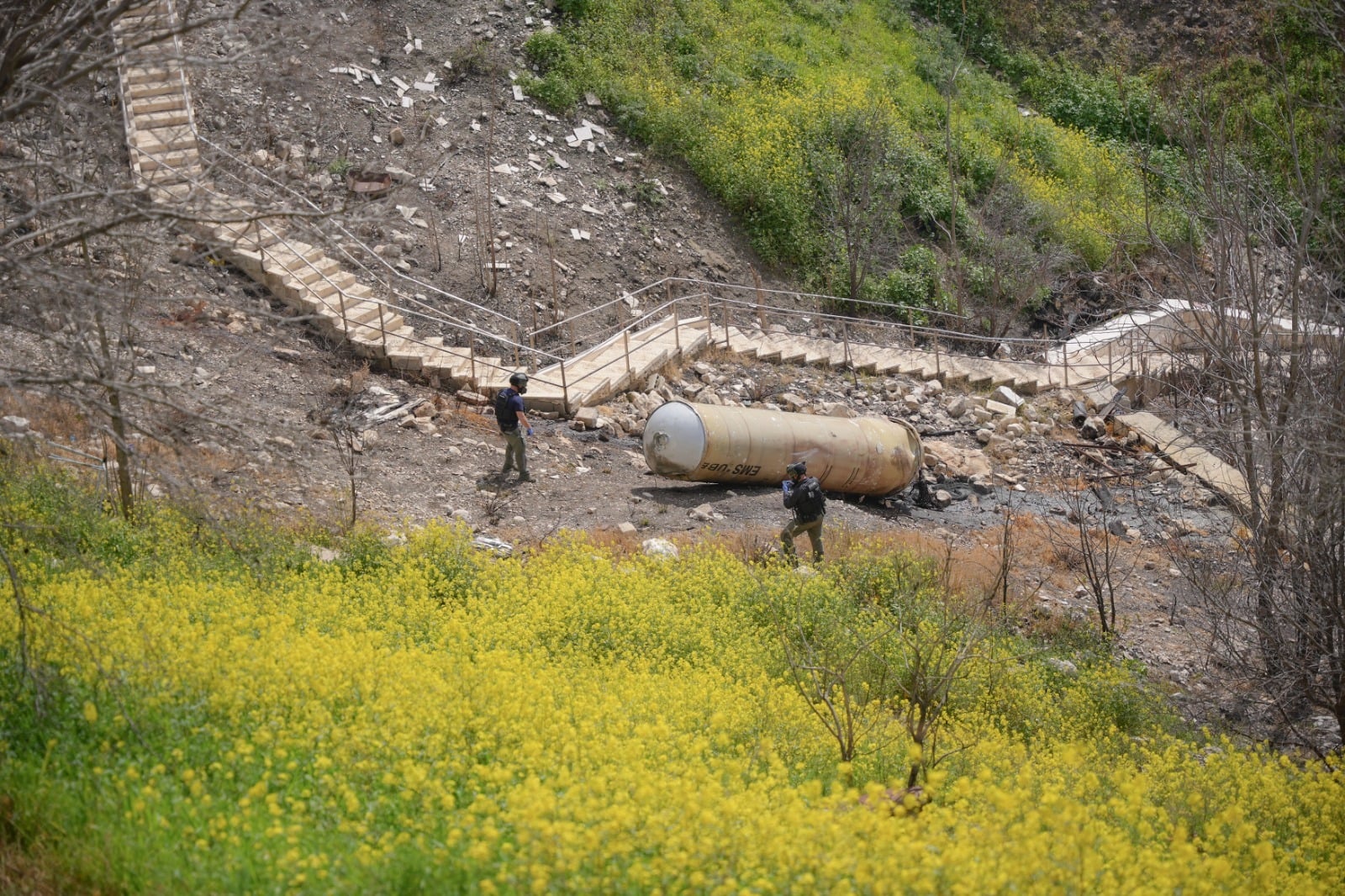
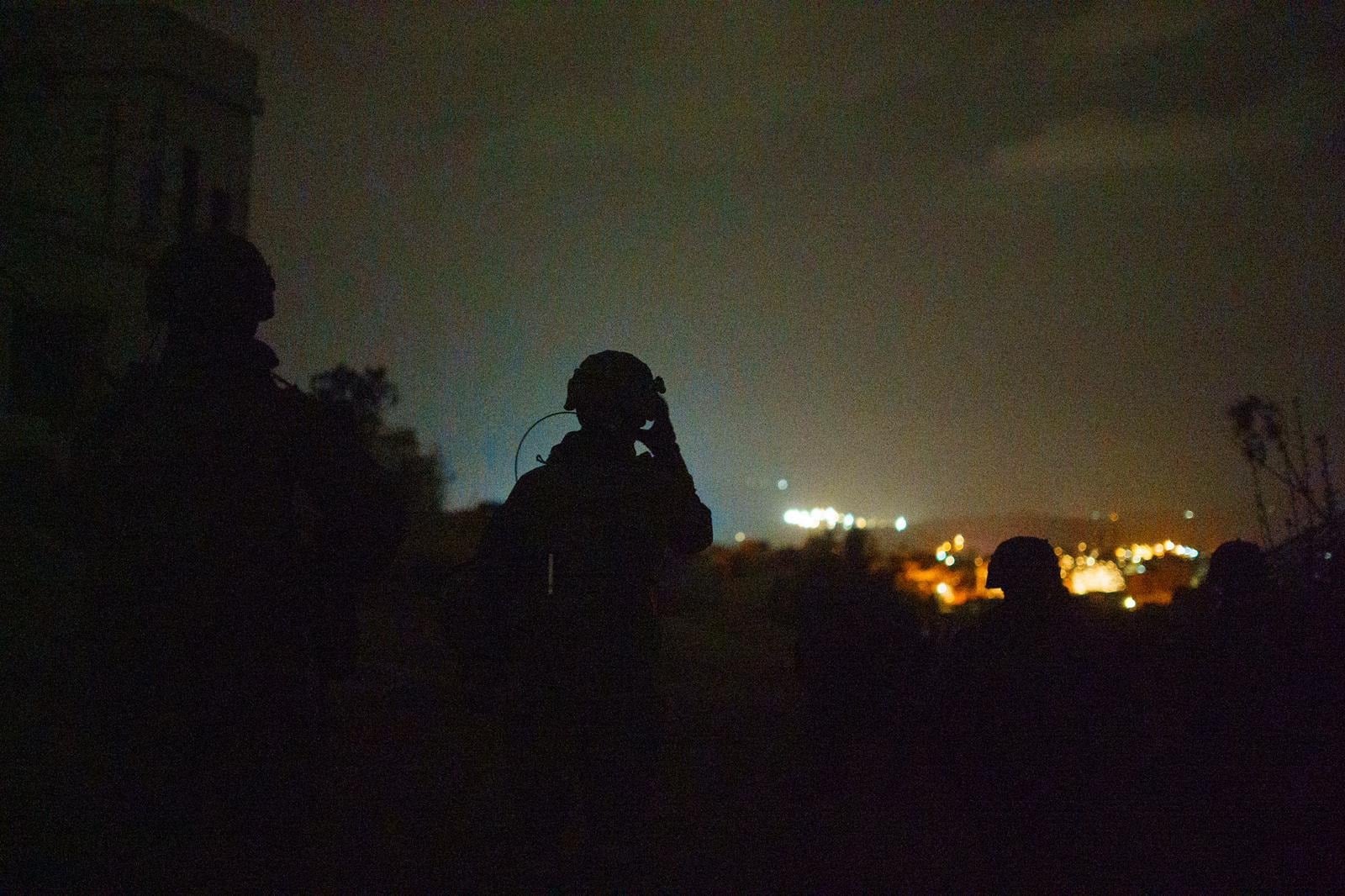
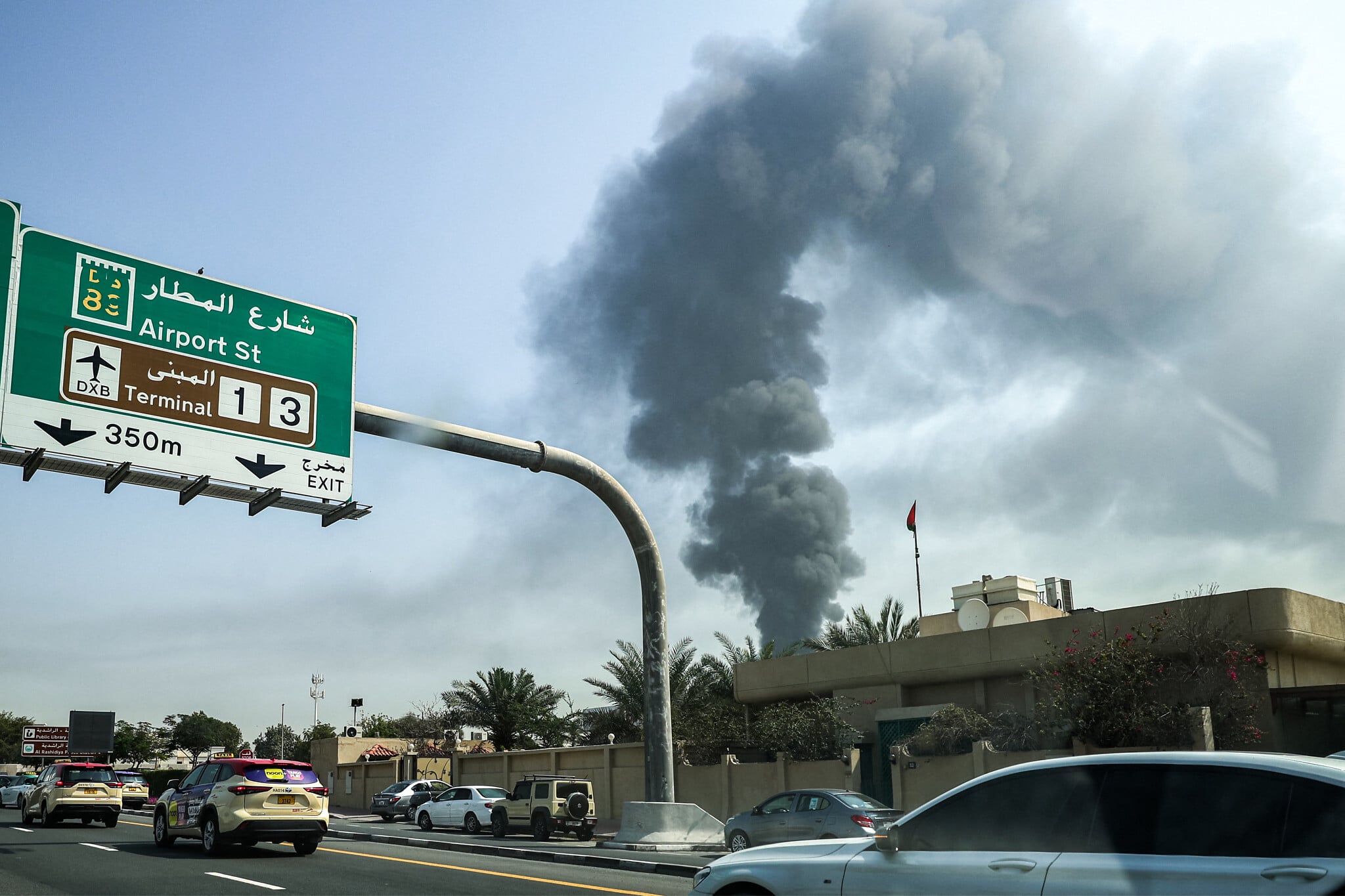
The Times of Israel liveblogged Monday’s events as they unfolded.
IDF says killed a Hamas commander in Gaza after ceasefire violation
The IDF says it struck and killed a Hamas commander in the Gaza Strip in response to a violation of the ceasefire by the terror group.
On Saturday, the military says, a Palestinian gunman opened fire on Israeli troops in the Strip. No injuries were reported in the incident.
“In response to the violation by the Hamas terror organization… the IDF struck and eliminated Kamal Ayash, a key commander in the anti-tank unit” of Hamas, the army says.
Health authorities in the Hamas-run Strip reported that the strike, on Sunday in Nuseirat in central Gaza, killed four, including two boys and a woman pregnant with twins. The strike hit a house, killing a couple in their 30s and their 10-year-old son, according to the nearby Al-Aqsa Martyrs Hospital.
Canada, France, Germany, UK warn against major Israeli ground offensive in Lebanon
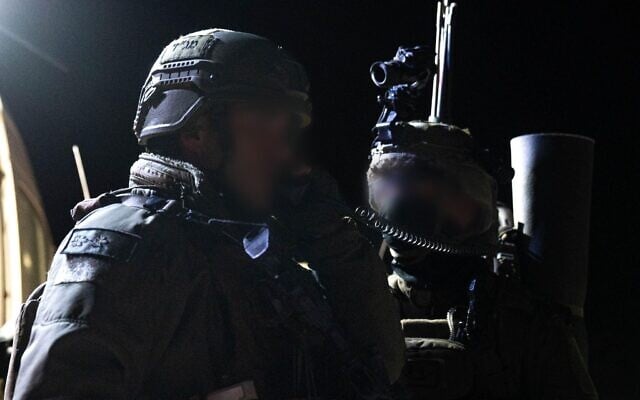
IDF troops in southern Lebanon, in a handout photo issued by the military on March 16, 2026. (Israel Defense Forces)
A “significant Israeli ground offensive” in Lebanon must be averted since it could have devastating humanitarian consequences, Canada, France, Germany, Italy, and Britain say in a joint statement.
“A significant Israeli ground offensive would have devastating humanitarian consequences and could lead to a protracted conflict,” says the statement by Canada, France, Britain, Germany and Italy.
“It must be averted. The humanitarian situation in Lebanon, including ongoing mass displacement, is already deeply alarming.”
The statement says the countries support efforts by the Lebanese government to disarm Iran-backed Hezbollah.
“We are gravely concerned by the escalating violence in Lebanon and call for meaningful engagement by Israeli and Lebanese representatives to negotiate a sustainable political solution,” the countries say. “We strongly support initiatives to facilitate talks and urge for immediate de-escalation.”
Knesset to vote on raising deficit, increasing defense spending amid Iran war
The Knesset is set to vote this evening on Finance Minister Bezalel Smotrich’s proposed bill to increase the deficit ceiling and defense spending within the proposed 2026 budget, in light of Israel’s war against Iran and Hezbollah.
The bill seeks to amend the proposed budget and raise the deficit ceiling to 5.1% of GDP, up from 3.9%, and allow roughly NIS 32 billion ($10.2 billion) in additional government spending above the legal expenditure cap.
It also calls to create a contingency reserve of up to NIS 7 billion ($2.2 billion) for security needs if war-related defense spending exceeds NIS 28 billion ($9 billion) — the amount that the government voted last week to transfer to the NIS 112 billion ($34 billion) defense budget by instituting a 3% cut across all ministries.
The government simultaneously authorized over NIS 5 billion ($1.6 billion) in discretionary funds for Haredi institutions, West Bank settlements, and other party priorities in the 2026 state budget, while also announcing that it had set aside its controversial draft exemption bill for yeshiva students, so that the 2026 state budget can be passed as quickly as possible to help cover the cost of the war with Iran.
The coalition repeatedly postponed discussion of the bill given fears that the ultra-Orthodox parties Shas and United Torah Judaism would vote against it, which remains a possibility.
The state budget passed its first reading in January with partial Haredi support, and needs to pass its second and third readings by March 31 or the government will fall, with a new election called automatically.
IDF says it killed 2 Palestinian hurling stones at Israeli cars in West Bank
The military says it killed two Palestinians who were hurling stones at Israeli motorists in the West Bank this evening.
According to the IDF, snipers from the 636th Combat Intelligence Collection Unit identified “three terrorists throwing stones at Israeli vehicles on a main road” near the town of Sinjil.
The troops opened fire on the Palestinians, killing two, the army says. “IDF troops launched a pursuit after the other terrorist,” it adds.
Settler attack on Palestinian hamlet included brutal sexual assault — report
An attack by extremist settlers on a Palestinian hamlet in the northern Jordan Valley over the weekend included a violent sexual assault, Haaretz reports, citing witness testimony.
“They pulled down the Palestinian man’s pants, poured water all over him, and brutally beat him into the dirt,” an American activist who was on site during the attack in Khirbet Humsa tells Haaretz.
“All he could do was curl into a fetal position and scream when they beat him with their clubs,” she recalls. “It was one of the worst things I’ve ever seen.”
Against the backdrop of near-daily settler attacks that have gone largely unchecked by the Israeli government, a small, but growing number of activists from Israel and abroad have started taking part in a practice known as “protective presence” in some of the Palestinian communities that have been under frequent attack.
Haaretz also speaks with several Khirbet Humsa residents, with one of them recalling her own assault.
“I woke up to the settlers’ shouts. They slapped me and dragged us outside, bound us, tore off my head covering, and ripped some of my clothes.”
“They pulled the girls out and beat them, even the little ones. They mocked us and celebrated our humiliation,” she says.
The oldest victim, a 74-year-old male, tells Haaretz, “Three of them beat me hard on the head, hands, and stomach. The other smashed the security cameras, the router and the lights.
“I started to lose consciousness. They poured water on me, and during this time, one settler stole the watch from my hand,” he adds.
Haaretz says that the Shin Bet is investigating the attack.
Trump says Cuba offensive may be next: ‘I could do anything I want with it’
Asked whether he could launch a military offensive against Cuba next, Trump responds in the affirmative.
“I do believe I’ll have the honor of… taking Cuba,” Trump says.
“Whether I free it, take it — I could do anything I want with it,” Trump adds.
Trump says he could end the Iran war this week, but doesn’t think he will
US President Donald Trump says he could wrap up the Iran war this week but doesn’t think he will.
Asked whether he could end the war this week given his long list of things that he says the US has accomplished against Iran, Trump responds, “Yeah.”
Pressed whether he will actually do so, Trump responds, “I don’t think so.”
“It’ll be wrapped up soon,” Trump says. “We’re going to have a much safer world.”
Earlier today, he indicated that keeping the war going will help ensure that the problem of Iran isn’t handed down to the next president.
Trump: If you believe Iran should not have a nuke, you have to love what I’ve done
US President Donald Trump says the current war with Iran was necessary to prevent Iran from obtaining a nuclear weapon.
“If you believe that Iran should not have a nuclear weapon, they should not have it, then you have to absolutely love what I’ve done,” Trump tells reporters in the Oval Office.
He claims that Iran would have used a nuclear weapon first against Israel and then the rest of the Middle East had he not struck the Islamic Republic’s nuclear sites last year.
He asserts that Iran “unexpectedly” decided to fire at its Arab neighbors in retaliation to the ongoing Israeli and US strikes. Iran had long warned — including days before the strikes began — that it would ensure any war launched against it would turn into a regional war.
Polymarket says it has ‘banned the accounts’ of those involved in making threats against ToI reporter, ‘will pass their info’ to authorities

This photo taken on March 16, 2026, shows a bet on the Polymarket site titled 'Iran strikes Israel on...?' (Emanuel Fabian/Times of Israel)
In a fresh statement, betting site Polymarket says it has “banned the accounts” of those involved in making threats against The Times of Israel’s military correspondent Emanuel Fabian.
As he reported earlier today, Polymarket users have threatened Fabian’s life to try to pressure him to make changes to his coverage of an Iranian missile impact in Israel, in order to win bets made on the site.
About an hour ago, a Polymarket spokesperson issued a statement to ToI condemning the threats.
Now the company posts on X: “We’ve banned the accounts for all involved & will pass their info to the relevant authorities.”
Fabian contacted Israel Police on Sunday and gave testimony earlier today. The police are investigating the matter.
Polymarket condemns the harassment & threats directed at Emanuel Fabian — or anyone else for that matter.
This behavior violates our Terms of Service & has no place on our platform. We've banned the accounts for all involved & will pass their info to the relevant authorities.
— Polymarket (@Polymarket) March 16, 2026
No injuries reported in latest ballistic missile salvo
No injuries are reported in Iran’s latest ballistic missile salvo on Israel, the seventh since midnight.
A small number of missiles were launched, which were likely intercepted or struck open areas, according to initial military assessments.
Sirens had sounded in central Israel and the West Bank.
President Herzog says Iran war marks ‘historical juncture’ for region
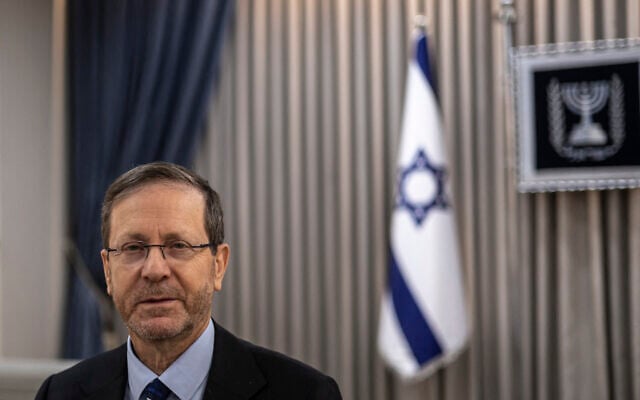
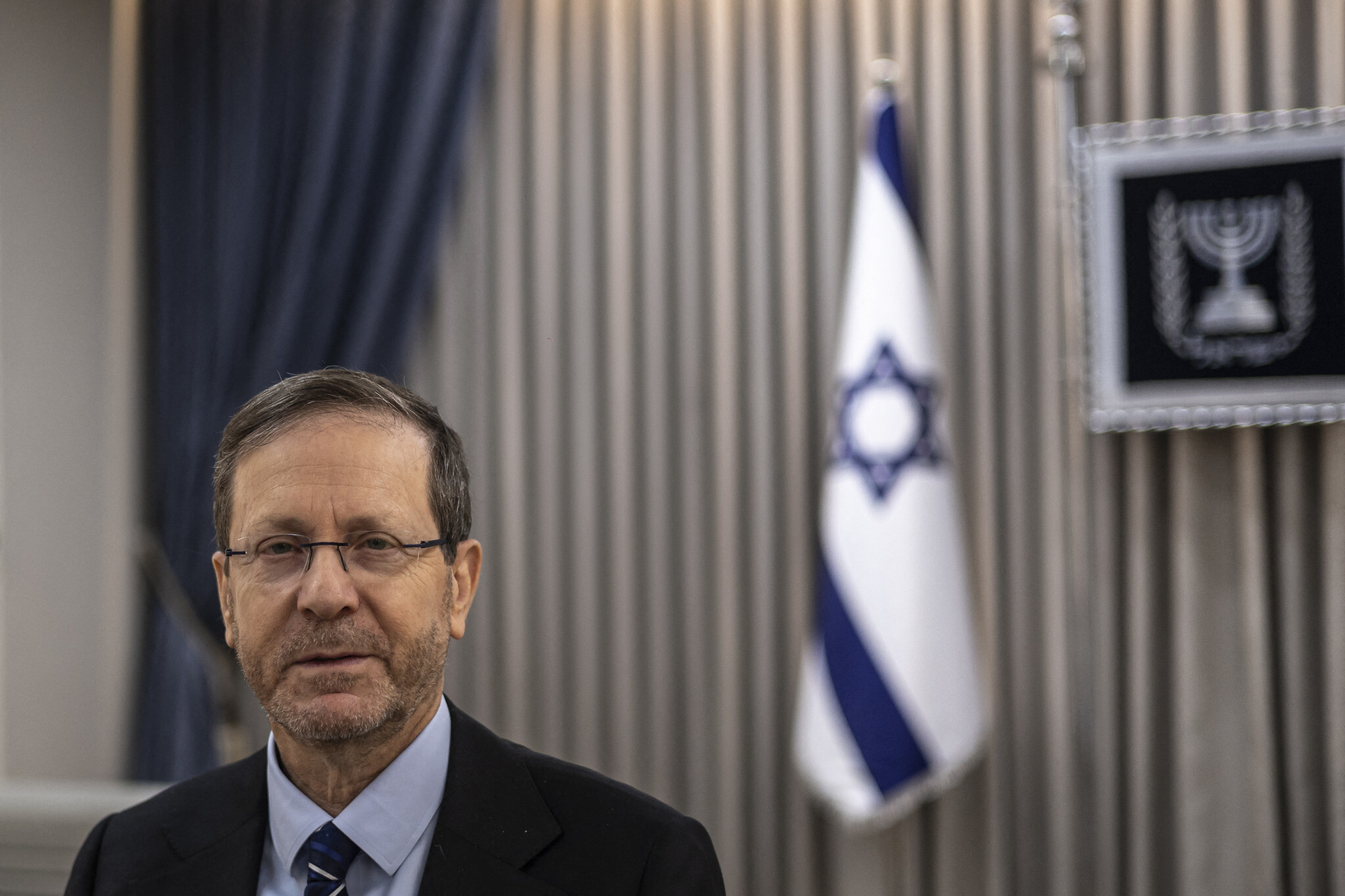
President Isaac Herzog poses for a photograph as he gives an interview at the President's Residence in Jerusalem, on March 16, 2026. (OLYMPIA DE MAISMONT / AFP)
President Isaac Herzog tells AFP that the war launched by Israel and the United States against Iran marks a key turning point for the entire region.
“We are at a historical juncture, there comes a moment that after well over a generation of endless wars, bloodshed and terror, the root cause of it, which comes from Tehran, will be blocked and stopped, and the whole direction of the region will change,” Herzog says at his Jerusalem residence.
He insists defeating the clerical authorities in Iran is “in the innermost national security interests of Europe,” adding that Iran had been seeking “10 times the amount of ballistic missiles, which would have threatened Europe big time.”
“After talking and talking for a whole generation, it’s about time for doing,” he says.
He also says Europe should back the country’s fight against Hezbollah, as Israeli forces carry out ground operations in Lebanon.
“Europe should support any effort, any effort, to eradicate Hezbollah now,” Herzog says. “They should understand that if you want to get anywhere, sometimes you need to win war.”
France on Saturday offered to host direct negotiations between the Israeli and Lebanese governments in Paris, saying that Beirut was ready to engage.
Herzog, whose role is mainly ceremonial, welcomes the proposal as a “very positive development.”
“I think it’s very important that there should be talks,” he says. “It’s about time we have an opportunity of moving forward with Lebanon.”
Sirens expected in central Israel as missile launched from Iran
Another ballistic missile attack from Iran has been detected by the IDF.
Sirens are expected to sound in central Israel in the coming minutes.
EU plans emergency measures to curb energy costs as Iran war hits markets
The European Union will take steps to ease the impact of surging energy prices caused by the US-Israeli war against Iran, European Commission President Ursula von der Leyen says, while stopping short of major market interventions such as capping gas prices.
In a letter to EU leaders before a Brussels summit on Thursday, she lays out plans focused on making more carbon-emissions permits available in the bloc’s market and providing more financial aid to industries. The proposal omits more radical measures called for by a handful of governments such as a redesign of the EU’s electricity market.
Europe’s heavy reliance on imported fuels means it is highly exposed to global price swings, and governments want to avoid a repeat of Europe’s 2022 energy crunch, when prices hit record highs after Russia cut gas supplies.
The EU imports most of its oil and gas from the US, Norway, and other suppliers that are not directly affected by Middle East supply cuts.
“At present, the physical security of supply of the European Union is assured. But the increase of fossil fuel prices is already weighing on our economy,” von der Leyen says.
She says the EU’s bill for oil and gas imports increased by 6 billion euros during the Iran conflict, which began on February 28.
Polymarket betting site condemns threats against Times of Israel reporter
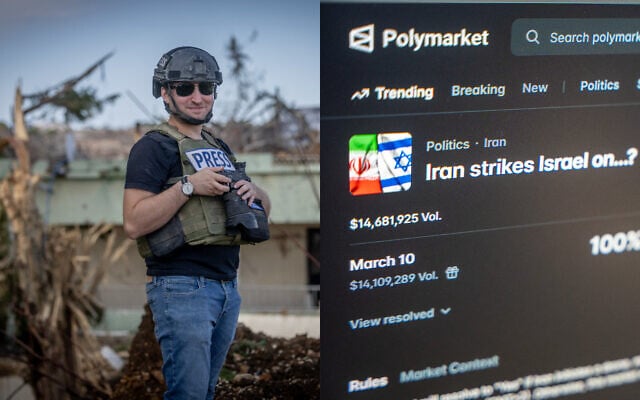
Left: The Times of Israel's military correspondent, Emanuel Fabian, in southern Lebanon on November 21, 2024; Right: This photo taken on March 16, 2026, shows a bet on the Polymarket site titled 'Iran strikes Israel on...?' (Chaim Goldberg/ Flash90; Emanuel Fabian/ Times of Israel)
The Polymarket betting site condemns threats against The Times of Israel’s military correspondent, Emanuel Fabian.
Polymarket users have threatened Fabian’s life to try to pressure him to make changes to his coverage of an Iranian missile impact in Israel, in order to win bets made on the site.
“Polymarket condemns the harassment and threats directed at Emanuel Fabian, or anyone else for that matter. This behavior violates our terms of service and has no place on our platform or anywhere else,” a spokesperson for Polymarket says in a statement to ToI.
“Prediction markets depend on the integrity of independent reporting. Attempts to pressure journalists to alter their reporting undermine that integrity and undermine the markets themselves,” the spokesperson says.
The spokesperson does not address questions about whether the company has heard from the Israel Police, which is investigating the matter, whether Polymarket can help identify suspects in the case, whether the platform is able to take measures to prevent threats or media interference, or whether Polymarket is aware of any similar incidents occurring in the past.
Israel says it struck IRGC Navy’s Tehran headquarters
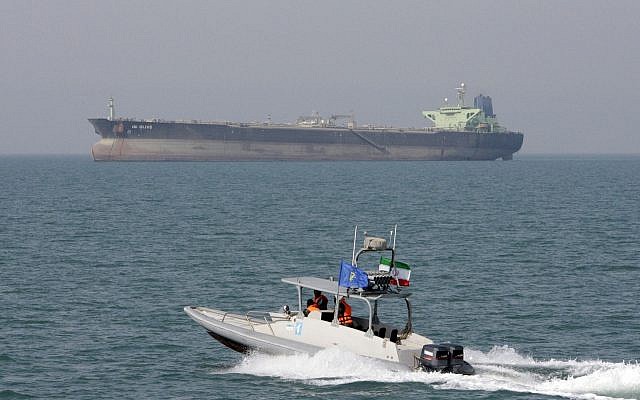
Illustrative: An Iranian Revolutionary Guard speedboat moves in the Persian Gulf with an oil tanker in the background. (AP Photo/Vahid Salemi)
The Israeli Air Force bombed the headquarters of the Islamic Revolutionary Guard Corps Navy in Tehran, the military says.
According to the military, the IRGC Navy headquarters was located within a large complex in eastern Tehran, and “for years served senior commanders to manage the force’s activities and to advance terror operations against the State of Israel and other countries in the maritime arena in the Middle East.”
The strike took place on Friday, according to the military.
IDF says it ‘does not act with intention of harming innocents’ after Palestinian family shot dead
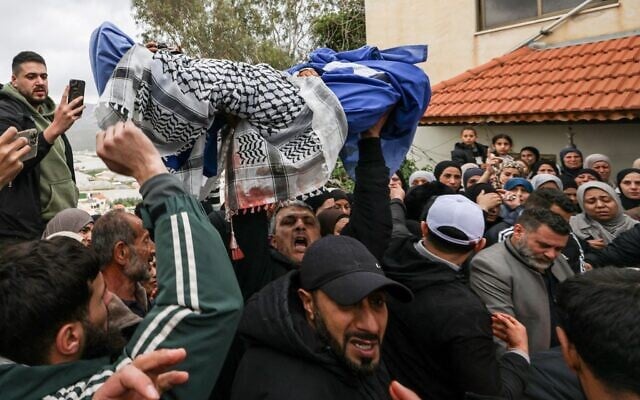
A family member lifts the body of 5-year-old Mohammed Bani Odeh during the funeral of a Palestinian family killed by Israeli troops while in their vehicle, in the West Bank town of Tammun on March 15, 2026. (JAAFAR ASHTIYEH / AFP)
IDF Spokesman Brig. Gen. Effie Defrin says the military “does not act with the intention of harming innocent civilians,” after a Palestinian couple and two of their young children were killed when Israeli security forces opened fire on their car in the northern West Bank on Saturday.
Both soldiers and police officers took part in the operation during which the shooting occurred.
Israel Police has claimed that the car sped toward its forces during a joint counter-terrorism operation in the area with the IDF, and that, feeling threatened, they opened fire.
“We operate according to the IDF’s system of values,” Defrin says in response to a question at a press conference. “Any harm to innocent people, certainly children and women, is stomach-turning. The IDF does not act with the intention of harming innocent civilians.”
Defrin says the military is investigating the incident, as is the Department of Internal Police Investigations, a Justice Ministry unit responsible for investigating police officers.
More registered voters in US view Israel negatively than positively, new poll indicates
Thirty-nine percent of Americans have negative views toward Israel, compared to 32% who have positive views toward the Jewish state, according to a poll published by NBC News.
Another NBC poll conducted shortly after Hamas’s October 7, 2023, onslaught had the numbers nearly flipped, with 47% of Americans having positive views toward Israel, compared to 24% who had negative views.
The shift is most defined among Democrats and Independents, with 57% and 48% of them respectively now holding negative views toward Israel. Just after October 7, those numbers were 35% and 22% respectively.
Among Republicans, 54% view Israel positively, but it is still a drop from the late 2023 poll, when that number was at 63%.
Asked whether their sympathies lie more with Israelis or Palestinians, 40% of registered voters said they side more with the Israelis, while 39% choose the Palestinians, according to the poll published by NBC News.
The split stood at 45% for Israelis and 13% for Palestinians when NBC News asked the question in November 2013.
The latest NBC News poll was conducted between February 27 and March 3, surveying 1,000 registered voters, with a margin of error of 3.1%.
New @NBCNews poll finds American public sentiment turning against Israel since 2023. Double-digit drops in positive views of Israel: -21 among Democrats, -19 among independents, -9 among Republicans. Overall, a double-digit increase in negative views. https://t.co/5GUwokF5qM pic.twitter.com/QSOa5tBYVk
— Sahil Kapur (@sahilkapur) March 16, 2026
In recording, Iranian official says Mojtaba narrowly survived Israeli strike
Iran’s newly appointed supreme leader, Mojtaba Khamenei, narrowly survived an Israeli airstrike on February 28, after stepping outside his residence moments before missiles hit the compound, according to leaked audio obtained by The Telegraph.
The recording allegedly features remarks by Mazaher Hosseini, head of protocol in the office of the late supreme leader Ali Khamenei, delivered to senior clerics and commanders of the Islamic Revolutionary Guard Corps at a March 12 meeting in Tehran.
According to Hosseini, Mojtaba had stepped into the compound’s yard shortly before Israel struck the residence at 9:32 a.m. local time. The February 28 strike killed several senior officials, including Ali Khamenei and other members of Iran’s leadership.
“God’s will was that Mojtaba had to go out to the yard to do something and then return,” Hosseini says in the recording, speaking in Farsi. “He was outside and was heading upstairs when they struck the building with a missile.”
According to Hosseini, Mojtaba Khamenei sustained only “a minor injury to his leg” in the strike.
Hosseini adds that Mojtaba Khamenei’s wife, son, and brother-in-law were killed in the strike.
Mostafa Khamenei, another son of Ali Khamenei, was also “nearby” at the time of the strike, according to the recording, but escaped with his wife, unharmed.
ADL chief doubles down on combating ‘most dangerous’ surge in antisemitism
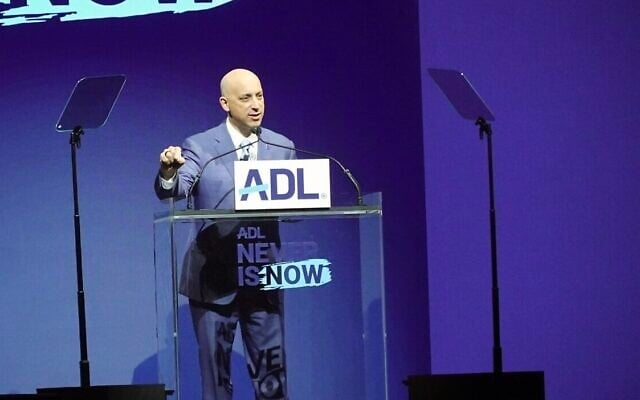
ADL head Jonathan Greenblatt at the group's annual Never Is Now conference, in New York City, March 16, 2026. (Luke Tress/Times of Israel)
ADL chief Jonathan Greenblatt doubles down on the group’s mission to combat antisemitism, amid a broader Jewish community debate over allocation of resources.
Commentators including the writer Bret Stephens have argued that Jewish institutions sink vast resources into combating antisemitism, but that the fight is mostly a wasted effort, and that those funds should instead be diverted to building Jewish institutions.
Greenblatt, opening the ADL’s annual Never Is Now conference in New York City, describes the recent spate in violent antisemitism, from the Bondi Beach massacre to shootings of Toronto synagogues and the attack on a Michigan congregation last week.
“Antisemitism has not just become murderous, it’s become mundane,” he says, pointing to violence as well as lesser incidents such as antisemitic chants at a Jewish soccer team in the UK.
“What would have made headlines a decade ago barely goes noticed today,” he tells the several thousand attendees.
“We are facing the most concentrated, the most dangerous, and lethal surge of antisemitism, the worst in living memory,” he says, taking aim at figures such as Tucker Carlson, Islamist extremists and white supremacists.
“If we don’t turn this tide, life in America as we know it will be irrevocably changed. Changed for Jews, sure, but also changed for everyone,” he says. “A country riddled by antisemitism is one where intolerance is widespread, where conspiratorial thinking tops free inquiry, where pluralism is imperiled and where democracy is in danger.
“Some have argued that we need to choose between fighting antisemitism and building Jewish life,” he says. “Those aren’t competing priorities, they are inseparable preconditions for the flourishing of Jewish life in an open society like ours.
“That doesn’t mean that the same tactics from 20 years ago will still work,” he says, citing recent threats like generative AI. “It does mean that we need to focus our efforts like never before, to try new things, to fail fast.”
“We need to innovate and take risks because playing it safe will not make the Jewish community safe,” he says.
No injuries reported Iranian missile attack
No injuries are reported in Iran’s latest ballistic missile salvo on Israel, the sixth since midnight, and the first in some six hours.
Sirens had sounded across central Israel and the West Bank during the attack.
A small number of missiles were launched, which were likely intercepted, according to initial military assessments.
Footage shows one of the interceptions.
מיירט חץ פוגע בטיל איראני pic.twitter.com/AKToNZ9GC5
— איתי בלומנטל ???????? Itay Blumental (@ItayBlumental) March 16, 2026
IDF detects new ballistic missile launch from Iran
The IDF says it had detected a new ballistic missile launch from Iran.
Sirens are expected to sound in the West Bank area in the coming minutes.
IDF intel chief says Iran ‘in distress’ as it begins to grasp damage from strikes – report
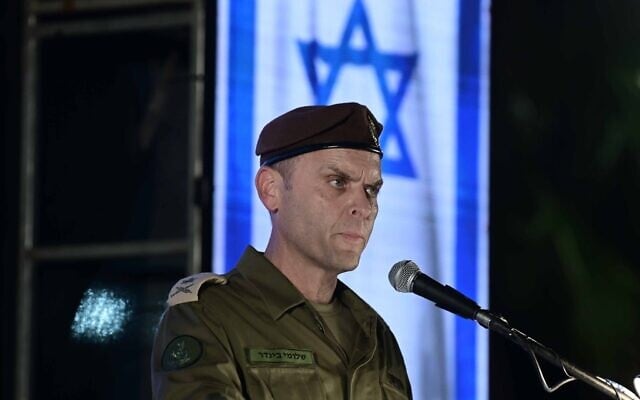
Maj. Gen. Shlomi Binder speaks at the IDF Intelligence headquarters at the Glilot Base near Herzliya, August 21, 2024. (Tomer Neuberg/Flash90/File)
The IDF’s Intelligence Directorate chief Maj. Gen. Shlomi Binder said in a recent closed-door security discussion that Iran’s military apparatus is “in distress” as a result of the war, according to Channel 12 news.
Binder reportedly said Iranian officials are only now beginning to grasp the extent of the damage inflicted on their capabilities.
“In recent days, the Iranians are beginning to understand what happened to them,” Binder is quoted as saying. “They are discovering how exposed their command structure is and the damage that has been caused.”
According to the report, Binder told participants that Iranian security forces are hesitant to operate due to the presence of Israeli and US aircraft, while others are either unwilling or unable to act.
“What they are firing is what they’re capable of firing — they simply cannot do more than that,” he said about Iran’s rate of missile fire, adding that Israeli strikes are “sealing the [missile] tunnels daily to ensure they have no way to launch additional missiles.”
Report: Israel preparing for at least another month of war with Iran
The war with Iran is expected to last at least another month, Channel 12 news reports, citing a senior Israeli official.
Israel is reportedly preparing for an extended phase of fighting as it seeks to further weaken the Iranian regime and capitalize on what it views as signs of internal instability within the country’s leadership.
According to the source, US President Donald Trump supports Israel in continuing the campaign.
Trump claims Iranian officials seeking deal, but ‘I don’t know if they’re ready yet’
US President Donald Trump reiterates that Iranian officials have expressed interest in reaching a diplomatic agreement with the US, but that he is not ready to do so, in addition to not being sure whether those seeking an off-ramp are even the ones actually in charge.
“They want to make a deal. They’re talking to our people. I don’t know if they’re ready yet. They’re taking a pounding,” Trump tells reporters during an event at the White House.
“We don’t even know who their leaders are because the first group was all dead and the second group got knocked out,” he adds.
“But we met with the next group, but we don’t know who their leader is,” he continues. “We have people wanting to negotiate. We have no idea who they are.”
Channel 12 speculates that Trump is using the word “met” and “negotiate” rather liberally, but says US special envoy Steve Witkoff has continued messaging Iran Foreign Minister Abbas Araghchi over the Signal app, including in recent days.
Earlier in the war, Witkoff had denied maintaining contact with Iran since the talks fell apart.
Channel 12 says Araghchi recently passed along a message expressing interest in a ceasefire. Araghchi has publicly denied that Iran has any interest in talks with the US or a truce.
Araghchi is seen as close to Ali Larijani, who former supreme leader whom Ali Khamenei tapped as the main decision-maker in the event that he is killed.
Channel 12 speculates that when Trump says he is not sure whether those in Iran who have allegedly reached out to the US are actually in charge, the president is referring to the fact that Khameni’s son Mojtaba is ostensibly supposed to be the one making decisions, not Araghchi and Larijani.
IDF soldier moderately wounded by gunfire in accident in southern Lebanon
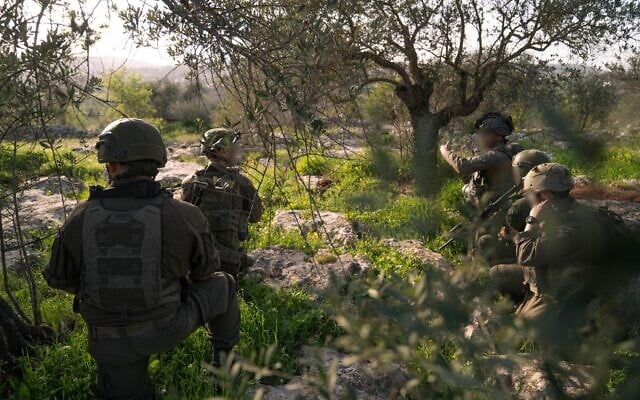
IDF troops in southern Lebanon, in a handout photo issued by the military on March 16, 2026. (Israel Defense Forces)
An IDF soldier was moderately hurt by gunfire, as a result of an “operational accident” in southern Lebanon earlier today, the military says.
The army says the soldier was taken to a hospital for treatment, and his family was notified.
The IDF is still investigating the circumstances of the incident, but according to an initial probe, he was not hit by enemy fire.
IDF issues another call for Lebanese civilians to leave Beirut’s Dahiyeh
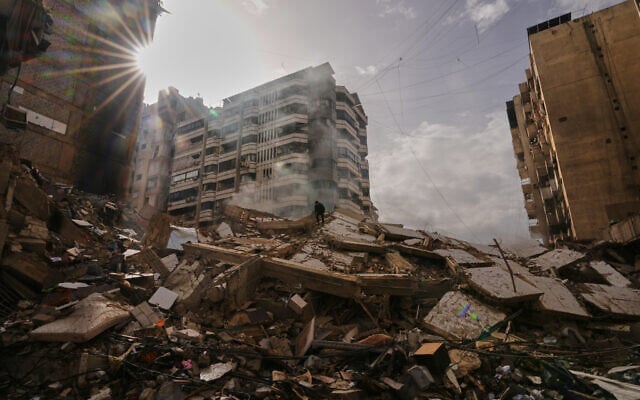
A man stands atop the rubble as smoke rises from a building destroyed in an Israeli airstrike in Dahiyeh, Beirut's southern suburbs, Lebanon, March 14, 2026. (AP/Hassan Ammar)
The IDF again calls on Lebanese civilians to evacuate Beirut’s southern suburbs, a Hezbollah stronghold known as the Dahiyeh.
“The IDF continues to operate and attack the military infrastructure belonging to the Hezbollah terror organization throughout the Dahiyeh area with increasing force. The IDF does not intend to harm you, and therefore, for your safety, you must evacuate immediately,” says army spokesman Col. Avichay Adaree.
The Israeli Air Force has struck dozens of Hezbollah targets in the Dahiyeh in the past week, and the military has repeatedly called on Lebanese civilians to evacuate the area.
IDF chief says Hezbollah feeling ‘shockwaves’ of Israel’s strikes in Iran
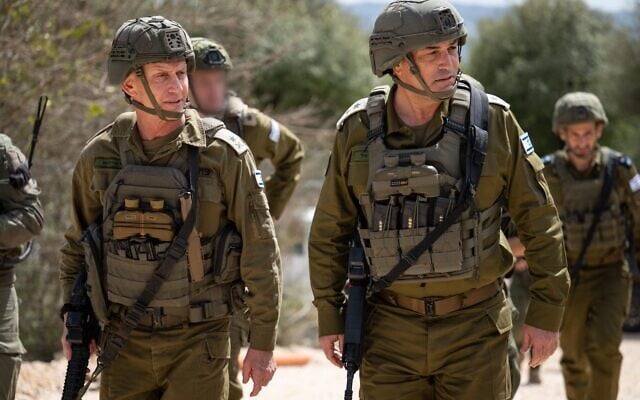
IDF Chief of Staff Lt. Gen. Eyal Zamir (right) and Northern Command chief in northern Israel, March 16. 2026. (Israel Defense Forces)
IDF Chief of Staff Lt. Gen. Eyal Zamir says the “shockwaves” of Israel’s strikes in Iran are being felt by Hezbollah, as he approves new battle plans for the military’s ground operation in southern Lebanon.
“Iran is the main arena. Weakening the regime and its capabilities will weaken the entire radical axis and, within that, the Hezbollah terror organization,” Zamir says during a visit to the northern border with Northern Command chief Maj. Gen. Rafi Milo.
“The campaign against Hezbollah is another central front. Any damage to the military build-up capabilities of Iran and the Revolutionary Guards also harms Hezbollah’s arming and financing capabilities. The shockwave of the strikes and the weakening of the radical regime in Iran are also felt in the campaign against Hezbollah,” he says, according to remarks published by the IDF.
Zamir says that since Hezbollah began attacking Israel amid the war with Iran, over 400 members of the terror group have been killed, including top officers.
“We are determined to deepen the operation until all of our objectives are achieved,” he adds.
EU has ‘no appetite’ to expand Mideast naval mission to Strait of Hormuz, Kallas says
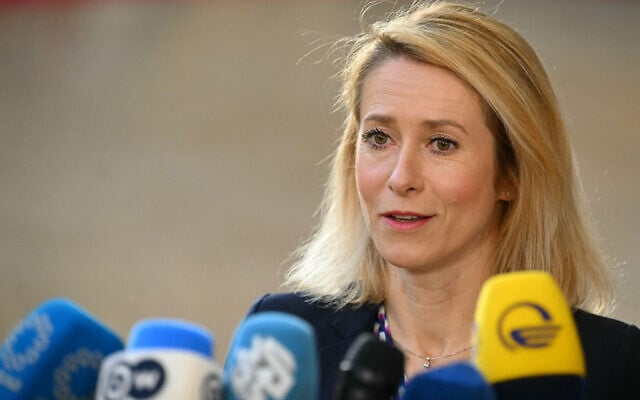
EU High Representative and Vice-President for Foreign Affairs and Security Policy Kaja Kallas addresses the media in Brussels on March 16, 2026. (NICOLAS TUCAT / AFP)
European Union foreign ministers showed “no appetite” to expand an EU naval mission in the Middle East to the Strait of Hormuz for the time being, EU foreign policy chief Kaja Kallas says.
US President Donald Trump has called on other nations to help police the strait after Iran responded to US-Israeli attacks by using drones, missiles and mines to effectively close the channel for tankers that normally transport a fifth of global oil and liquefied natural gas.
The EU’s Aspides mission — named after the Greek word for “shields” — was established in 2024 to protect ships from attacks by Yemen’s Houthi rebel group in the Red Sea.
“There was in our discussions a clear wish to strengthen this operation, but for the time being, there was no appetite in changing the mandate of the operation,” Kallas tells reporters after a meeting of the EU foreign ministers in Brussels.
Six people reported lightly hurt after Hezbollah rocket strike on Nahariya home
Six people were injured in the Hezbollah rocket strike on a home in Nahariya, medics now say.
Magen David Adom says it treated two adults and four minors with signs of smoke inhalation. They are all listed in good condition.
The IDF says the impact was caused by a rocket launched from Lebanon, and not a failed interceptor as initially thought.
Answering a question, Trump says ‘Israel would never’ use nuclear weapon against Iran
Trump is asked by a reporter during an event at the White House about a call from his unofficial AI adviser David Sacks for the US to quickly declare victory against Iran or risk getting entangled in a dragged-out conflict where Israel could well use a nuclear weapon.
Trump says he had not heard about those comments from Sacks, but insists that “Israel wouldn’t do that. Israel would never do that.”
Trump also says the US does not know whether Iran’s newly selected supreme leader, Mojtaba Khamenei, is alive, after declaring last week that he likely is.
“We don’t know if he’s dead or not,” Trump says.
Last week, Trump said he thinks that Khamenei is alive but “probably damaged in some form.”
Trump says “some people” are “saying that he lost his leg… Other people are saying he’s dead. Nobody’s saying he’s 100% healthy.”
He accuses Iran of engaging in disinformation regarding the war.
“They’re using disinformation, plus AI, and that’s a terrible situation,” he says, citing fake footage of US and Israeli targets burning.
Trump says he has discussed the IDF offensive against Hezbollah with Israel’s leaders, but avoids answering a question as to whether Washington supports a large-scale operation.
“Hezbollah is a big problem, and they’re rapidly being eliminated,” he says.
IDF says it killed Hamas gunmen in Gaza, including two who invaded Israel on Oct. 7
The IDF says it struck a cell of armed Hamas operatives in the Gaza Strip yesterday, two of whom it says were terrorists who participated in the October 7, 2023, onslaught.
According to the military, troops identified the gunmen preparing to carry out an attack on Israeli forces in Gaza. The operatives were then targeted in a strike and killed “to remove the threat,” it says.
The IDF says it can now confirm that among the gunmen were Rami Ibrahim Harb and Mutaeb Ziyad Darah, members of Hamas’s elite Nukhba Force, who invaded Israel during the October 7 onslaught.
The military identifies two others as Abd Muhammad Amasi, a member of the Popular Resistance Committees, and Tawfiq Khaldi, a Hamas operative.
Three more Hamas members were also killed in the strike, the army adds.
צה"ל חיסל חוליית מחבלי חמאס שקידמה מתווה טרור נגד כוחותינו: חוסלו מחבלים שהשתתפו בטבח ה-7 באוקטובר
אתמול, זיהו כוחות צה״ל חוליית מחבלים חמושים מארגון הטרור חמאס, שתכננו לבצע מתווה טרור נגד כוחותינו.
צה״ל תקף וחיסל את המחבלים החמושים במטרה להסיר את האיום.
כעת ניתן לאשר כי בין… pic.twitter.com/da4w1c3CtE
— צבא ההגנה לישראל (@idfonline) March 16, 2026
Army says impact in Nahariya caused by rocket, not interceptor
After a preliminary examination, the IDF says that the impact in Nahariya was not a failed interceptor missile, but rather a rocket launched from Lebanon.
Three people were hurt when the projectile struck a building in the northern city, sparking a fire.
Rotterdam synagogue blast had terrorist intent, prosecutors say
Dutch prosecutors say the four men suspected of causing an explosion at a synagogue in Rotterdam on Friday acted with terrorist intent.
“The acts were meant to instill fear in the Jewish community,” the prosecutors say.
The four, aged 17 to 19, were apprehended shortly after an arson attack caused a fire at the synagogue early on Friday.
Lebanon registers more than one million displaced in Israel-Hezbollah war
Lebanese authorities say more than one million people have registered as displaced since war erupted on March 2 between Israel and Hezbollah.
A statement says the number of displaced people who registered their names on a website affiliated with the social affairs ministry has reached 1,049,328, with 132,742 of them staying in more than 600 collective shelters.
4 wounded during Hezbollah attack; IDF checking if failed interceptor impacted Nahariya
Four people are reported injured in the north following the latest Hezbollah rocket attack on the region.
Three were hurt in Nahariya after a projectile impacted in the city. The IDF is investigating whether a failed interceptor missile caused the incident, amid Hezbollah’s rocket and drone attack on the area.
Footage shows what appears to be an interceptor crashing down on the city and exploding.
The IDF is investigating whether a failed interceptor missile caused the impact in Nahariya, amid Hezbollah's rocket and drone attack on the area.
Footage shows what appears to be an interceptor crashing down on the city and exploding. pic.twitter.com/a22P8jB3xk
— Emanuel (Mannie) Fabian (@manniefabian) March 16, 2026
The impact in Nahariya wounded three people, medics say.
Magen David Adom says it treated a woman, aged 53, and two girls, aged 16 and 18, with signs of smoke inhalation, after a fire was caused by the impact.
At another impact site, near Kibbutz Kabri, a man in his 40s is listed in light-to-moderate condition after being hit by a blast, MDA adds.
Middle East oil exports drop at least 60% as Hormuz stays mostly closed, data shows

Liberia-flagged tanker Shenlong Suezmax, carrying crude oil from Saudi Arabia, that arrived clearing the Strait of Hormuz, is seen at the Mumbai Port in Mumbai, India, March 12, 2026. (AP/Rafiq Maqbool)
Daily oil exports from the Persian Gulf, home to top exporter Saudi Arabia and other major producers, have dropped by at least 60% in the week leading up to March 15 compared to February due to disruptions and output cuts amid the US-Iran war, according to shipping data and Reuters calculations.
The effective closure of the Strait of Hormuz, normally used to transport about a fifth of the world’s oil supply, has forced exporters to cancel shipments and shut production at oilfields, creating the world’s biggest ever supply disruption. Crude oil prices have surged to the highest in four years and those of some fuels to record highs.
Crude, condensate and refined fuels exports from eight Middle Eastern countries — Saudi Arabia, Kuwait, Iran, Iraq, Oman, Qatar, Bahrain, and the United Arab Emirates — in the week to March 15 averaged 9.71 million barrels per day, data from Kpler shows, down 61% from 25.13 million bpd in February.
Data from Vortexa shows an even more dramatic drop, with exports from the eight countries last week reaching 7.5 million bpd, down 71% from February’s 26.1 million bpd.
Prior to the war, the eight countries accounted for 36% or global seaborne oil exports of 70.43 million bpd, according to Kpler.
The actual exports could be even lower as some volumes go into floating storage but do not leave the Gulf.
Air Force strikes Iranian intelligence command center in Tehran
The Israeli Air Force bombed an Iranian intelligence command center in Tehran earlier today, the military announces.
The headquarters belonged to Iran’s Intelligence Ministry, and according to the IDF, was embedded within a building belonging to Iran’s electricity company.
“The strike on the headquarters is part of deepening the blows to the regime’s core systems and its security capabilities,” the military adds.
Israeli ground offensive in Lebanon is an ‘error,’ German chancellor says
German Chancellor Friedrich Merz warns that an Israeli ground offensive in Lebanon is an “error” which will “further exacerbate the already highly tense humanitarian situation” in the country.
“We urgently call on our Israeli friends: Do not take this path — it would be an error,” Merz says after IDF announced what it described as “limited ground operations” in Lebanon.
Medics responding to reported Hezbollah rocket impact in Nahariya
Medics are responding to reports of a rocket impact in the northern city of Nahariya, following a Hezbollah barrage on the area.
The impact sparked a fire.
It is not immediately clear if anyone was hurt.
תיעוד: פגיעה ישירה בנהריה, מד"א מטפלים בנפגע אחד לפחות@ItayBlumental @CBeyar pic.twitter.com/q0JRECqvt5
— כאן חדשות (@kann_news) March 16, 2026
Trump: Some countries ‘very enthusiastic’ about helping secure Hormuz ‘and some aren’t’
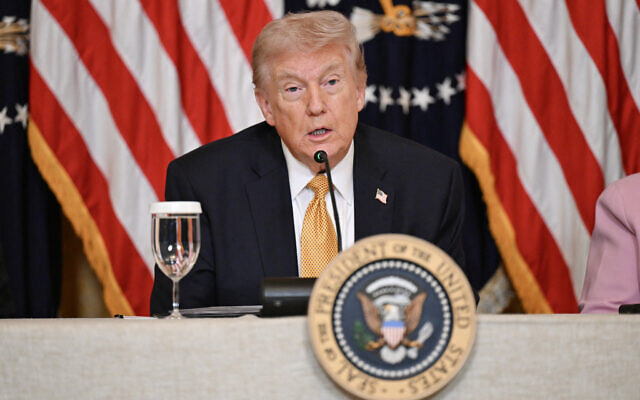
US President Donald Trump speaks during a lunch with the Kennedy Center Board Members in the East Room of the White House on March 16, 2026 in Washington, DC (Annabelle GORDON / AFP)
US President Donald Trump acknowledges that some countries aren’t enthusiastic about joining his initiative to secure the safe passage of vessels through the Strait of Hormuz.
“Numerous countries have told me they’re on the way. Some are very enthusiastic about it… and some aren’t,” Trump says in remarks at a White House event.
He claims skeptics include countries that the US has helped for many years, adding that securing the Strait of Hormuz will be more beneficial to other countries than Washington because the latter doesn’t use the channel for the import of its oil.
“The level of enthusiasm matters to me,” Trump says.
“We strongly encourage the other nations to get involved with us and get involved quickly, with great enthusiasm,” he adds.
Trump says one or two countries will likely decline to join his initiative.
“We don’t need anybody. We’re the strongest nation in the world… I’m almost doing [this initiative]… because I want to find out how [countries will] react. I’ve been saying for years that if we ever did need them, they won’t be there.”
WATCH: President Trump gives a press conference, including on the Iran war
President Donald Trump is giving a press conference.
Sirens in Western Galilee amid Hezbollah attack
Sirens sound in the Western Galilee amid a Hezbollah attack from Lebanon.
The alerts are activated in Acre, Nahariya, and numerous surrounding communities, warning of rocket fire and a suspected drone infiltration.
Medics say they have not received any reports of injuries yet.
Trump says Chief of Staff Susie Wiles diagnosed with breast cancer, will continue work
White House Chief of Staff Susie Wiles has been diagnosed with early-stage breast cancer, but will continue working at the White House during her treatment, President Donald Trump says.
“Her Strength and her Commitment to continue doing the job she loves, and does so well, while undergoing treatment, tells you everything you need to know about her,” Trump says in a Truth Social post.
Wiles managed Trump’s comeback 2024 campaign and has been seen as one of his most important political advisers, running a more disciplined White House than in his first term.
Iranian women’s team leaves Malaysia for Oman after asylum reversal
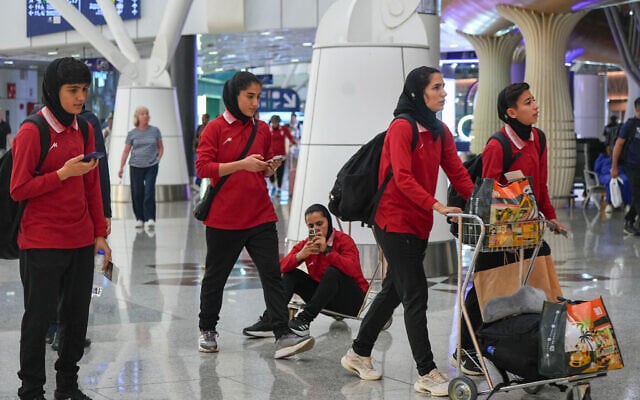
Members of Iran's women's soccer team arrive at the Kuala Lumpur International Airport in Sepang, Malaysia, Monday, March 16, 2026. (AP Photo/Azneal Ishak)
The Iranian women’s soccer team has left Malaysia for Oman, ending days of uncertainty after five of the seven squad members who sparked a diplomatic furor by seeking asylum in Australia reversed their decisions and rejoined the team in Kuala Lumpur.
The squad spent several hours at the airport checking in and waiting for their flight. They declined to speak to reporters. Some chatted while others used their mobile phones. A lone player knelt several times and prayed on a mat before boarding the plane. Iran embassy staff at the airport also refused to comment.
The Asian Football Confederation general secretary, Windsor John, earlier told The Associated Press the team’s departure was arranged by the Iranian embassy. He said the AFC, which is supporting the Iranian team in Kuala Lumpur, was told they are flying to Oman, but that isn’t their final destination. He said he wasn’t aware of their full travel plans.
Asked if the confederation is satisfied that the women will be safe back in Iran, Windsor said the AFC and FIFA will check up on them regularly with the Iranian football federation “as they are our girls as well.”
Yair Golan says government lacks plan to end war with Iran, Hezbollah
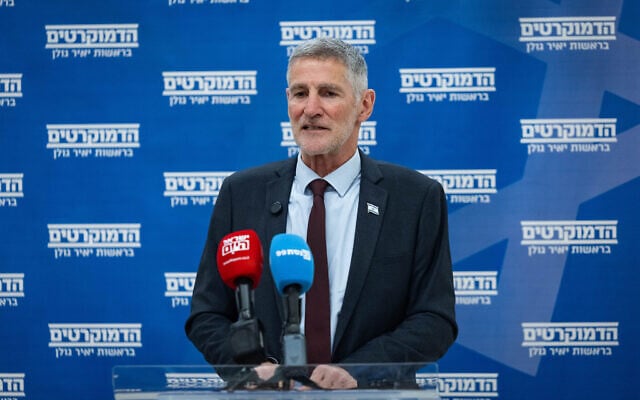
Democrats chair Yair Golan leads a faction meeting at the Knesset, the Israeli parliament in Jerusalem, on February 9, 2026. (Yonatan Sindel/Flash90)
The Democrats party leader Yair Golan says that the government has no plan for ending Israel’s war against Iran and against Hezbollah in Lebanon, in one of the first remarks from an opposition leader challenging the government’s policies since the US and Israel launched a joint campaign against the Islamic Republic more than two weeks ago.
“In Iran, there is no exit strategy or plan to end the campaign. Without regional cooperation and sustained American backing, we will not be able to turn military achievements into Iran abandoning its nuclear program and limiting its ability to destabilize the region,” says the left-wing leader, speaking before a faction meeting at the Knesset.
“This government does not know how to win wars. It knows only one thing: how to open another front, another round, another cycle of bloodshed without goals, without a horizon, and without a strategy that can translate military achievements into real security,” he continues, calling Prime Minister Benjamin Netanyahu an “obstacle” to national security.
“He boasts and takes pride in the achievements of the IDF, but fails in his duty to turn them into a strategic-political decision,” he continues.
Golan points to Israel’s war in Gaza, where he notes that despite military accomplishments, significant casualties, and more than two years of fighting, Hamas remains at large.
“We must not allow this failure to replicate itself in Iran and Lebanon,” he says, following the IDF’s announcement today that it had begun a “targeted ground operation” in southern Lebanon.
Golan, who fought in Lebanon in the 1982 war and subsequent conflicts and later served as chief of the IDF’s Northern Command and as deputy chief of staff, says, “The military option in Lebanon always exists, but it must be said clearly: before sending divisions into the Lebanese quagmire, the diplomatic option must be exhausted to the fullest. We must not allow this government to drag us into an endless war there as well.”
Iranian media says supreme leader appoints former Guards chief as military adviser
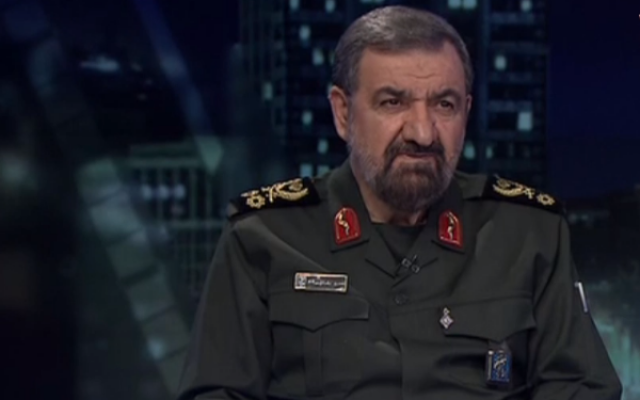
Mohsen Rezaei (MEMRI screenshot)
Iran’s new supreme leader has appointed the former chief of the Revolutionary Guards as a military adviser, local media reports.
“General Mohsen Rezaei was appointed as military adviser by the order of commander-in-chief Ayatollah Mojtaba Khamenei,” Mehr news agency reports.
Other media also reports the appointment.
Rezaei, 71, previously headed the Islamic Revolutionary Guard Corps, the ideological arm of Iran’s military. He has since held several senior positions within Iran’s political system.
Turkey condemns Israel’s ‘genocidal’ ground operation in Lebanon
Turkey condemns Israel’s ground operation in Lebanon, cautioning against “another humanitarian catastrophe” unfolding in the Middle East.
“We firmly condemn the Israeli ground operation in Lebanon, which is worsening instability in the region,” the foreign ministry says in a statement.
“The implementation by the Netanyahu government of genocidal and collective punishment policies, this time in Lebanon, will lead to yet another humanitarian catastrophe in the region,” it says.
Home Front Command says guidelines remain unchanged until at least Wednesday night
The IDF Home Front Command says its current wartime guidelines remain unchanged until at least Wednesday night, meaning schools remain closed in most parts of the country.
By Wednesday at 8 p.m., another assessment will be conducted by the Home Front Command.
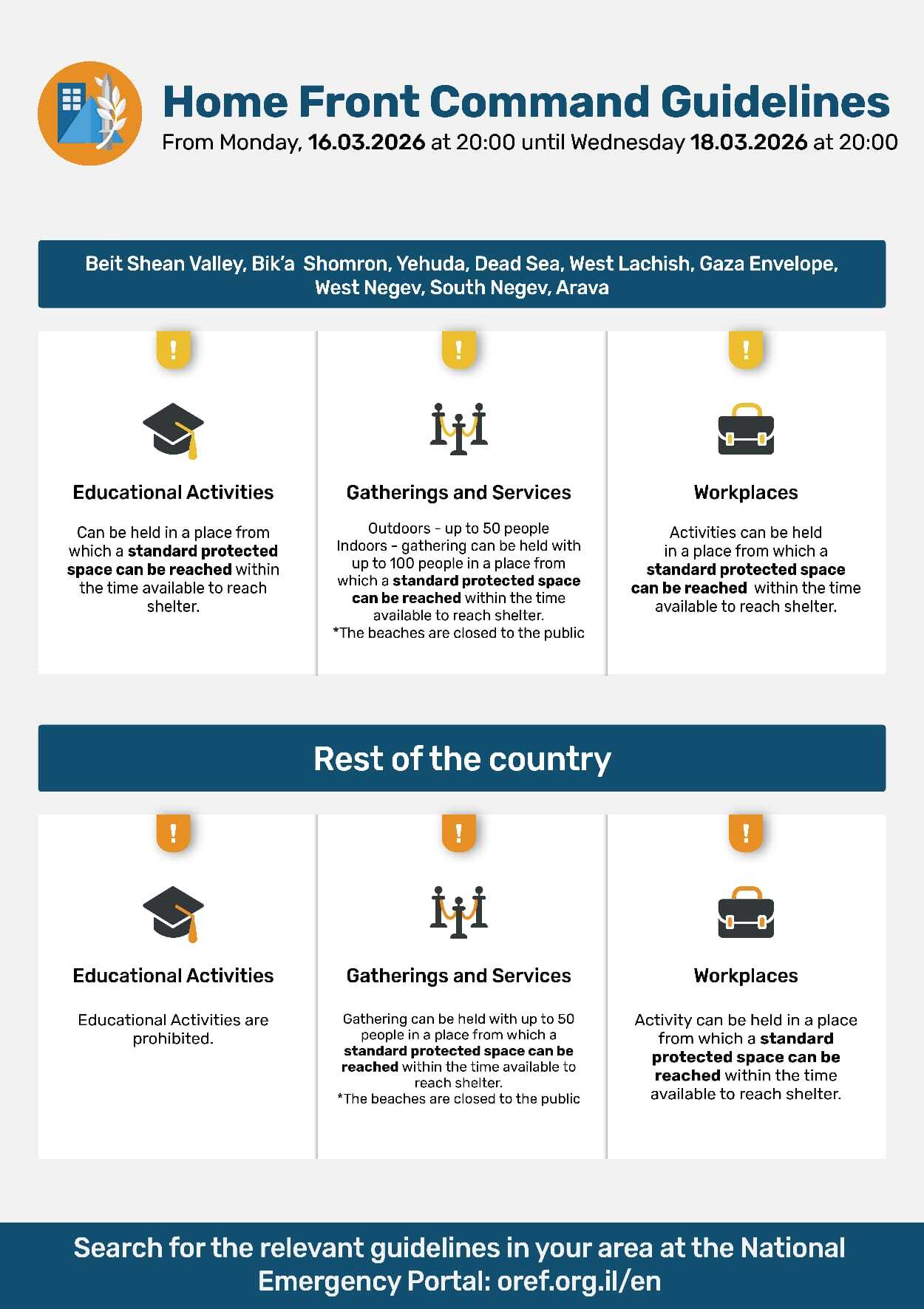
Under the current guidelines, educational institutions can operate, provided there is an adequate shelter that can be reached in time, in the following areas: the Beit Shean Valley, Jordan Valley, West Bank, Dead Sea area, West Lachish, Gaza border communities, Western Negev, Southern Negev, and Arava.
Gatherings of up to 100 people indoors and 50 people outdoors are also permitted, under the same conditions in those areas.
In the rest of the country, educational activities are still prohibited. Gatherings of up to 50 people are allowed, provided a shelter can be reached in time, and workplaces can operate under the same conditions.
Lapid reverses policy, introduces no-confidence motion against the government

Opposition Leader and head of the Yesh Atid party MK Yair Lapid leads a faction meeting at the Knesset in Jerusalem, on March 16, 2026 (Yonatan Sindel/Flash90)
Opposition Leader Yair Lapid introduces a no-confidence motion against the government in the Knesset, a week after his Yesh Atid party announced that its policy was “not to vote in favor of no-confidence motions” during the conflict with Iran.
“I didn’t want to submit a no-confidence motion today, but you left me no choice,” Lapid declares, arguing that he felt compelled to take such a step because the coalition is advancing controversial legislation unconnected to the war effort and transferring billions of shekels in coalition funds to the ultra-Orthodox community in the midst of an armed conflict.
“I did not want to submit a motion of no confidence. Not because I have confidence in the government, I have no confidence in it, but because it is not customary to submit motions of no confidence during a war, and it is certainly not customary to submit a motion of no confidence during a war with whose goals I agree [and] which I have been supporting for two and a half weeks,” he says, pledging to both support the war abroad and oppose the government’s legislative agenda at home.
The opposition rallied behind the government and the IDF following the outbreak of war with Iran late last month and, at first, it appeared that the coalition would scale down partisan political activity. All Knesset discussions and votes were suspended following the outbreak of hostilities on February 28, with parliamentary activity only resuming several days later, initially limited to discussions on war-related legislation, budgetary matters and necessary meetings of the Foreign Affairs and Defense Committee.
However, after a two-week halt, full parliamentary debate resumed Sunday with the coalition looking to push through a number of controversial bills, including legislation to overhaul the media market, split up the role of the attorney general, and establish a politically appointed panel to probe the failures surrounding the Hamas-led October 7, 2023, attack.
Addressing reporters ahead of his party’s weekly faction meeting in the Knesset this afternoon, Lapid said the way the coalition is behaving is a “disgrace.”
“There is nothing more obvious than the government’s plan — that because of the war we will remain silent while they dismantle the country. It will not work. We will continue to support the security forces, but they will not succeed in silencing us,” he said.
Iran’s FM says ‘neighboring states’ encouraging killing of Iranians, demands clarification
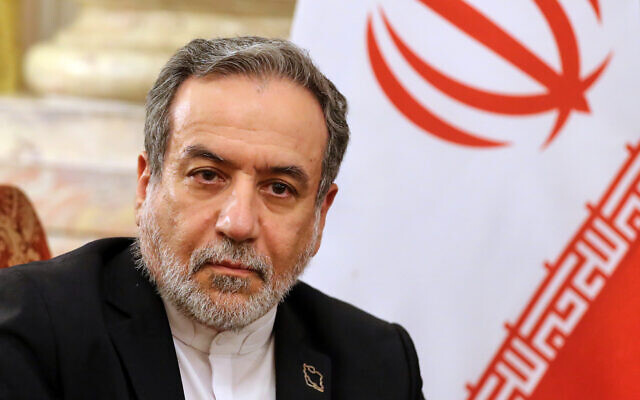
Iranian Foreign Minister Abbas Araghchi looks on during a meeting with Director General of the International Atomic Energy Agency (IAEA) Rafael Grossi, and Egyptian Foreign Minister Badr Abdelatty, at Tahrir Palace in Cairo, September 9, 2025. (AP/Khaled Elfiqi, File)
Iranian Foreign Minister Abbas Araghchi says that some “neighboring states” hosting US forces and allowing attacks on Iran are also actively encouraging the killing of Iranians.
He claims hundreds of Iranian civilians, including more than 200 children, have been killed in Israel–US strikes.
“Stances should be promptly clarified,” he adds in a post on X.
Araghchi is apparently responding to reporting by The New York Times that Saudi Crown Prince Mohammad Bin Salman has been urging the US to continue the strikes on Iran to “Cut off the head of the snake.”
In Jerusalem, missile fragments fall near Church of Holy Sepulchre, National Library close to the Knesset
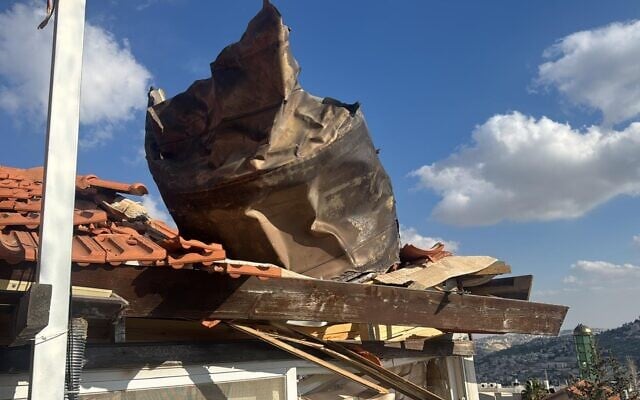
A missile fragment is seen in Jerusalem following an Iranian attack on March 16, 2026. (Fire and Rescue Service)
Fragments from intercepted Iranian ballistic missiles fell in several areas of Jerusalem in today’s attacks, according to the police and rescue services.
The Fire and Rescue service says a large chunk from an intercepted missile struck a home in East Jerusalem, causing damage.
Other fragments landed near the National Library, not far from the Knesset, and at the Church of the Holy Sepulchre in the Old City.
הפרגוד: אחד הרסיסים בעיר העתיקה בירושלים pic.twitter.com/mGeVN6tvIw
— הפרגוד (@moshepargod) March 16, 2026
One person was lightly hurt after touching a hot missile fragment. Magen David Adom says he suffered a minor burn to his hand.
The public is urged not to approach missile fragments and to alert authorities if they discover one.
Knesset advances bill to allow government to control budget for Kan public broadcaster
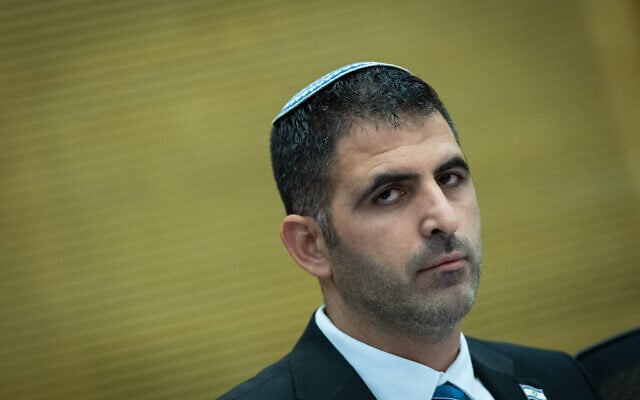
Communications Minister Shlomo Karhi at the special panel on a contentious communications bill at the Knesset, December 8, 2025. (Yonatan Sindel/Flash90)
The Knesset House Committee votes to transfer a bill to allow the government to determine the budget of the Kan public broadcaster from the Knesset Economics Committee, whose leadership opposes the measure, to the Finance Committee.
This represents a victory for Communications Minister Shlomo Karhi, who has been engaged in a two-year legislative effort to dismantle the public broadcaster.
Karhi says the bill will remove power from “bureaucrats and legal advisers” and give it to the Knesset, in a post on X. He vows to continue to “dismantle the deep state” until “we return our Jewish and democratic state to the people.”
The request to transfer the bill was prompted because the Economics Committee is led by Likud MK David Bitan, who has blocked previous efforts by Karhi to hamper the public broadcaster.
Opponents of the move, including Kan itself, argue that allowing the government to set Kan’s budget would open the door to political interference and mark another attempt to harm independent media.
It also follows the communications minister’s appearance yesterday before the High Court of Justice, which is hearing petitions over his refusal to appoint new members to the council of the Kan Public Broadcasting Corporation — a move that has limited the body’s ability to function, including approving a budget, for the past year.
Last July, the court ordered Karhi to extend the tenure of one council member until it issues a final ruling on the matter, which he refused to do.
On X, Karhi says that he “believes in the supremacy of the law – not in the distorted interpretations of the attorney general’s legal advisers.” Attorney General Gali Baharav-Miara has long opposed his wider media overhaul legislation.
Karhi further suggests that he will continue to defy legal decisions that he disagrees with, saying that “court rulings will be respected, as long as they are in accordance with the law.”
Husband of woman killed by Jewish terrorist: I’d have liked him to go to university, not prison

Yakoub Rabi (C) with his attorneys Nabila Kaboub (L) and Mohamad Rahal. (Courtesy)
Yakoub Rabi says the conviction of the man who killed his wife, Aisha Rabi, “changed nothing for me.”
A Jewish terrorist was convicted today in the 2018 stoning attack in which Aisha Rabi, a 47-year-old Palestinian mother of eight, was killed as she was driving in the West Bank. The convicted man’s name is barred from publication because he was a minor at the time.
Her husband tells The Times of Israel: “I heard the moment the decision was announced and looked at the killer and felt pain. I would have liked to see [the convicted man] at university, becoming a teacher — not standing in court as a killer, not going to prison.”
He says that as he was leaving the courthouse, the man’s family cursed at him.
Rabi adds, “What I want for my children, I want for others.”
He says that despite the time that has passed, life remains difficult. “Aisha is in my memory — in my heart and in my mind, and in those of the children. I still drive her car.
“She already has four grandchildren” born after her death, he says.
Jewish extremist convicted in 2018 killing of Palestinian woman
A Jewish extremist is convicted on at least one charge included in an indictment filed against him in 2019 over a stoning attack in which Aisha Rabi, a 47-year-old Palestinian mother of eight, was killed as she was driving.
The two-to-one ruling in the Lod-Central District Court is yet to be published because the convict was a minor when he committed the offense.
The charges in the indictment were manslaughter, aggravated stone throwing at a moving vehicle, and intentional sabotage of a vehicle. It is not yet known on which charge he has been convicted.
In 2020 Israeli authorities recognized the attack as terrorism.
Rabi was killed after the youth, who was 16-years old at the time, hurled a large rock at the windshield of her car as she traveled with her husband and daughter near the northern West Bank’s Tapuah Junction.
According to the indictment, the youth departed from the Pri Haaretz yeshiva in the settlement of Rehelim, where he studied, accompanied by several other students, on the evening of October 12, 2018.
The group arrived at a hilltop between the Rehelim Junction and the Tapuah Junction, overlooking Route 60 — the West Bank’s main north-south artery. The convicted youth then hurled a large rock weighing roughly two kilograms (4.4 pounds) at a Palestinian vehicle, “out of an ideological motive of racism and hostility toward Arabs everywhere,” the indictment said.
Police investigating senior official in Netanyahu’s office on suspicion of sexual misconduct
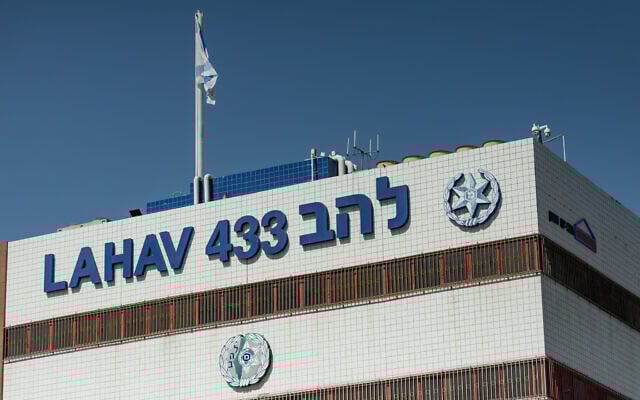
General view of the Israel Police Lahav 433 major crimes unit headquarters in the city of Lod on April 2, 2025. (Chaim Goldberg/Flash90)
Police have been investigating a senior official in the Prime Minister’s Office on suspicion of sexual misconduct for the past several months.
The case was subject to a gag order that expired overnight. Police did not request that the court extend the order, according to Hebrew media reports.
The investigation into the incident in question, said to have taken place around three years ago in a hotel, was launched after information about the sexual misconduct allegations reached police. The alleged victim is refusing to file a formal complaint.
Detectives in the police’s Lahav 433 major crimes unit are struggling to investigate the allegations due to the woman’s reluctance to file a complaint, and are expected to close the case if nothing changes, the Kan public broadcaster reports. The alleged victim is not employed in the PMO.
White House press secretary defends Trump’s insistence that allies help US open Hormuz Strait
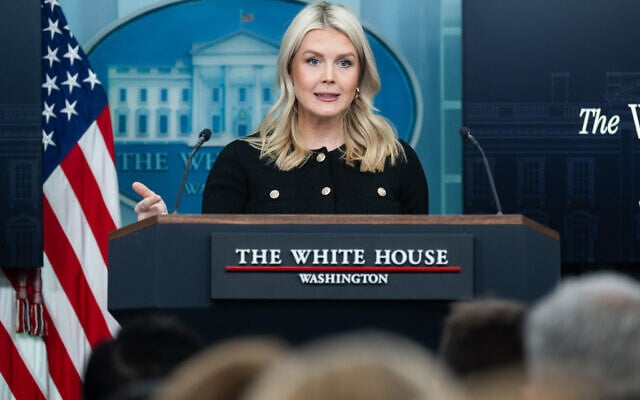
White House Press Secretary Karoline Leavitt speaks during a press briefing in the Brady Press Briefing Room of the White House in Washington, DC, on February 18, 2026. (SAUL LOEB / AFP)
White House press secretary Karoline Leavitt is pressed on US President Donald Trump’s demand that American allies join Washington in ensuring safe passage for ships in the Strait of Hormuz amid Iran’s efforts to block the sea channel, a key artery for the movement of oil, in response to the US-Israeli offensive against Iran.
“These other countries are benefiting greatly from the United States military taking out the threat of Iran,” Leavitt tells reporters outside the White House.
“The rogue Iranian regime has long not just posed a threat to the United States of America, but to our Gulf and Arab partners in the region,” she says, pointing to Iran’s strikes on civilian targets over the past two-plus weeks and noting that Iran’s missiles also have the potential to reach Europe.
Lapid slams government for advancing ‘destructive’ laws in wartime

Opposition Leader Yair Lapid addresses his Yesh Atid party’s weekly faction meeting in the Knesset, March 16, 2026. (Courtesy of Yesh Atid)
Opposition Leader Yair Lapid slams the coalition for advancing controversial, partisan bills during wartime, insisting that while the opposition “will continue to support the security forces,” it will also continue to speak out against the government’s legislative agenda.
The way the coalition is behaving is a “disgrace,” Lapid tells reporters ahead of his party’s weekly faction meeting in the Knesset, arguing that had the Knesset been dealing with compensation for small businesses or the approval of assistance “for reservists and their families, we would come happily, but that’s not why you opened” the Knesset after a period of restricted activity due to the war.
“There is nothing more obvious than the government’s plan, that because of the war we will remain silent, while they dismantle the country. It will not work for them. We will continue to support the security forces, but they will not succeed in silencing us,” he says.
“They keep telling us: ‘Support us,’ ‘Show unity,’ ‘You are not supporting Netanyahu enough,’ and at the same time, without batting an eyelid, without a trace of shame, are putting on the table the most divisive, most polarizing, most destructive laws. The fact that they are bringing these laws in a time of war is disrespect for the people who are sitting in shelters, for the pilots who are operating in Iran, for the fighters in Lebanon,” he says.
After a two-week halt due to the Iran war, parliamentary debate resumed Sunday with the coalition looking to push through a number of controversial bills, including legislation to overhaul the media market, split up the role of the attorney general, and establish a politically appointed panel to probe the failures surrounding the Hamas-led October 7, 2023, attack.
On Thursday, Knesset Speaker Amir Ohana’s office announced plans to increase the amount of activity at the Knesset, paving the way for renewed discussion of controversial legislation.
Prior to Ohana’s announcement, the government appeared to be making some efforts to remove contentious legislation from the agenda, with Prime Minister Benjamin Netanyahu and Finance Minister Bezalel Smotrich stating that they would be shelving several unpopular proposed economic reforms as well as a contentious bill intended to exempt yeshiva students from military conscription.
However, the government also decided, in the middle of the war, to allocate over NIS 5 billion ($1.6 billion) in discretionary coalition funds for Haredi institutions, West Bank settlements and other coalition priorities in the 2026 state budget, generating significant opposition criticism.
Knesset committee advances bill expanding Orthodox control over Western Wall Plaza
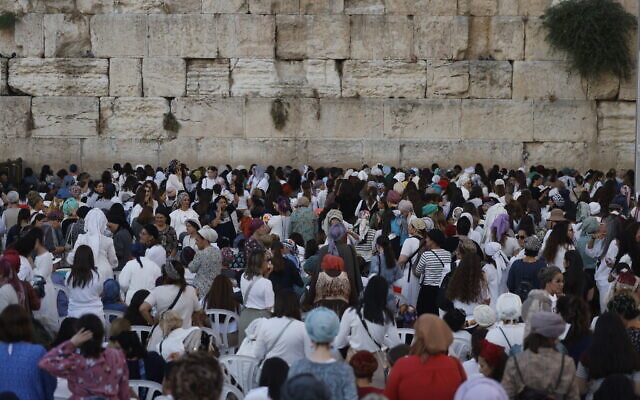
Jewish women pray at the Western Wall, Judaism's holiest prayer site in the Old City of Jerusalem, July 8, 2024. (Chaim Goldberg/Flash90)
The Knesset House Committee votes to send a bill expanding Orthodox control over the Western Wall Plaza to the Constitution, Law and Justice Committee for preparation for its first reading in the Knesset plenum.
The bill, which advanced in a preliminary reading last month, is intended to undercut a recent High Court of Justice ruling that the state must move forward with a planned upgrade of the Western Wall egalitarian plaza, which would improve conditions at a side area used for non-Orthodox prayers at the Jewish holy site.
If passed into law, the bill would give the country’s two chief rabbis, both Orthodox, ultimate authority over Jewish holy sites including the so-called Ezrat Israel, which is used as an egalitarian prayer area, and would define any activity at the site contrary to their instructions, including non-Orthodox worship, as a “desecration.”
The law currently states that desecration of a holy place carries a penalty of seven years in prison.
“In the midst of a war, while Jews of all stripes are fighting for their lives and are in the army, in the reserves, and on the home front, the coalition chooses to promote the Western Wall Law, the he same law that defines those citizens as second-class Jews, the same law that divides the people and harms one of its most unifying symbols,” declares Anna Kislensky of the Reform Movement, which has championed non-Orthodox prayer at the Western Wall.
As antisemitic violence in the Diaspora, where most Jews are not Orthodox, is increasing, “the Israeli government chooses to take advantage of the emergency to tell the Jews of the Diaspora you are not Jewish enough to pray in your own way at the Western Wall,” she adds.
“You have to rub your eyes in disbelief. In the midst of a war, when millions of Israeli citizens are in safe rooms and shelters, the economy is not functioning, the education system is paralyzed and children are sitting at home, and the Western Wall plaza stands empty, the coalition finds it urgent to continue advancing the disgraceful” bill, says the Women of the Wall organization, which has held monthly public women’s prayer services at the Western Wall for decades.
“At a time when we need our sisters and brothers in the Diaspora more than ever to stand with us on the international stage, the State of Israel is spitting in their faces and telling them: your place is not here with us,” Women of the Wall adds.
No injuries reported in latest Iranian missile salvo, medics scanning impact sites
No injuries are reported in Iran’s latest ballistic missile salvo on Israel, the fifth since midnight.
Magen David Adom says its medics are scanning sites where impacts were reported. It is not immediately clear if the reports refer to direct missile impacts, submunitions from a cluster bomb warhead, or falling fragments following interceptions.
Sirens sounded across the Jerusalem area and parts of the south amid the attack.
New Iranian missile launch detected, sirens set to sound in Jerusalem area, central Israel
The IDF says it had detected a new ballistic missile launch from Iran.
Sirens are expected to sound in the Jerusalem area and central Israel in the coming minutes.
‘Kill a Jew, go to heaven’ graffiti scrawled in large NYC park
Graffiti that says, “Kill a Jew, go to heaven,” is scrawled on a boulder in Riverside Park on Manhattan’s Upper West Side.
Micah Lasher, who is Jewish and represents the area in the New York State Assembly, says the NYPD and Parks Department are investigating and removing the threat from the New York City park.
“This is in the park where I raised my kids, in one of the most Jewish neighborhoods in the city,” Lasher, who is running for Congress, says.
I share this appalling message reluctantly, but it is important for people to see the kind of antisemitic hate that has become commonplace. This is in the park where I raised my kids, in one of the most Jewish neighborhoods in the city. My thanks to the NYPD and the Parks… pic.twitter.com/QAgyVJoDMF
— Micah Lasher (@MicahLasher) March 15, 2026
The graffiti comes as anti-Israel activist rhetoric has become increasingly extreme, Diaspora Jews contend with regular threats and violent incidents, and Jews in New York City continue to be targeted in hate crimes far more than any other group in the city.
Swastika graffiti also regularly appears on streets on the Upper West Side, a historically Jewish neighborhood.
Also, over the weekend, graffiti in San Jose, California, called for the “eradication of Jews” and said, “Kill all Jews.”
https://abc7news.com/post/san-jose-state-investigating-graffiti-found-campus-calling-eradication-jews/18711774/
UAE says it intercepts 6 Iranian missiles, 21 drones today
The United Arab Emirates has intercepted 6 ballistic missiles and 21 drones launched by Iran today, according to the Emirati defense ministry.
According to the UAE defense ministry, it has intercepted 304 ballistic missiles, 15 cruise missiles and 1,627 UAVs throughout the war.
The number of missiles and drones Iran has fired at the UAE has declined dramatically since the war broke out on February 28.
Impt infographic from @TheStudyofWar and @AEI pic.twitter.com/6A6le32BS5
— Lazar Berman (@Lazar_Berman) March 16, 2026
Gantz backs talks with Lebanon and combat against Hezbollah, slams controversial Knesset bills
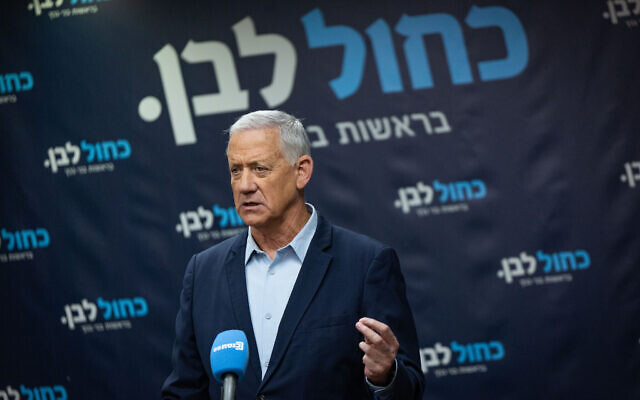
Blue and White leader Benny Gantz leads a faction meeting at the Knesset in Jerusalem, February 9, 2026. (Yonatan Sindel/Flash90)
Blue and White chairman Benny Gantz slams the coalition for advancing controversial, partisan legislation in the middle of a war, telling reporters that “we win in Tehran and lose in Jerusalem.”
“Instead of focusing on dismantling the regime in Tehran, the Knesset is busy splitting the role of the attorney general,” he says, referring to one of the coalition’s contentious bills, ahead of his opposition party’s weekly faction meeting in the Knesset.
“Instead of only dealing with keeping Hezbollah away from the border, we are dealing with laws that will keep Jews away from the Western Wall,” he adds. “Instead of providing a solution for people living in shelters in the north, we are dealing with giving benefits to television channels that are close to the government.”
Turning to the conflict with the Hezbollah terror group in the north, Gantz says that he supports “direct negotiations with the Lebanese government but it must take place under continued military pressure on Hezbollah [and] until Hezbollah is dismantled we must continue ourselves dismantling it militarily.”
“If the Lebanese government wants to take responsibility, recognize the State of Israel, and dismantle Hezbollah, it is more than welcome,” Gantz adds.
“As someone who served 22 years in Lebanon and was the last soldier to leave the security zone by government decision, I call on the government to not evacuate a single Israeli community, but rather evacuate all of Southern Lebanon,” he adds, insisting that “if we proceed with full military determination and diplomatic wisdom normalization is achievable within months alongside security for the people of Northern Israel.”
Earlier today, the IDF announced a “targeted” ground operation in southern Lebanon.
Netanyahu mingles with public in 2nd video after conspiracy theories about his death
After releasing a video yesterday mocking conspiracy theories that he had been killed in an Iranian strike, Prime Minister Benjamin Netanyahu posts a 90-second video showing him interacting with the public at an outlook in the Jerusalem Hills.
The video appears to have also been filmed yesterday, as Netanyahu is near the coffee shop in which the first video was filmed, and is wearing the same outfit.
He stresses the importance of getting out of the house for fresh air, quizzes bystanders on where the closest shelter is and urges patience as the war with Iran goes on.
שומרים על ההנחיות ומנצחים ביחד >> pic.twitter.com/HC5w3PqKuV
— Benjamin Netanyahu – בנימין נתניהו (@netanyahu) March 16, 2026
Liberman: Netanyahu government ‘incapable’ of victory over Iran or Hezbollah
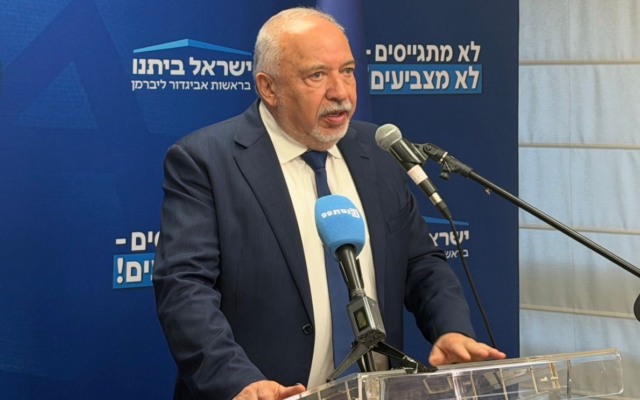
Yisrael Beytenu chairman Avigdor Liberman addresses a faction meeting in the Knesset, March 16, 2026. (Courtesy of Yisrael Beytenu)
Prime Minister Benjamin Netanyahu’s government is “incapable” of achieving Israel victory over Iran or Hezbollah, asserts Yisrael Beytenu chairman Avigdor Liberman.
Israel is “two-and-a-half years into the war and still all the fronts against Iran, Hamas and Hezbollah are open,” the opposition party leader tells reporters ahead of his party’s weekly faction meeting in the Knesset. Referring to the Hamas-led onslaught, he says, “The October 7 government is taking us back to the starting point.”
“Where is the ‘absolute victory’ against Hamas? We are seeing the same ‘absolute victory’ these days in the north as well. We must clearly redefine the goals of the war: overthrowing the regime in Iran and eliminating Hezbollah. This government is simply incapable of doing this,” he says.
‘Not our war’: German defense minister rejects Trump’s call for military support against Iran
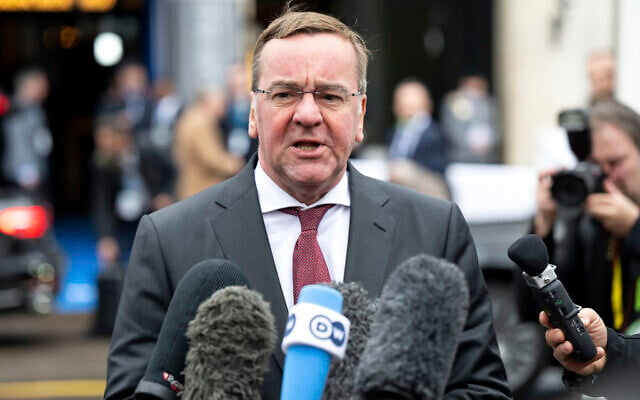
German Defense Minister Boris Pistorius speaks during a press statement in front of the Bayerischer Hof hotel, home of the Munich Security Conference, in Munich, Germany, February 17, 2023. (Sven Hoppe/dpa via AP)
German Defense Minister Boris Pistorius rejects demands by US President Donald Trump for military support in the US-Israeli war against Iran and downplays threats that such a stance by allies would hurt the NATO alliance.
“What does (…) Donald Trump expect a handful or two handfuls of European frigates to do in the Strait of Hormuz that the powerful US Navy cannot do?” he says in Berlin. “This is not our war, we have not started it.”
Asked about Trump’s warning that NATO faces a “very bad” future if its members fail to come to Washington’s aid, Pistorius says he does not anticipate NATO to fall apart over these differences.
US ‘fine’ with some ships getting through Strait of Hormuz, Bessent says

US Secretary of the Treasury Scott Bessent gives remarks during a roundtable meeting at the US Treasury Department on May 29, 2025 in Washington, DC. (Anna Moneymaker/Getty Images/AFP)
The United States is “fine” with some Iranian, Indian and Chinese ships going through the Strait of Hormuz for now, US Treasury Secretary Scott Bessent says, adding that any action to mitigate higher energy prices would depend on how long the Iran war lasts.
“We are seeing more and more of the fuel ships start to go through. The Iranian ships have been getting out already, and we’ve let that happen to supply the rest of the world. We’ve seen Indian ships go out now … we believe some Chinese ships have gone out,” he tells CNBC in an interview.
“That should start ramping up before there are any of the flotillas or protective armadas in the Gulf. So we think that there will be a natural opening that the Iranians are letting out. And for now, we’re fine with that. We want the world to be well supplied,” Bessent says.
Asked if there were any tools the Trump administration would use to mitigate higher prices and impacts from the war outside of oil reserve releases, Bessent tells CNBC “it will depend on the duration of the conflict.”
Hamas holds talks with Trump’s Board of Peace as Iran war strains Gaza plan — Reuters
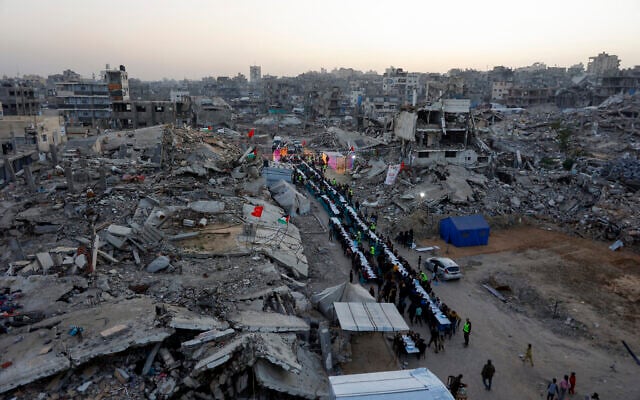
Palestinians gather for a mass fast-breaking iftar meal organized by the Turkish IHH Foundation, amid the rubble of destroyed buildings in Gaza City on February 18, 2026. (Omar AL-QATTAA / AFP)
Envoys from US President Donald Trump’s Board of Peace have met representatives of Hamas in Cairo in an effort to safeguard the Gaza ceasefire, under serious strain since the US and Israel launched a war with Iran, three sources tell Reuters.
The weekend meeting is the first publicly reported since the start of the Iran war between the terror group, which is backed by Tehran, and the board, which is chaired by Trump and has been tasked with overseeing postwar Gaza.
Following the meeting, Israel announced yesterday that it would soon reopen the sole crossing for pedestrians between Gaza and Egypt, shut since the Iran campaign began. One of the sources says he believes the Israeli announcement was a direct result of the meeting between Hamas and the board.
Prior to the war in Iran, Trump’s plan for Gaza was his flagship initiative for the Middle East.
The sources say the Hamas representatives warned the board that the terror group could back away from its previous promises under the Gaza ceasefire if Israel maintains new restrictions on Gaza imposed during the Iran war.
Israel shut Gaza’s borders after the war’s launch on February 28, saying crossings could not be operated safely. It later resumed the limited flow of goods and aid but kept shut the sole crossing for pedestrians into Egypt, at Rafah. Yesterday it announced it would reopen the crossing later this week following a “security assessment.”
Reuters has previously reported that talks on the disarmament of Hamas – meant to be a focus of the next phase of Trump’s plan – have been on hold since the start of the Iran war.
One of the sources says Trump’s board was represented at the talks with Hamas by Aryeh Lightstone, an American aide to Trump’s special envoy Steve Witkoff. The other two sources say meetings that included Lightstone were on the agenda although they are unable to confirm whether Lightstone had attended yet.
Further meetings are expected this week. The sources spoke on the condition of anonymity because they are not authorized to speak publicly.
A US official says Lightstone had attended Gaza-related meetings in Cairo in the past several days, without confirming whether he met with the Hamas delegation. US negotiators are continuing to meet with regional partners to fulfil Trump’s 20-point plan for Gaza, the US official adds.
Israel’s government does not immediately respond to a request for comment on whether its decision to reopen the Rafah crossing was a result of the Cairo meeting. Hamas declines to comment.
Times of Israel staff contributed to this report.
Smotrich urges parents to send kids back to school, says it won’t affect government stipends

Finance Minister Bezalel Smotrich of Religious Zionism leads a faction meeting at the Knesset in Jerusalem, January 19, 2026 (Yonatan Sindel/Flash90)
Finance Minister Bezalel Smotrich calls on parents who are allowed to do so to send their children back to school following two weeks when classrooms were shuttered due to the Iran war.
He reassures several regional councils in the south that the reopening of schools in their districts will not impact the local residents’ eligibility to receive government stipends meant for those who were prevented from working due to the war.
Beginning today, schools in areas deemed at lower risk from missile fire were allowed to open, provided they have protected areas where students can shelter while under attack from Iran or Hezbollah. Schools elsewhere, including in major cities such as Jerusalem, Tel Aviv and Haifa, remain closed.
According to the Maariv daily, local governments reached out to Smotrich to express concern that the reopening of schools could negatively impact such benefits, leading the minister to reply in a letter that “the return of students to school will not harm the parents’ economic rights. Their entitlement to compensation is fully preserved.”
He further calls on parents “to send their children to educational institutions, in accordance with the Home Front Command’s instructions, with full confidence that their economic rights are guaranteed and protected.”
Several cities and towns, including the coastal city of Ashkelon, the settlement of Ariel in the West Bank, and the southern city of Dimona, had announced they would not reopen schools today, despite being allowed to do so under Home Front Command guidelines.
IDF says it destroyed Iranian space facility that worked on ‘attacking satellites’

Illustration: This handout picture taken and released by the Russian space agency Roscosmos on July 25, 2025, shows a rocket booster with a number of satellites, one belonging to Iran, blasting off in far eastern Russia. (Russian Space Agency Roscosmos/AFP)
The IDF says it struck and destroyed an Iranian space facility in Tehran that was used by the regime to develop “capabilities for attacking satellites.”
The site was used to develop various military space programs, including the Chamran-1 satellite, as well as “capabilities to strike satellites, posing a threat to the State of Israel’s satellites and to space assets of other countries around the world,” the military says.
Artillery attack on Yemen village kills at least 10, government blames Houthis
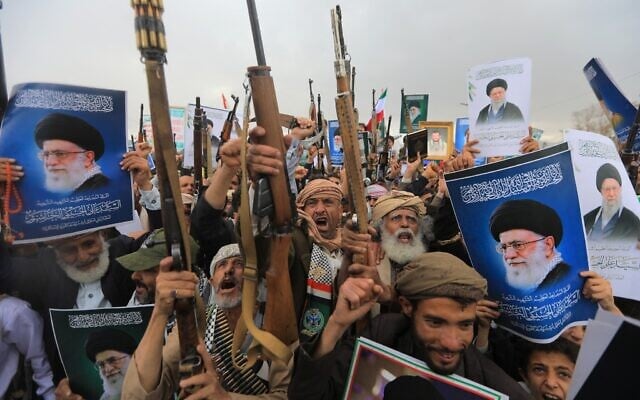
Houthi supporters brandish rifles and chant slogans during a rally in solidarity with Iran and Lebanon, amid the US-Israeli conflict with Iran, in the Yemeni capital Sanaa on March 6, 2026. (Mohammed HUWAIS / AFP)
An artillery attack on a village in northern Yemen killed at least 10 people, including six children, and wounded more than 30 others, officials say, as the government blamed the Iran-backed Houthi terror group for the shelling.
The Houthis targeted a group of people gathered for iftar, the evening meal that breaks the daily fast during the Muslim holy month of Ramadan, in Hajjah province, according to the country’s Information Ministry. The province is mostly controlled by the Houthis, but some areas are held by Yemen’s internationally recognized government that is based in Aden.
The circumstances of the attack yesterday are unclear and Houthi officials decline to comment.
The Information Ministry says in a statement that the death toll is likely to rise and several among the wounded are in critical condition.
Fighting between the Houthis and government forces has also covered Hajjah since Yemen plunged into civil war in 2014, when the Houthis seized the capital, Sanaa, and much of northern Yemen and forced the government into exile. A Saudi-led coalition, including the United Arab Emirates, intervened the following year in an attempt to restore the government to power.
The conflict has pushed the economy to the brink of collapse and caused “severe” food insecurity in northern provinces, including Hajjah, according to the World Food Program.
Amsterdam police probe new blast claimed by same group that claimed Jewish school explosion

A police car parked outside a Jewish school in Amsterdam, where an explosion was reported overnight, March 14, 2026. (Stéphanie HAMEL / AFP)
Dutch police are investigating an explosion that damaged an office building in Amsterdam and was claimed by the same extremist organization that claimed it was behind a recent blast at a Jewish school in the area, a police spokesperson says.
It is not immediately clear if the building has a link to Amsterdam’s Jewish community.
Officers are investigating the explosion, which led to a small fire that was quickly extinguished by security guards and caused minor damage, the spokesperson says, adding that police are examining whether the two incidents were indeed linked.
Sienna Investment Managers, which manages the building, does not immediately reply to an emailed request for comment.
Saturday’s explosion, for which the same group claimed responsibility, caused minor damage to a Jewish school. Amsterdam Mayor Femke Halsema and Dutch Prime Minister Rob Jetten condemned the attack.
Germany warns major Israeli ground campaign in Lebanon would worsen humanitarian situation
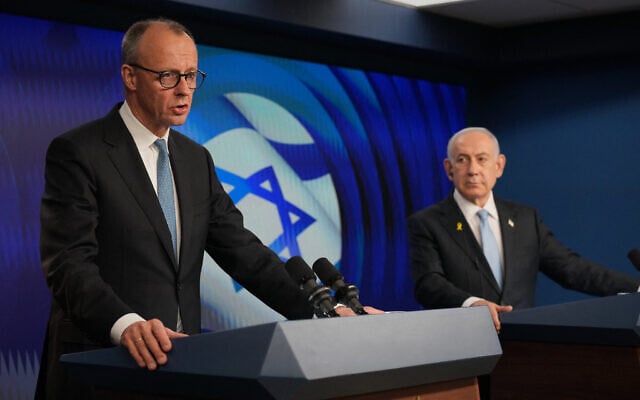
German Chancellor Friedrich Merz (left) speaks during a joint press conference with Israeli Prime Minister Benjamin Netanyahu in Jerusalem on December 7, 2025. (Ariel Schalit/POOL/AFP)
Germany is enormously concerned by the developments in Lebanon, says a government spokesperson in Berlin, and warns that a major Israeli ground offensive there would significantly worsen the already tense humanitarian situation in the region.
“A glance at this part of the war zone fills us with concern because we see preparations for a major Israeli ground offensive, which would significantly worsen the already tense humanitarian situation in the region,” says the spokesperson.
The spokesperson adds that Germany welcomed efforts to restart talks between Israel and Lebanon.
Earlier today, the Israel Defense Forces announced a “targeted” ground operation amid its conflict with Hezbollah, to expand the buffer zone Israel holds in south Lebanon.
Katz on Lebanon ground op: Displaced Lebanese ‘won’t return home’ until north Israel is safe
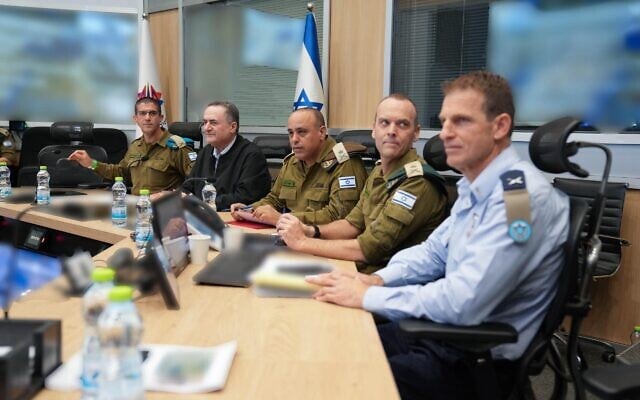
Defense Minister Israel Katz (2nd L) holds an assessment at the Kiriya in Tel Aviv on March 16, 2026 (Ariel Hermoni/Defense Ministry)
Defense Minister Israel Katz says the targeted ground operation in south Lebanon that the IDF announced today will continue until the Hezbollah terror group no longer poses a threat to the residents of northern Israel.
The comments come hours after the IDF announced it had begun a “targeted ground operation against key targets” in southern Lebanon, pushing more forces deeper into the area as part of an expanded buffer zone after Hezbollah began attacking Israel earlier this month amid the war with Iran.
Katz adds that the operation in south Lebanon is meant to resemble the military’s operations in Gaza during its two-year war against Hamas.
“The IDF has begun a ground maneuver in Lebanon to remove threats and protect the residents of the Galilee and the north,” Katz says in a statement after holding an assessment with military brass. “Hundreds of thousands of Shiite residents of south Lebanon who have evacuated and are evacuating from their homes will not return to the area south of the Litani [River] until the safety of the residents of the north is guaranteed.”
Katz says that he and Prime Minister Benjamin Netanyahu have told the military to destroy terror infrastructure close to the border in order to prevent Hezbollah’s return, “just as was done against Hamas in Rafah, Beit Hanoun and the terror tunnels in Gaza.”
The defense minister vows to restore a sense of security to the residents of northern Israel, saying that Hezbollah leader Naim Qassem is hiding underground as his actions make over a million Lebanese “refugees in their own country.”
He threatens that if the Hezbollah chief misses his predecessor Hassan Nasrallah, and former Iranian supreme leader Ali Khamenei, both of whom were killed by Israel, “he will soon be able to meet them in the depths of hell.”
Hezbollah will pay a “heavy price” for its efforts to destroy Israel, Katz says.
Qatar says diplomacy with Iran possible ‘if they stop the attacks’
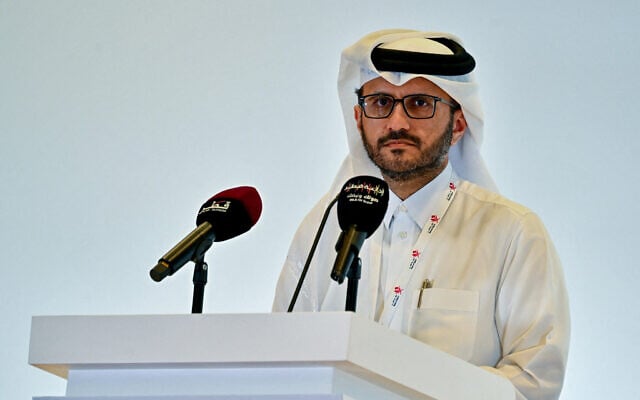
Qatar's Foreign Mininstry spokesperson Majed al-Ansari looks on at a press conference during the 2025 Arab-Islamic emergency summit in Doha on September 15, 2025. (Mahmud HAMS / AFP)
Diplomatic talks with Iran are only possible if it ceases its attacks, Qatar’s foreign ministry spokesman says, as Tehran presses its missile and drone campaign against Gulf states.
“If they stop the attacks, then we can find a way out with diplomacy. But as long as our countries are being attacked, this is not the time to establish committees, it’s the time to take a very principled position [on] protecting our countries and for them to stop attacking us immediately,” Qatar’s foreign ministry spokesman Majed al-Ansari says.
Limit on number of passengers is lifted for Israeli airlines flying to North America

An El Al plane takes off at Ben Gurion International Airport, outside of Tel Aviv, March 5, 2026. (Yossi Aloni/Flash90)
Beginning today, Israeli airlines flying from Tel Aviv’s Ben Gurion Airport to North America will not have to limit the number of passengers per flight.
The Transportation Ministry approves a directive permitting Israeli airlines to operate flights to North America at full seat capacity until further notice, lifting the previous limit of 100 passengers per flight. The directive applies to El Al, Israir, Arkia, and Air Haifa.
The 100-seat limit remains in place for flights from Ben Gurion to other destinations.
The ministry emphasizes that the operation of flights to North America remains subject to the schedule determined by Ben Gurion Airport, and is contingent on the guidelines of the Home Front Command.
Israel is also assessing the possibility of easing passenger limits on flights from the country to destinations in Europe. The Transportation Ministry is considering increasing the capacity on outbound flights using narrow-body aircraft to Europe to about 170 passengers.
The move comes after El Al, Israel’s flagship carrier, launched special flights today to help thousands of US citizens stranded in the country since the outbreak of the Iran war on February 28 return home.
As part of an agreement with the US State Department and the US Embassy in Jerusalem, El Al will operate six non-stop flights from Tel Aviv to New York designated exclusively for US citizens. The flights will depart at full capacity.
Starmer: UK working with allies on ‘viable’ plan to reopen Hormuz, won’t enter ‘wider war’
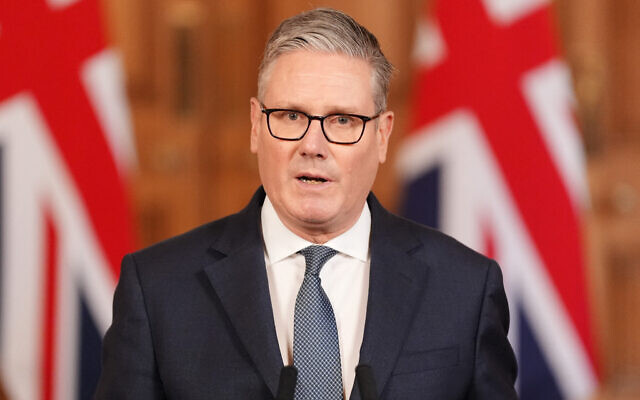
Britain's Prime Minister Keir Starmer speaks from Downing Street in central London on February 28, 2026, following the US and Israel's strikes on Iran. (Jonathan Brady / POOL / AFP)
UK Prime Minister Keir Starmer says Britain is working with allies to come up with a “viable” plan to reopen the Strait of Hormuz, the vital oil conduit effectively shut by Iran in its war with Israel and the US.
“We’re working with all of our allies, including our European partners, to bring together a viable collective plan that can restore freedom of navigation in the region as quickly as possible and ease the economic impacts,” Starmer tells reporters, adding he has discussed the situation with US President Donald Trump.
The UK leader adds that while Britain was “taking the necessary action to defend ourselves and our allies, we will not be drawn into the wider war.”
Less than 50% of students in areas where schools allowed to reopen are back in class

Education Minister Yoav Kisch attends a joint meeting of the Education, Culture and Sports Committee, the Welfare Committee, and the Committee on the Rights of the Child at the Knesset in Jerusalem, January 26, 2026. (Yonatan Sindel/Flash90)
On the first day when some Israeli schools have been allowed to reopen following two weeks of closure due to the war, less than half of eligible students have returned to classrooms, according to Education Ministry data.
Beginning today, schools in areas deemed at lower risk from missile fire were allowed to open, provided they have protected areas where students can shelter while under attack from Iran or Hezbollah. Lower-risk areas are marked “yellow” according to a government color-coding system.
Of the 365,000 students who live in “yellow” regions, 173,000, or 47 percent, have returned to in-person classes.
The yellow areas include the Beit She’an Valley, Jordan Valley, West Bank, Dead Sea area, Ashkelon area, Gaza border communities and other areas in southern Israel.
After the HFC’s latest assessment on Saturday night, several municipalities announced they would not reopen schools yet, including Ashkelon, Dimona, and the West Bank settlement of Ariel.
“Many thousands of students in municipalities classified as ‘yellow’ have already returned to educational institutions today,” says Education Minister Yoav Kisch. “This marks a first step in a gradual and responsible process.”
“The next step for the education system will be to approve an ad-hoc plan to allow special education frameworks to operate under a safe framework throughout the country,” he adds.
Schools in major cities including Jerusalem, Tel Aviv and Haifa remain closed.
Iran’s FM: Tehran has not requested ceasefire, end to war must be definitive
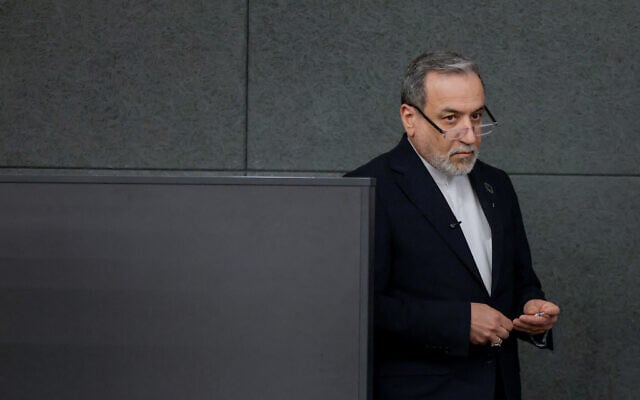
Iran's Foreign Minister Abbas Araghchi looks on after he delivered a speech during a session of the United Nations Conference on Disarmament, on the sideline of a second round of US-Iranian talks with Washington in Geneva, on February 17, 2026. (Valentin Flauraud / AFP)
Iran has not requested a ceasefire, Foreign Minister Abbas Araghchi says, according to the semi-official Students News Network, and wants to ensure that any end to the war with Israel and the US is definitive.
Araghchi says that the Strait of Hormuz is only closed to “enemies and those supporting their aggression.”
A foreign ministry spokesperson adds that states not party to the war have been able to transit their vessels through the strait with coordination and permission from Iran’s armed forces.
German foreign minister does not see role for NATO in Strait of Hormuz; Denmark weighs helping

German Foreign Minister Johann Wadephul addresses a joint press conference with the Lithuanian Foreign Minister at the Ministry of Foreign Affairs in Vilnius, Lithuania, January 5, 2026. (Petras Malukas / AFP)
Germany does not see a role for the NATO alliance, which includes the United States, in addressing the blockade of the Strait of Hormuz, German Foreign Minister Johann Wadephul says in Brussels.
“I don’t see that NATO has made any decision in this direction or could assume responsibility for the Strait of Hormuz. If that were the case, then the NATO bodies would address it accordingly,” says Wadephul ahead of a meeting of the EU Foreign Affairs Council.
US President Donald Trump ratcheted up pressure on European allies to help protect the strait, warning that NATO faces a “very bad” future if its members fail to come to Washington’s aid.
Denmark’s foreign minister, meanwhile, says the country must consider, with an open mind, how it can contribute to enabling sailings in the strait.
No injuries reported in latest Iranian missile attack
No injuries are reported in Iran’s latest ballistic missile salvo on Israel, the fourth since midnight.
A small number of missiles were launched, which were likely intercepted or struck open areas, according to initial military assessments.
Sirens had sounded across northern Israel and the Jerusalem area amid the attack.
New Iranian missile launch detected, sirens set to sound in Jerusalem area
As sirens sound in northern Israel amid an Iranian ballistic missile attack, an early warning is issued in the Jerusalem area as another Iranian launch is detected by the IDF.
Iranian women’s soccer team to depart Malaysia for Oman after asylum reversal
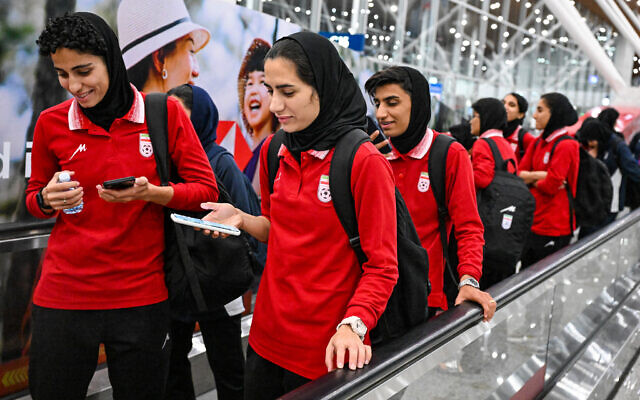
Members of Iran's women's soccer team arrive at the Kuala Lumpur International Airport after taking part in the AFC Women's Asian Cup Australia 2026 tournament in Australia, in Sepang, Malaysia, on March 11, 2026. (Mohd RASFAN / AFP)
The Iranian women’s soccer team is set to leave Malaysia tonight, ending days of uncertainty after most of the seven squad members who sparked a diplomatic furor by seeking asylum in Australia reversed their decisions and rejoined the team in Kuala Lumpur.
Asian Football Confederation general secretary Windsor John tells The Associated Press that the team’s departure is arranged by the Iranian embassy. He said the AFC, which is supporting the Iranian team in Kuala Lumpur, has been told they are flying to Oman but that isn’t their final destination. He says he isn’t aware of their full travel plans.
Asked if the confederation is satisfied that the women will be safe back in Iran, Windsor says both the AFC and FIFA will check up on them regularly with the Iranian football federation “as they are our girls as well.”
The squad flew from Sydney to Kuala Lumpur on March 10 after being knocked out of the Women’s Asian Cup in Australia, initially leaving behind six players and a support staff member who had accepted protection visas.
Four players and the staffer have since rejoined the team in Kuala Lumpur, the latest flying in today. No reasons have been given for the changes of heart. The Iranian diaspora in Australia blames pressure from Tehran.
Windsor said at a news conference earlier that his confederation had not received any direct complaints from players about returning home, despite media reports their families in Iran could face retaliation for the team failing to sing their national anthem before the opening match.
Two team members remain in Australia,
Australian Assistant Immigration Minister Matt Thistlethwaite describes the women’s plight in Australia as a “very complex situation.”
“These are deeply personal decisions, and the government respects the decisions of those that have chosen to return. And we continue to offer support to the two that are remaining,” Thistlethwaite says.
Those who have stayed in Australia have been moved to an undisclosed safe location and are receiving assistance from the government and the Iranian diaspora community, he says.
New Iranian missile launch detected, sirens set to sound in northern Israel
The IDF says it had detected a new ballistic missile launch from Iran.
Sirens are expected to sound in northern Israel in the coming minutes.
1 in 5 UK university students ‘reluctant’ to share house with Jewish student — poll
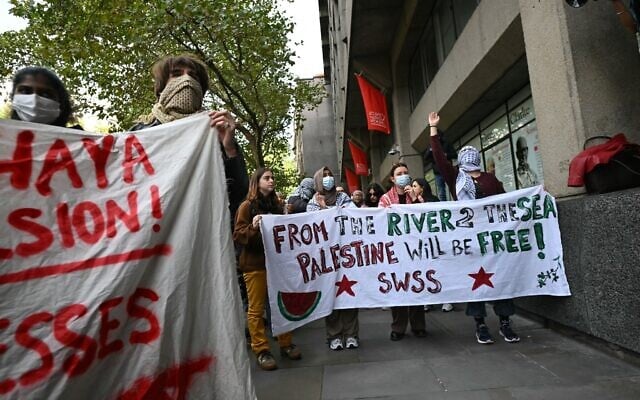
Pro-Palestinian and anti-Israel student protesters outside King's College London during an inter-university march for Gaza in London on October 7, 2025, the second anniversary of the deadly Hamas-led attack on Israel which launched the Israel-Hamas war in Gaza. (JUSTIN TALLIS / AFP)
One in five university students in the UK would be “reluctant” to share a house with a Jewish student or would never do so, according to a new poll commissioned by the British Union of Jewish Students.
The poll was conducted by JL Partners between January 26 and February 4, and polled a representative sample of 1,000 UK university students who study at 170 institutions. It does not give a margin of error.
The survey finds that nearly one in four respondents (23 percent) have seen behavior that targets Jewish students for their religion or ethnicity. Almost four in 10 (39%) who “witness regular Israel-Palestine protests” have seen frequent harassment of Jewish students, according to the poll.
In addition, close to half have heard chants or slogans “glorifying Hamas, Hezbollah or other proscribed groups on campus” (49%) or seen justification of the October 7, 2023, attack led by Hamas (47%), the poll says.
A large majority (82%) say calls to “Globalize the intifada” are antisemitic.
The poll found that most students say protests have disrupted their learning, and disapprove of demonstrations that block access to learning.
Air Force launches ‘extensive’ strikes targeting Iranian regime infrastructure — IDF
The Israeli Air Force has launched a new wave of “extensive” airstrikes in Tehran, Shiraz, and Tabriz, the IDF announces.
The military says the strikes are targeting Iranian regime infrastructure sites.
Shin Bet chief’s brother, 4 others released to house arrest in Gaza smuggling case
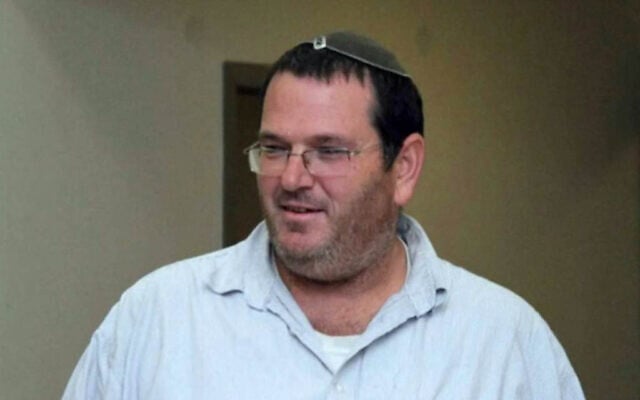
Bezalel Zini. (Facebook, used in accordance with Clause 27a of the Copyright Law)
Smuggling suspect Bezalel Zini, the brother of Shin Bet chief David Zini, is released to house arrest alongside four others following a decision by the Supreme Court rejecting the prosecution’s appeal to extend their remand.
The State Attorney’s Office filed an appeal in the Supreme Court last week against the Beersheba District Court’s decision to release Zini and the other suspects implicated in a Gaza smuggling ring. The suspects are alleged to be responsible for trafficking cigarettes and other prohibited goods into the enclave.
In order to keep a suspect in custody prior to conviction, a judge must find that there is a high probability that the individual poses a danger to others or is liable to obstruct legal proceedings if released.
Presiding Supreme Court judge Gila Canfy-Steinitz casts doubt in her ruling on the notion that Zini and the other suspects pose a public safety risk, claiming there are flaws in prosecutors’ attempts to attribute the offense of assisting the enemy during wartime to the defendants, according to a Ynet report.
She reportedly notes that prosecutors have not accused the defendants of direct contact with Hamas or provided evidence that the smuggled goods or their monetary value ever reached the Gaza-based terror group.
Zini, an IDF reservist who headed logistics for forces doing demolition work in Gaza, is suspected of abusing his access to the enclave to smuggle 14 crates of cigarettes from Israel into Gaza on three occasions, earning a total of NIS 365,000 ($117,405). He was indicted in February alongside two others, including a fellow reservist, on charges of assisting the enemy during wartime, fraud and bribery.
A day prior to Zini’s indictment, 12 others, allegedly part of the same larger smuggling network, were charged after allegedly trafficking goods into Gaza on 15 separate occasions.
With the Supreme Court’s ruling today, all suspects implicated in the smuggling ring are set to remain in house arrest until a verdict is issued in the case.
142 people taken to hospital over past 24 hours as result of war, Health Ministry says

Patients and medical staff are seen in an underground parking area converted into a treatment ward at Ichilov Hospital in Tel Aviv, March 8, 2026. (Chaim Goldberg/Flash90)
The Health Ministry reports that over the past 24 hours, 142 injured people have been taken to hospitals as a result of the conflict with Iran.
Among those treated in hospitals, three are in moderate condition, and 134 are in good condition. Five have been treated for anxiety.
The ministry does not give a breakdown of the causes of injuries, and some may be sustained by people trying to reach shelter rather than as a direct result of missile fire from Iran or rocket fire from Lebanon.
The ministry says that since the beginning of the war with Iran on February 28, 3,369 people have been admitted to hospitals, 81 of whom are currently hospitalized.
Among those hospitalized, one person is in critical condition, seven are in serious condition, 14 are in moderate condition, and 59 are in good condition.
The ministry’s figures include both civilians and soldiers.
Woman lightly injured, taken to hospital after Iranian missile attack on central Israel
A woman is lightly injured as a result of Iran’s ballistic missile attack on central Israel, medics say.
Magen David Adom says it is taking a woman in her 30s to a hospital after she sustained minor trauma wounds.
Several impact sites were reported across central Israel, apparently from cluster bomb munitions from the Iranian missile.
Home in central Israel damaged by apparent Iranian cluster bomb attack
Damage was caused to a home in a central Israeli town by an apparent Iranian cluster bomb munition, following Iran’s latest ballistic missile attack, footage shows.
Multiple impact sites were reported across central Israel, with no injuries, according to rescue services.
Damage was caused to a home in a central town by an apparent Iranian cluster bomb munition.
Multiple impact sites were reported across central Israel, with no injuries. pic.twitter.com/2y9dg2Dj1j
— Emanuel (Mannie) Fabian (@manniefabian) March 16, 2026
China says it is communicating with all sides about the Strait of Hormuz

China's Foreign Minister Wang Yi arrives at the Munich Security Conference in Munich, Germany, February 13, 2026. (AP Photo/Michael Probst)
China is in communication “with all sides” about the situation in the Strait of Hormuz, the foreign ministry says, reiterating the country’s call for a de-escalation of the Middle East conflict.
At a regular press briefing, the ministry is asked if China has received any request from US President Donald Trump to assist in ensuring the security of the Strait, a vital artery for global energy shipments. Trump has called on other countries to help open the strait, which has been effectively closed by Iran.
“We are in communication with all parties on the current situation and are committed to promoting the easing and cooling down of the situation,” ministry spokesperson Lin Jian tells reporters.
Lin says China again urges all sides to cease fighting immediately to prevent escalation and broader economic fallout.
Fire erupts in UAE’s Fujairah oil industry zone after drone attack
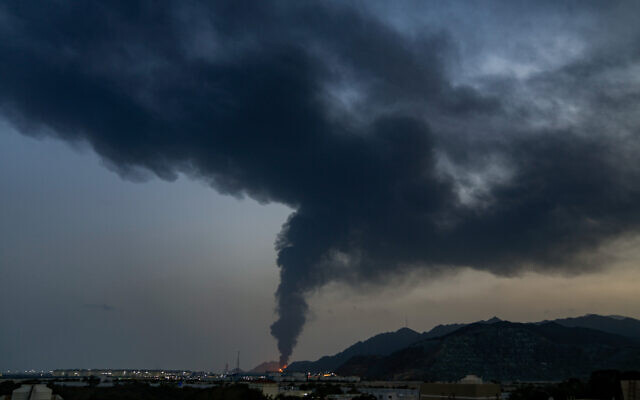
Illustration: Fire and a plume of smoke is visible after, according to authorities, debris of an Iranian intercepted drone hit the Fujairah oil facility, in Fujairah, United Arab Emirates, March 3, 2026. (Altaf Qadri/AP)
A drone attack on oil infrastructure on the UAE’s east coast sparks a fire, authorities say, as Iran presses its campaign of strikes against Gulf states.
“A large fire broke out in the Fujairah Oil Industries Zone as a result of being targeted by a drone, with no injuries reported,” Fujairah authorities say, adding “efforts continue to bring it under control.”
The site sits on the UAE’s Gulf of Oman coast, beyond the Strait of Hormuz, which has effectively been closed by Iran.
2 impacts from suspected Iranian cluster bomb in central Israel, no injuries reported
The Iranian ballistic missile fired at Israel a short while ago may have carried a cluster bomb warhead, according to rescue services.
At least two impacts are reported in central Israel, possibly caused by cluster bomb munitions or other falling fragments.
There are no immediate reports of injuries in the attack, the third since midnight, which set off sirens across central Israel.
Iran issues threats to USS Ford strike group, regime-linked media report
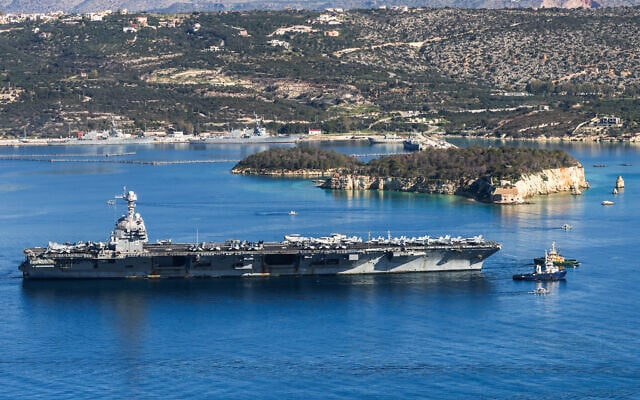
The US Navy aircraft carrier USS Gerald R. Ford, dispatched to the region amid tensions with Iran, departs Souda Bay on the Greek island of Crete on February 26, 2026. (Costas METAXAKIS / AFP)
Logistics and service centers enabling the USS Gerald Ford aircraft carrier to remain operational are considered to be targets by Iran, the spokesperson for the Iranian military’s unified command, Khatam al-Anbiya, says.
“Aircraft carrier Gerald Ford in the Red Sea is a threat to Iran. Accordingly, the logistics and service centers for USS Ford strike group are considered to be targets,” Ebrahim Zolfaqari says in a video shared by the semi-official Fars news agency.
IDF says it destroyed former Iranian leader Ali Khamenei’s plane at Tehran airport
The Israeli Air Force struck and destroyed the aircraft of former Iranian supreme leader Ali Khamenei at Tehran’s Mehrabad Airport overnight, the military says.
The IDF says the plane had been used by Khamenei and other top Iranian officials “to advance military procurement and manage relations with axis countries through domestic and international flights.”
The military adds that the destruction of the “strategic asset” is a blow to Iran’s “coordination capabilities” with proxy groups, its “building of military power, and the regime’s rehabilitation capabilities.”
חיל-האוויר השמיד את מטוסו של מנהיג משטר הטרור האיראני בשדה התעופה ״מהאראבד״ שבטהרן – המטוס שימש את עלי ח׳אמנהאי, מנהיג משטר הטרור האיראני, בכירים נוספים ממשטר הטרור וגורמים בצבא איראן, לקידום רכש צבאי ולניהול קשרים עם מדינות הציר באמצעות טיסות פנים וחוץ.
השמדת המטוס פוגעת… pic.twitter.com/lOtRRIHTff
— Israeli Air Force (@IAFsite) March 16, 2026
Earlier this month, the IAF struck and destroyed 16 aircraft at Mehrabad Airport that the military said were used by the Quds Force, the extraterritorial arm of the Islamic Revolutionary Guard Corps, to ship weapons and cash to proxy terror groups, chief among them Hezbollah in Lebanon.
According to the military, Iran had moved some of the aircraft into storage areas for out-of-service planes in an attempt to make it more difficult for Israel to identify them.
New Iranian missile launch detected, sirens set to sound in central Israel
The IDF says it had detected a new ballistic missile launch from Iran.
Sirens are expected to sound in central Israel in the coming minutes.
Man shot and killed in Tira amid ongoing crime wave in Arab community
A man was shot and killed in his car in Tira this morning, as the homicide rate in Arab society continues to climb.
Paramedics in the Magen David Adom emergency service found the slain man, around 30 years old, unconscious and suffering from bullet wounds in his vehicle.
He was pronounced dead at the scene of the crime.
With his death, 68 members of the Arab community have been killed in violent incidents since the start of the year, according to the Abraham Initiatives organization, a rate of nearly one per day.
There was a brief lull in the near-daily killings at the start of the Iran war, but that appeared to have fizzled out last week, after four Arab citizens were killed in crime-related incidents.
Yesterday, a Palestinian from Kafr Aqab in East Jerusalem was shot and killed in Nazareth.
Saudi Arabia’s MBS speaking regularly with Trump, urging harsh action against Iran — NYT
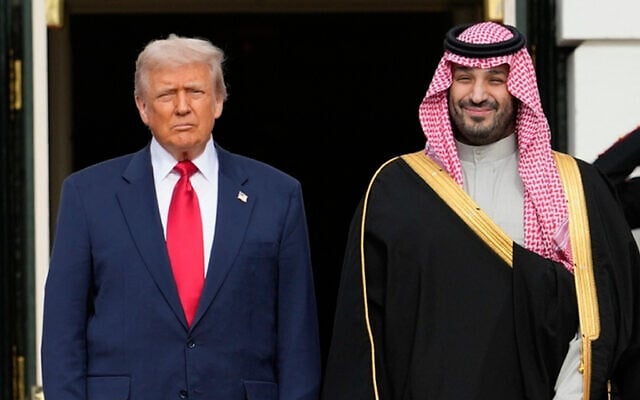
US President Donald Trump stands with Saudi Arabia's Crown Prince Mohammed bin Salman on his visit to the White House, November 18, 2025, in Washington. (AP Photo/Mark Schiefelbein)
Saudi Arabia’s Crown Prince Mohammed Bin Salman, known as MBS, is speaking regularly with US President Donald Trump amid the US-Israeli war with Iran, and is urging him to continue attacking Iran harshly, The New York Times reports.
According to the report, which cites several unnamed officials, MBS has conveyed advice previously given by Saudi Arabia’s late King Abdullah: to “cut off the head of the snake.”
That advice from Abdullah was contained in a trove of diplomatic cables that leaked in 2010, in which Gulf leaders were revealed to have urged more forceful American action against Iran’s nuclear program.
Iran judiciary chief urges swift verdicts for those linked to US, Israel
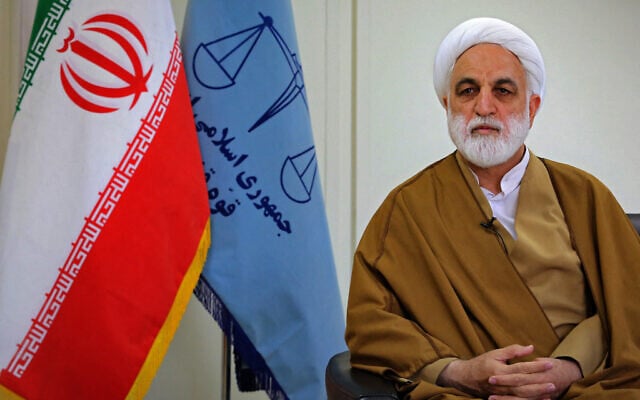
An undated handout picture provided by the Iranian supreme leader official website on July 1, 2021 shows the new chief of Iran's judiciary authority, Gholamhossein Mohseni-Ejei. (KHAMENEI.IR / AFP)
Iran’s head of the judiciary says there should be no leniency or delay in issuing verdicts against those allegedly affiliated with Israel and the United States.
“We must not delay or show leniency in executing final verdicts against those who, during wartime and unrest, committed crimes and were affiliated with the aggressor enemy,” says Gholam Hossein Mohseni Ejei, according to Tasnim news agency.
He adds that it is “necessary to accelerate the review and resolution of cases involving elements accused of threatening public security.”
Authorities have in recent weeks carried out sweeping raids across Iran, arresting in the last few days hundreds of people said to be suspected of cooperating with Israel and the United States, which are at war with Iran, local media report.
Yesterday, Iranian authorities arrested at least 20 people in the country’s northwest on suspicion of cooperating with Israel, local media reported.
Iran frequently arrests people and accuses them of spying without providing evidence.
Times of Israel staff contributed to this report.
EU to discuss how to keep Hormuz Strait open, EU’s top diplomat says

The European Union's top diplomat Kaja Kallas speaks at a press conference, following an informal video conference of EU foreign ministers to address the situation in the Middle East, in Brussels on June 17, 2025. (Nicolas Tucat/AFP)
EU member states will discuss what can be done from the European side to keep the Strait of Hormuz open, the EU’s foreign policy chief Kaja Kallas says.
“It is in our interest to keep the Strait of Hormuz open and that’s why we are also discussing what we can do in this regard from the European side,” she said, speaking to journalists ahead a EU foreign affairs meeting in Brussels.
US President Donald Trump has called on countries in Europe and elsewhere to help open the strait, a key artery for the world’s oil supply.
Missile strike kills Palestinian in Abu Dhabi, authorities say, amid ongoing Iranian attacks
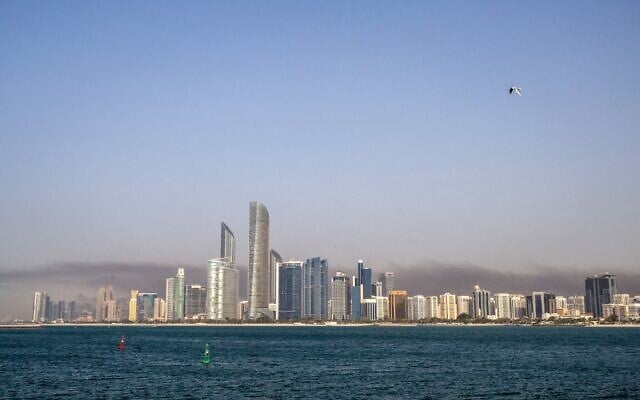
Illustration: A plume of smoke rises from the Zayed Port following a reported Iranian strike in Abu Dhabi on March 1, 2026. (Ryan Lim/AFP)
A Palestinian civilian was killed on the outskirts of the Emirati capital Abu Dhabi when a missile hit their car this morning, authorities say, as Iran continued striking the Gulf amid its war with the US and Israel.
“Authorities in the Emirate of Abu Dhabi responded to an incident in the Al Bahia area involving a missile strike on a civilian vehicle, which resulted in the death of one Palestinian national,” the Abu Dhabi Media Office says in a statement.
Iran military says regional facilities used by ‘satanic’ opposition TV channel could be targeted
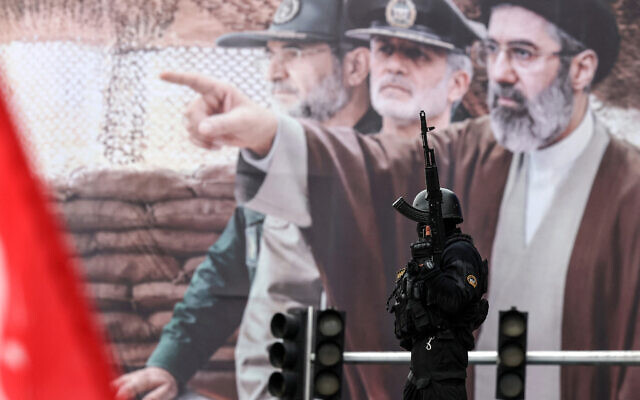
An Iranian security force officer stands guard next to a huge billboard of Iran's newly nominated supreme leader Ayatollah Mojataba Khamenei during Al-Quds (Jerusalem) Day rally, a commemoration in support of the Palestinian people on the last Friday of the Islamic holy month of Ramadan, in Tehran on March 13, 2026. (AFP)
Iran’s military warns countries in the region against cooperating with the London-based TV channel Iran International, saying media infrastructure used to support the opposition-linked station would be placed on its list of targets.
“The Zionist International Network, using the satellite capacity and media infrastructure of some countries in the region, is acting to create tension, create false narratives… to help the goals of criminal America and the Zionist regime,” the operational command Khatam Al-Anbiya said in a statement late yesterday, referring to the US and Israel.
“We warn that if you continue to help this evil and satanic network, the elements of cooperation with it will be placed in the bank of targets of the Islamic Republic of Iran,” it added, according to the state television website.
It is not immediately clear where the infrastructure used by the channel in the region is located.
Iran has labelled Iran International a terror organization since 2022 and in recent months has said it is “affiliated with the Zionist regime,” warning that cooperation with the channel would be punishable.
On Sunday, Iranian authorities announced the arrest of at least 18 people accused of sending images and information to the channel.
Iran still to play in World Cup, says Asian soccer body
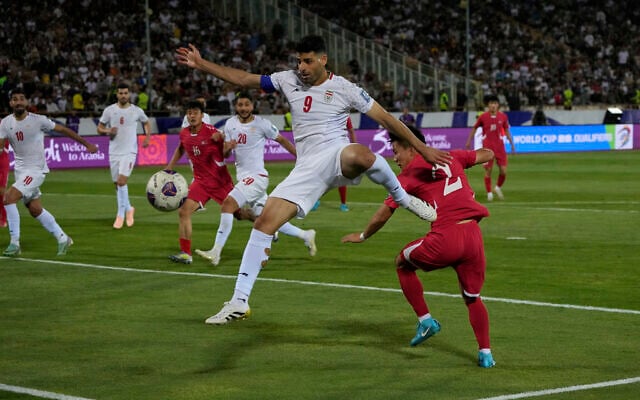
Iran's Mehdi Taremi shoots the ball during the 2026 World Cup Asian qualifier group A soccer match between Iran and North Korea, at Azadi Stadium in Tehran, Iran, June 10, 2025. (AP Photo/Vahid Salemi)
The Iranian men’s soccer team is still planning to play in the upcoming World Cup in North America, Asian soccer officials say, despite a warning that they may be at risk because the tournament is being co-hosted by the US, which is at war with Iran.
US President Donald Trump warned the team on Thursday that their “life and safety” could be at risk, should they attend this summer’s soccer extravaganza, co-hosted by the United States, Canada and Mexico.
The war, triggered by US-Israeli strikes on February 28, has thrown into doubt Iran’s participation.
“As far as we know, Iran is playing,” says Windsor Paul John, the Asian Football Confederation’s general secretary.
“We are monitoring whether they are playing or not, but at the moment they are. There is no official information that they are not playing,” he tells a press conference at the AFC’s headquarters in Kuala Lumpur.
Windsor stresses that the AFC wants Iran, a “top team,” to play in the global tournament.
“So we hope that they will solve their issues… and be able to participate in the World Cup,” he says.
Trump, in a post on his Truth Social Platform said the Iranian team was welcome, “but I really don’t believe it is appropriate that they be there, for their own life and safety.”
Meanwhile the captain of the Iranian women’s soccer team, which played in the Asian Cup in Australia, withdrew her bid for asylum on Sunday.
Seven members of Iran’s visiting soccer delegation competing in the Women’s Asian Cup had sought sanctuary in Australia after they were branded “traitors” at home for refusing to sing the national anthem.
Following the captain’s reported move to go back on her asylum request, only two of them are now set to remain in Australia.
School returns in parts of Israel after more than two weeks off due to war

Children arrive for the first day of school in Jerusalem, September 1, 2025. (Chaim Goldberg/Flash90)
Students are returning to school in some areas of Israel after a break of more than two weeks due to the war with Iran.
Schools closed beginning on March 1, following the beginning of the war the previous day. Government regulations prohibited schools from opening throughout the country during the subsequent two weeks due to ongoing missile and drone fire from Iran and Hezbollah, even as many workplaces have reopened.
Beginning today, however, schools in areas deemed at lower risk from missile fire have begun welcoming children back. Schools in those areas, marked “yellow” according to a government color-coding system, are allowed to open provided they have protected areas where students can shelter during missile fire.
The areas where schools may reopen include the Beit She’an Valley in the north, the Dead Sea area, several areas of southern Israel including the Gaza border region, and schools in West Bank settlements. Schools are set to remain open until the Passover break begins next week.
Schools remain closed in major cities including Jerusalem, Tel Aviv and Haifa. The government has faced criticism for reopening workplaces while keeping schools closed.
Some municipalities in areas where reopening is permitted have opted to keep schools closed due to safety concerns.
IDF begins ‘targeted ground operation’ in south Lebanon to expand buffer against Hezbollah
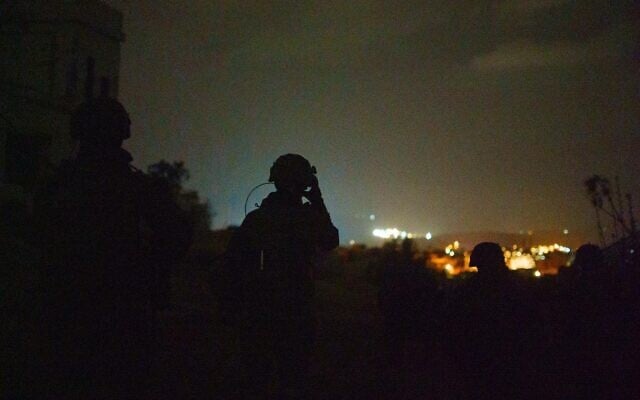
IDF troops of the 91st "Galilee" Regional Division operate in southern Lebanon, in a handout photo issued by the military on March 16, 2026. (Israel Defense Forces)
The Israeli military says it has begun a “targeted ground operation against key targets” in southern Lebanon, pushing more forces deeper into the area as part of an expanded buffer zone after Hezbollah began attacking Israel earlier this month amid the war with Iran.
The 91st “Galilee” Regional Division began a raid late Saturday in the eastern sector of southern Lebanon, during which troops encountered and killed several Hezbollah operatives, according to the military.
The IDF says the operation is aimed at expanding “the forward defense area.”
“This operation is part of the effort to establish forward defense, including the destruction of terror infrastructure and the elimination of terrorists operating in the area, to remove threats and create an additional layer of security for residents of the north,” the military says.
Before the troops pushed into the area, the IDF says it carried out massive airstrikes and artillery shelling “to remove threats.”
Meanwhile, the 146th Reserve Division remains deployed to the western sector of southern Lebanon, and the 36th Division has been carrying out a raid in the eastern sector.
The IDF has been preparing to deploy more forces in southern Lebanon and further expand its buffer zone to push away the threat of Hezbollah from the border.
Japan not currently mulling maritime ops despite Trump pressure over Hormuz Strait

Sanae Takaichi, Japan's Prime Minister contender and former economic security minister, speaks at the Liberal Democratic Party's (LDP) leadership election in Tokyo on October 4, 2025. (Photo by Kim Kyung-Hoon / POOL / AFP)
Japan says it is not currently thinking about ordering maritime security operations, after US President Donald Trump called for other countries to send warships to help protect the Strait of Hormuz amid the US-Israeli war with Iran.
“In the current Iran situation, we are not at the moment considering issuing a maritime security operation,” Defense Minister Shinjiro Koizumi tells parliament.
Trump called for reinforcements on Saturday from countries including Japan after earlier vowing that the US Navy would “very soon” begin escorting tankers through the vital shipping lane for oil in the Middle East.
Japanese Prime Minister Sanae Takaichi says that she has not received a request from Trump.
“The question is what Japan should do on our own initiative and what’s possible within our legal framework, rather than what’s requested by the United States,” she tells parliament. “We have asked various sections of various ministries to discuss this.”
Any maritime security operation would be “extremely difficult legally,” she adds.
Sending its Self-Defense Forces abroad is politically sensitive in officially pacifist Japan, as many voters support the US-imposed, war-renouncing 1947 constitution.
Takayuki Kobayashi, the policy chief of Takaichi’s ruling Liberal Democratic Party, said yesterday the threshold was “extremely high” for Tokyo to send in its warships.
UAE says its air defense systems are intercepting Iranian missiles and drones
The United Arab Emirates’ air defense systems are intercepting Iranian missiles and drones, the Gulf nation’s Defense Ministry says.
“UAE air defences are currently responding to incoming missile and drone threats from Iran,” the UAE Ministry of Defense writes on X.
Earlier, Dubai authorities said a “drone-related incident” had sparked a fire near the airport and flights had been temporarily suspended.
Iran has fired missiles at the UAE throughout the war with the US and Israel that began on February 28.
Times of Israel staff contributed to this report.
Iran war an ‘abject lesson’ on fossil fuel dependence, UN climate chief says

Simon Stiell, United Nations climate chief, speaks during a session at the China Pavilion at the COP29 U.N. Climate Summit, Friday, Nov. 15, 2024, in Baku, Azerbaijan. (AP Photo/Peter Dejong)
The disruption to energy markets caused by the Iran war is an “abject lesson” in the risks of relying on fossil fuels, and underscores the case for governments to wean their economies off oil and gas, the UN climate secretary will tell EU policymakers today.
While geographically far from the crisis in the Middle East, the European Union has felt its disruption through surging global energy prices. European gas prices have jumped by 50% during the war that began on February 28.
“Fossil fuel dependency is ripping away national security and sovereignty, and replacing it with subservience and rising costs,” Simon Stiell, Executive Secretary of the UN climate change arm UNFCCC, will tell EU officials and government ministers at an event in Brussels.
“Europe is more reliant on fossil fuel imports than almost any other major economy,” Stiell will say, in prepared remarks that warned reliance on fossil fuels was leaving consumers “at the mercy of geopolitical shocks and price volatility.”
The EU imports more than 90% of its oil and 80% of its gas.
EU leaders are hurriedly drafting emergency measures to shield consumers from the energy price spike.
In the longer term, the European Commission says its climate change strategy to replace fossil fuels with locally-produced renewable and nuclear energy will secure countries’ energy security, and cut them free from volatile fuel prices.
But governments including Italy and Hungary are urging Brussels to weaken its climate change policies, to provide short-term cost relief for industries.
Saudi Arabia says it has intercepted more than 60 drones since midnight
Saudi Arabia has intercepted more than 60 drones since midnight, according to a new tally of defense ministry figures.
The Saudi defense ministry posts a series of statements on X describing the interception of a total of 61 drones overnight in the east of the country.
Sirens sound in Kiryat Shmona area amid Hezbollah rocket attack
Incoming rocket sirens sound in Kiryat Shmona and other towns in the Galilee Panhandle, amid a barrage by Hezbollah from Lebanon.
Trump said weighing seizing Iran’s Kharg Island oil hub if Hormuz Strait not opened — report
US President Donald Trump is mulling the option of seizing Iran’s key oil depot on Kharg Island if Tehran continues to deny oil tankers passage through the crucial Strait of Hormuz, Axios reports, citing unnamed US officials.
Such a move would require American boots on the ground, the report notes.
The report also says Trump is working to put together a coalition of countries aimed at securing the waterway’s opening and seeks to announce it this week — details that were reported earlier by the Wall Street Journal.
‘One Battle After Another’ wins Best Picture Oscar and 5 other awards
Paul Thomas Anderson’s political-rebel action drama “One Battle After Another” wins the Best Picture Oscar.
A few minor Jewish connections can be found in the film, which had 13 nominations going into the ceremony and ends up also winning best director, best film editing, best casting for Cassandra Kulukundis, best adapted screenplay, and best supporting actor for Sean Penn.
Radiohead band member Jonny Greenwood, who has faced backlash from fans over his collaborations with Israeli musicians, does not win for best score. Israeli-American actress and musician Alana Haim, a frequent Anderson collaborator, also has a small role, and one of the movie’s storylines involves a secret cabal of white supremacists who restrict membership to the “Gentile-born.”
Meanwhile, Jessie Buckley wins the best actress award for “Hamnet,” while Michael B. Jordan wins best actor for “Sinners.”
‘The Voice of Hind Rajab’ doesn’t win Oscar for Best International Feature Film
Tunisian docudrama “The Voice of Hind Rajab,” about a five-year-old girl allegedly killed by Israeli forces in Gaza in 2024 and told from the perspective of the Palestinian Red Crescent, fails to win the Oscar for Best International Feature Film.
The film, by Franco-Tunisian director Kaouther Ben Hania, tells the story of Hind Rajab Hamada, who was fleeing in Gaza City with six relatives when their car came under fire.
Palestinian actor Motaz Malhees, who played the role of a call center operator in the film, has said a travel ban imposed by the White House prevented him from attending the ceremony.
Instead, the Best International Feature Film award goes to Norwegian director Joachim Trier’s “Sentimental Value.”
Fire contained in vicinity of Dubai airport after drone attack, flights suspended
A fire caused by a drone attack near Dubai International Airport has been contained with no injuries reported, but flights are temporarily suspended, Dubai authorities says.
“A drone incident in the vicinity of Dubai International Airport affected one of the fuel tanks,” the Dubai media office says on X.
Emirates airline also announces in a post on X the temporary suspension of flights to and from Dubai.
Gulf Arab states have faced more than 2,000 missile and drone attacks since the outbreak of the US-Israeli war on Iran on February 28, with targets including US diplomatic missions and military bases but also critical Gulf oil infrastructure, ports, airports, hotels and residential and office buildings.
Israel’s 2 Oscar nominees fall short of prize
Israel’s two nominees at tonight’s Oscars fail to win.
Hilla Medalia’s “Children No More: Were and are Gone” loses the Best Documentary Short category to “All the Empty Rooms,” while Meyer Levinson-Blount’s “Butcher’s Stain” is bested by “The Singers” and “Two People Exchanging Saliva,” which jointly win Best Live Action Short Film.
IDF says toppling Iran’s regime isn’t one of the army’s war goals
In a press conference last night, IDF Spokesperson Effie Defrin said that toppling Iran’s regime isn’t a goal of the current war as far as the military is concerned.
“We in the army, as an army, don’t have a goal of toppling a regime. We don’t topple a regime. We do create the conditions and undermine it so that, over time, the Iranian people will take their fate into their own hands and reclaim this country, which has been taken hostage by this terror regime. That is the story,” he said in response to a question.
No injuries reported in Iran’s missile attack on southern Israel
No injuries are reported in Iran’s latest ballistic missile salvo on Israel, the second since midnight.
A small number of missiles were launched, which were likely intercepted, according to initial military assessments.
Sirens had sounded in Beersheba and the surrounding area in southern Israel three times amid the attack.
Sirens sound in southern Israel amid new Iranian missile salvo
The IDF says it had detected a ballistic missile launch from Iran.
Sirens subsequently sound in southern Israel, including Beersheba.
Meanwhile, incoming rocket sirens sound in several Lebanon border towns in the north amid Hezbollah attacks.
Trump says Israel working with US to secure Strait of Hormuz, demands other countries pitch in
US President Donald Trump says Israel has been working with the United States on securing maritime traffic through the Strait of Hormuz, as he reiterates his demand that other countries help protect the key waterway that Iran has been targeting amid the current war.
Trump tells reporters on Air Force One that Washington is in talks with some seven countries about policing the critical shipping lane for oil and gas.
“I’m demanding that these countries come in and protect their own territory, because it is their own territory,” Trump says, claiming the shipping channel is not something the United States needs because of its own access to oil.
Trump says China gets about 90% of its oil from the strait, while the US gets a minimal amount. He declines to discuss whether China will join the coalition.
“It would be nice to have other countries police that with us, and we’ll help. We’ll work with them,” Trump says.
He says Washington is in contact with Iran but expresses doubt that Tehran is prepared for serious negotiations to end the conflict.
“I don’t think they are ready,” he says.
IDF launches ‘extensive’ wave of strikes on regime targets in Tehran
The IDF says that following airstrikes on Hezbollah targets in Beirut, the military has initiated an “extensive” wave of strikes on “infrastruicture of the Iranian terror regime” in Tehran.
Fire said to break out in vicinity of Dubai International Airport after drone attack
Dubai Media Office says Emirati authorities are dealing with a fire resulting from a drone attack in the vicinity of Dubai International Airport.
UK slams Hezbollah’s attacks on Israel, says it’ll give over $6 million for Lebanon aid
British Foreign Secretary Yvette Cooper says the UK will provide over 5 million pounds ($6.62 million) of emergency funding to support humanitarian work by the Lebanese government amid conflict in the region.
Cooper also condemns Hezbollah’s attacks against Israel and calls for them to cease.
“The actions of this proscribed terrorist group — at the instigation of the Iranian regime — are once again drawing the people of Lebanon into a conflict they do not want and which is not in their interests,” she says.
Saudi crown prince, UAE president say continued Iranian attacks on GCC states threaten regional security
Saudi Crown Prince Mohammed bin Salman and United Arab Emirates President Sheikh Mohamed bin Zayed Al Nahyan have affirmed in a phone call that continued Iranian attacks on Gulf Cooperation Council countries represent a dangerous escalation threatening regional security and stability, Saudi state media reports.
Trump warns NATO faces ‘very bad future’ if allies fail to help open Hormuz Strait
US President Donald Trump has warned that NATO faces a “very bad” future if US allies fail to assist in opening up the Strait of Hormuz, in an interview with the Financial Times.
Trump tells the FT he may also delay his summit with China’s President Xi Jinping later this month as he presses Beijing to help unblock the crucial waterway.
“It’s only appropriate that people who are the beneficiaries of the Strait will help to make sure that nothing bad happens there,” Trump tells the newspaper.
No reports of injuries following latest Iranian missile attack
No reports of injuries have been received following the latest Iranian missile attack on central Israel, the Magen David Adom ambulance service says.
Projectiles reportedly fell in open areas.
The IDF Home Front Command says people can leave bomb shelters.
Sirens sound in Tel Aviv area amid missile attack from Iran
Sirens blare in the Tel Aviv area and parts of the West Bank amid what the IDF says is an Iranian missile salvo from Iran.
Rockets strike near Baghdad airport for second time in a day
Four rockets landed tonight near Baghdad International Airport, marking the second such incident in a day, an Iraqi security official says, speaking on condition of anonymity because they are not authorized to brief the media.
Two militia sources say the rockets targeted Victoria Base, a former US base next to the airport that still provides logistical support for American operations.
The attack follows an earlier strike that wounded four airport security personnel and staff. Iran-backed militias in Iraq have launched a series of attacks on US facilities in the country since the US and Israel launched strikes on Iran, triggering the ongoing war in the Middle East.
France’s Macron urges Iran to cease attacks against Middle East countries
French President Emmanuel Macron has asked Iranian President Masoud Pezeshkian to put an immediate end to the attacks Iran is carrying out against countries in the region, whether directly or through proxies, including in Lebanon and Iraq, Macron says in an X post.
He adds that “freedom of navigation in the Strait of Hormuz must be restored as soon as possible.”
I have just spoken with Iranian President Massoud Pezeshkian.
I called on him to put an immediate end to the unacceptable attacks Iran is carrying out against countries in the region, whether directly or through proxies, including in Lebanon and Iraq. I reminded him that France…
— Emmanuel Macron (@EmmanuelMacron) March 15, 2026
IDF launches fresh wave of strikes on Hezbollah sites in Beirut
The IDF says it has launched a wave of airstrikes against Hezbollah infrastructure in Beirut.
No further details are given by the military.
Earlier, the IDF repeated an evacuation warning for several neighborhoods in Beirut’s southern suburbs.
Iran’s internet blackout deepens further, says internet watchdog
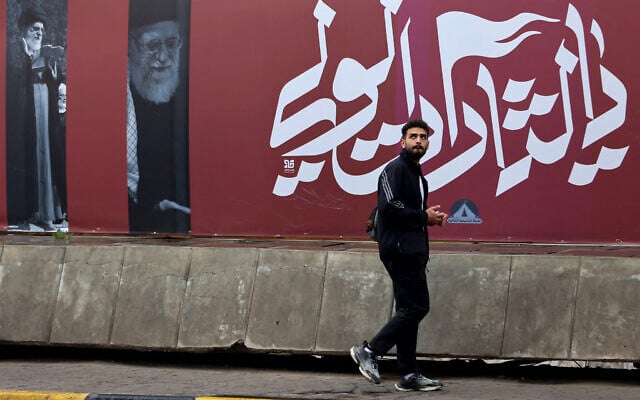
A man walks past a banner depicting Ayatollah Ali Khamenei, Iran's late supreme leader who was killed on February 28 in a US-Israeli strike in Tehran, displayed at Baghdad's central Tahrir Square on March 15, 2026. (AHMAD AL-RUBAYE / AFP) /
An internet watchdog says Iran’s internet blackout has deepened, disrupting even semi-official Iranian news organizations.
It was not immediately clear what caused the disruption.
“Connectivity rapidly collapses from 12:00 p.m. UTC,” Alp Toker, the founder of NetBlocks, tells The Associated Press. Iranian state media social accounts that usually post frequently on X, including Fars News Agency, also abruptly stopped updating around the same time, coinciding with the disruption, he adds.
This is the first time a disconnection at that scale happened during the war that is entering its third week, but Netblocks observed “a similar blackout during the early part of the blackout during Iran’s January protests, so it isn’t unprecedented.”
While the Iranian public have been heavily restricted from accessing the internet since the start of the war on February 28, many Iranians were still able to get online using VPNs or Starlink connections. The latest disruption appears to have affected many of those routes, leaving significantly fewer users able to connect
Iran issues warning for strikes in specific areas of Dubai and Doha
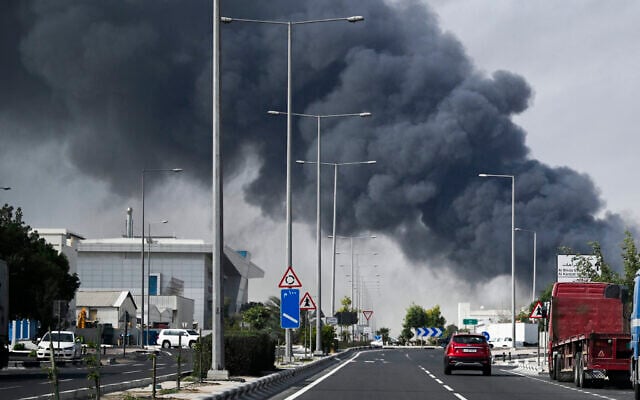
Motorists drive past a plume of smoke rising from a reported Iranian strike in the industrial district of Doha on March 1, 2026. (Mahmud HAMS / AFP)
Iran’s Media Operations Center issues urgent warning to civilians in specific areas of Dubai and Doha, according to Press TV, saying they may be targeted in the coming hours.
According to the report, Iran claims that US military personnel are hiding in those locations, and urges residents to evacuate immediately.
The maps published by Press TV show an area in the Ain Khaled neighborhood on the outskirts of Doha, Lusail, north of Doha, and the Al Waab district of Doha.
https://twitter.com/PressTV/status/2033286493398077949
WSJ: Trump administration to announce coalition to escort ships through Strait of Hormuz
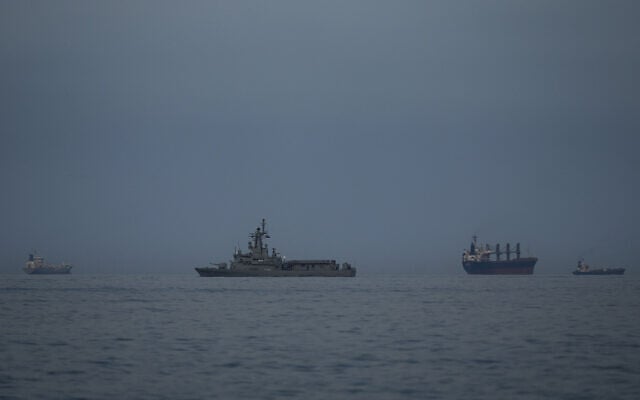
A UAE navy vessel patrols next to cargo ships and oil tankers in the Strait of Hormuz as seen from Khor Fakkan, United Arab Emirates, March 11, 2026. (AP/Altaf Qadri)
The Trump administration plans to announce as early as this week that multiple countries have agreed to form a coalition that will escort ships through the Strait of Hormuz, the Wall Street Journal reports, citing US officials.
Reuters could not immediately verify the report.


read more: