

Smotrich: IDF chief ‘taking advantage’ of wartime backing to promote officers
Halevi’s only mandate is to ‘conduct the war and that’s it,’ far-right minister says; Lapid calls Haredi enlistment an ‘existential issue,’ says Netanyahu will avoid real solutions
 Add ToI as a Preferred Source on Google
Sam Sokol is a former political correspondent at The Times of Israel. He was previously a reporter for the Jerusalem Post, Jewish Telegraphic Agency and Haaretz. He is the author of "Putin’s Hybrid War and the Jews"

The military chief has no mandate to design a “new and reformed IDF” during wartime, Finance Minister Bezalel Smotrich charged Monday, echoing criticism of Lt Gen. Herzi Halevi’s recent round of senior appointments.
Speaking to the press at the start of his party’s weekly faction meeting, the far-right leader asserted that Halevi had not been tasked with overhauling the military. Rather, in the wake of the “failure” of October 7, the IDF’s leadership mandate must only be “to conduct the war and that’s it.”
“There is no mandate to design the new and reformed IDF. I call on the chief of staff to stop the round of appointments. This is not the time,” he said, adding that such a project could only be undertaken by a new military high command “appointed after the victory.”
“To be clear, now is a war and I fully support the IDF at all levels and in all ranks, even when I do not agree with you on everything,” he continued, adding that the IDF cannot “take advantage” of this support to determine Israel’s future security strategy.
Last week, Halevi announced the first list of senior appointments in the military since the October 7 onslaught, including three new brigadier generals and 11 new colonels, as well as 26 colonels who are moving positions but staying at the same rank.
Smotrich’s criticism came after the IDF announced that Brig. Gen. Barak Hiram, the commander of the Israeli military’s 99th Division, was formally censured for the demolition of a university in the Gaza Strip earlier this year without the necessary authorization.

Addressing the issue of the Haredi draft exemption law, which has been a source of contention among coalition parties in recent weeks, Smotrich called on the Haredi parties to work with other coalition parties to find a solution to the issue.
Declaring that “now is the time for change,” Smotrich said that a solution to the issue could only be found through “respect” and not through the “contempt and hatred” of opposition politicians such as Yesh Atid leader Yair Lapid, who is pushing a bill requiring the enlistment of full-time yeshiva students.
At this “crucial” hour, “we need mobilization in Haredi society,” he added.
Haredi men of military age have been able to avoid the draft for decades by enrolling for study in yeshivas and obtaining repeated one-year service deferrals until they reach the age of military exemption.
However, the continuing war in Gaza and the government’s efforts to extend soldiers’ terms of service while yeshiva students remain at home have sparked renewed pushback against the status quo, with lawmakers across the political spectrum calling to pass legislation bringing them into the army.
Pushing back after Halevi called the drafting of Haredim “the need of the hour,” ultra-Orthodox politicians have argued that “there is a surplus of manpower.”
Lapid also addressed the topic of the Haredi draft exemption at Yesh Atid’s faction meeting Monday, asserting that the IDF is “stretched to the limit” and that Israel cannot continue to fight on multiple fronts without ultra-Orthodox troops.
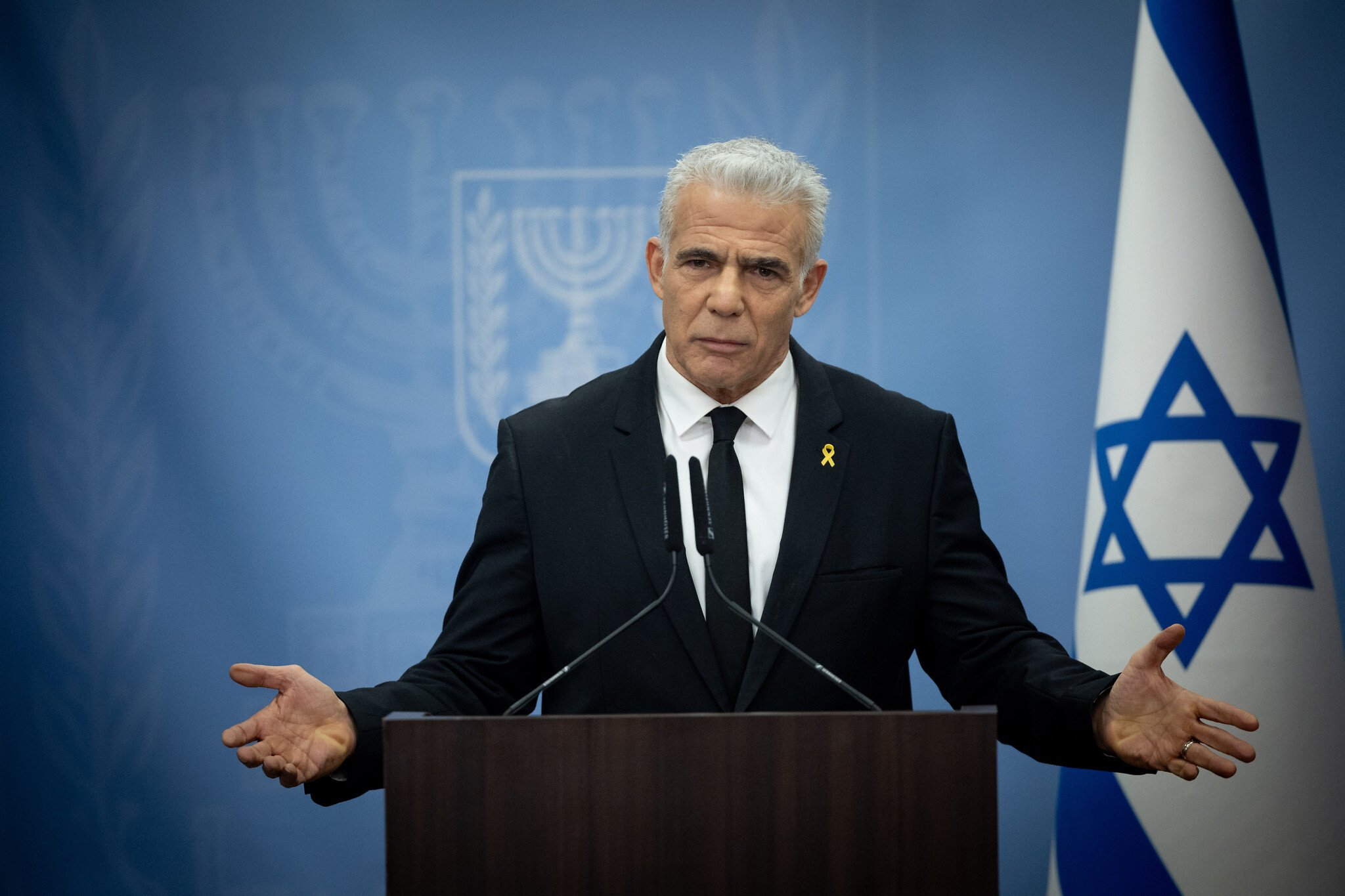
Speaking with reporters at the meeting, Lapid asserted that “if there is a flare-up in the north, there are not enough soldiers to manage it,” and called the debate over the conscription law “no longer just an ideological debate,” but an “existential” one.
“Today, there are 66,000 ultra-Orthodox youth of conscription age. That’s 105 battalions that don’t enlist,” he said, arguing that “if the State of Israel does not recruit the Haredi young people, it has no right to send more and more reserve orders to people who have already done 70, 90, and 120 days of reserve duty this year.”
Complaining that the Ministerial Committee for Legislation rejected his party’s universal enlistment bill, Lapid accused the government of being more concerned with the “security of the coalition” than with the security of the country.
Lapid’s bill, which has yet to come up for a vote, requires yeshivas to meet steadily rising annual quotas for enlistment in order to maintain their budgets.
The number of full-time Torah students given deferrals during any given year would be capped at 2,000, while those in yeshiva would be provided with incentives to train for their eventual integration into the workforce.

Prime Minister Benjamin Netanyahu’s government will “try to come up with an outline that looks like a solution, but is not a solution,” he said.
Minister Benny Gantz’s proposed enlistment plan, which calls for gradual annual increases in Haredi service, but does not detail specific quotas, is “an outline in which no Haredi would enlist,” Lapid contended. “It will not work. We cannot continue to delude ourselves.”
Lapid heaped criticism on Netanyahu, referring to an unsourced Channel 12 report that said the prime minister had conveyed to the Haredi parties that “he would be sure to compensate them retroactively” if judges find that the current government policy exempting Haredim from military and national service is illegal — at which point Haredim who do not serve would be considered to be breaching the law, and they and the institutions where they study would be denied state funds.
Turning to Sephardic Chief Rabbi Yitzhak Yosef’s declaration that Haredim would “go abroad” if forcibly enlisted in the military, Lapid said that “no one wants them to go abroad, but it’s no longer a theoretical debate. If they don’t enlist, they won’t get money.”

“Saying they need to enlist isn’t [an attack] against him or the world of Torah. Soldiers are dying every day and we don’t have enough of them,” he added.
Yisrael Beytenu chairman Avigdor Liberman also criticized Yosef on Monday, telling reporters that his comments stood “in complete contradiction to Jewish law” and noting that “all the great men of [ancient] Israel were warriors.”
“I don’t understand the attitude of the Haredi [power brokers], who only care about power, honor and money. For the chief rabbi in the midst of a war to say that they will leave the country if they are drafted is clearly irresponsible and unreasonable,” he said.
The Hawkish lawmaker also leveled the charge that Israel’s military deterrence has collapsed under Netanyahu, who he said has been adhering to the same outmoded strategic conceptions that brought about the October 7 massacre.
“Everything that is happening in the north is, in one word, a disgrace. It is impossible to count how many launches there were in the last day in the north of the country,” Liberman told reporters in the Knesset, referring to dozens of rocket attacks a day earlier.








The Times of Israel Community.