

Live updates (closed)
 Add ToI as a Preferred Source on Google






The Times of Israel liveblogged Sunday’s events as they unfolded.
Iran says it rejected US proposal as ‘surrender,’ insisted on reparations, full control of Hormuz
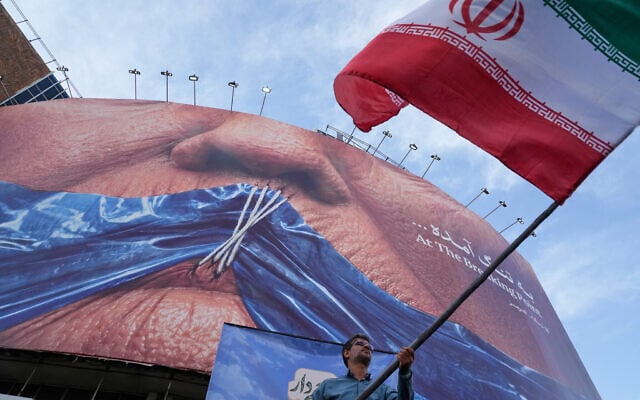
A man waves an Iranian flag for a pro-government campaign under a billboard with graphic showing Strait of Hormuz and sewn lips of US President Donald Trump in a square in downtown Tehran, Iran, May 6, 2026. (AP Photo/Vahid Salemi)
After US President Donald Trump publicly derided as “totally unacceptable” Iran’s response to the latest American offer to end the war, Tehran says its response was a rejection of the US proposal.
Iranian state television reports that Tehran rejected the proposal as amounting to “surrender,” insisting instead on “war reparations by the US, full Iranian sovereignty over the Strait of Hormuz, an end to sanctions, and the release of seized Iranian assets.”
The response also calls on the US to end its naval blockade, guarantee no further attacks and end a US ban on Iranian oil sales, the semi-official Tasnim news agency says.
IDF investigating reports that a strike in Lebanon’s Nabatieh killed civilian man, child
The IDF says it is investigating after an airstrike targeting suspected Hezbollah operatives in the Nabatieh area of southern Lebanon on Saturday killed civilians.
Lebanon’s health ministry reported that a Syrian man and his 12-year-old daughter were killed by Israeli drone strikes while riding a motorcycle in Nabatieh.
In response to a query by The Times of Israel, the IDF says that it had identified several suspects leaving a building known to be used by Hezbollah for military activity.
“To remove the threat, troops carried out precise strikes on the suspects near the building,” the military says.
The IDF says it is aware of civilians harmed by the strike, adding that the incident is under further investigation.
Trump: Iran’s response to US proposal ‘totally unacceptable’

US President Donald Trump and Eric Trump watch the Maaden LIV Golf Virginia tournament at Trump National Golf Club, May 9, 2026, in Sterling, Virginia. (AP Photo/Alex Brandon)
US President Donald Trump firmly rejects Iran’s response to the latest proposal for ending the war.
“I have just read the response from Iran’s so-called ‘Representatives,’” he writes on Truth Social.
“I don’t like it — TOTALLY UNACCEPTABLE!”
Tehran delivered its answer to Pakistani mediators earlier today.
Air defenses intercept apparent Hezbollah drone over northern Israel
An apparent Hezbollah drone launched from Lebanon was intercepted by air defenses over northern Israel a short while ago, the military says.
The drone triggered sirens in several communities in the Galilee.
Jailed Iranian Nobel winner Mohammadi moved to hospital in Tehran
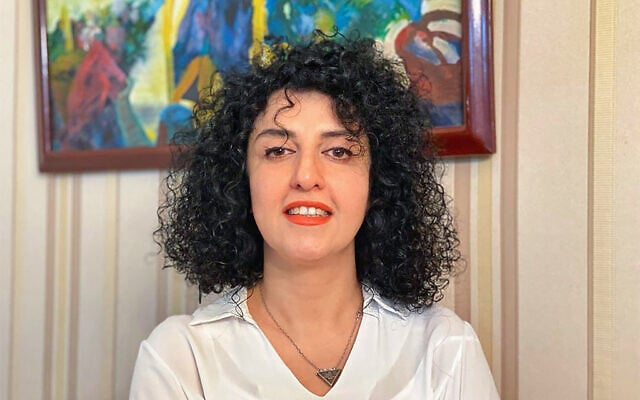
Narges Mohammadi, the Iranian women's rights campaigner imprisoned by Iran who won the Nobel Peace Prize, on October 6, 2023. (AFP/ Narges Mohammadi Foundation/ File)
Iran’s imprisoned Nobel Peace Prize winner Narges Mohammadi has been moved to a hospital in the capital, Tehran, and has been granted a suspension of her sentence on heavy bail, a foundation run by her family says.
Mohammadi, 54, won the prize in 2023 while in prison for a campaign to advance women’s rights and abolish the death penalty. She suffered a heart attack two weeks ago.
Her family had called for her to be transferred from Zanjan, northwest of Tehran, where she was serving her sentence and where she had been initially taken to the hospital, so that she could receive better medical care.
She is now at Tehran Pars Hospital for treatment by her own medical team after being transferred by ambulance, the Narges Mohammadi Foundation says in a statement.
Mohammadi was sentenced to a new prison term of seven and a half years, the foundation said in February. The Nobel committee at the time called on Tehran to free her immediately.
She was arrested in December after denouncing the death of a lawyer, Khosrow Alikordi. A prosecutor told reporters that she had made provocative remarks at Alikordi’s memorial ceremony.
The foundation gives no details of the bail arrangements or suspension of her sentence.
“However, a suspension is not enough,” it says. “Narges Mohammadi requires permanent, specialized care. We must ensure she never returns to prison.”
Netanyahu before phone call with Trump: Israel is fully committed to protecting Syrian Druze
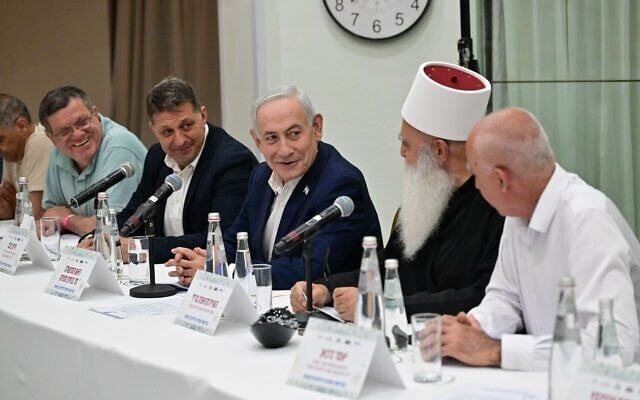
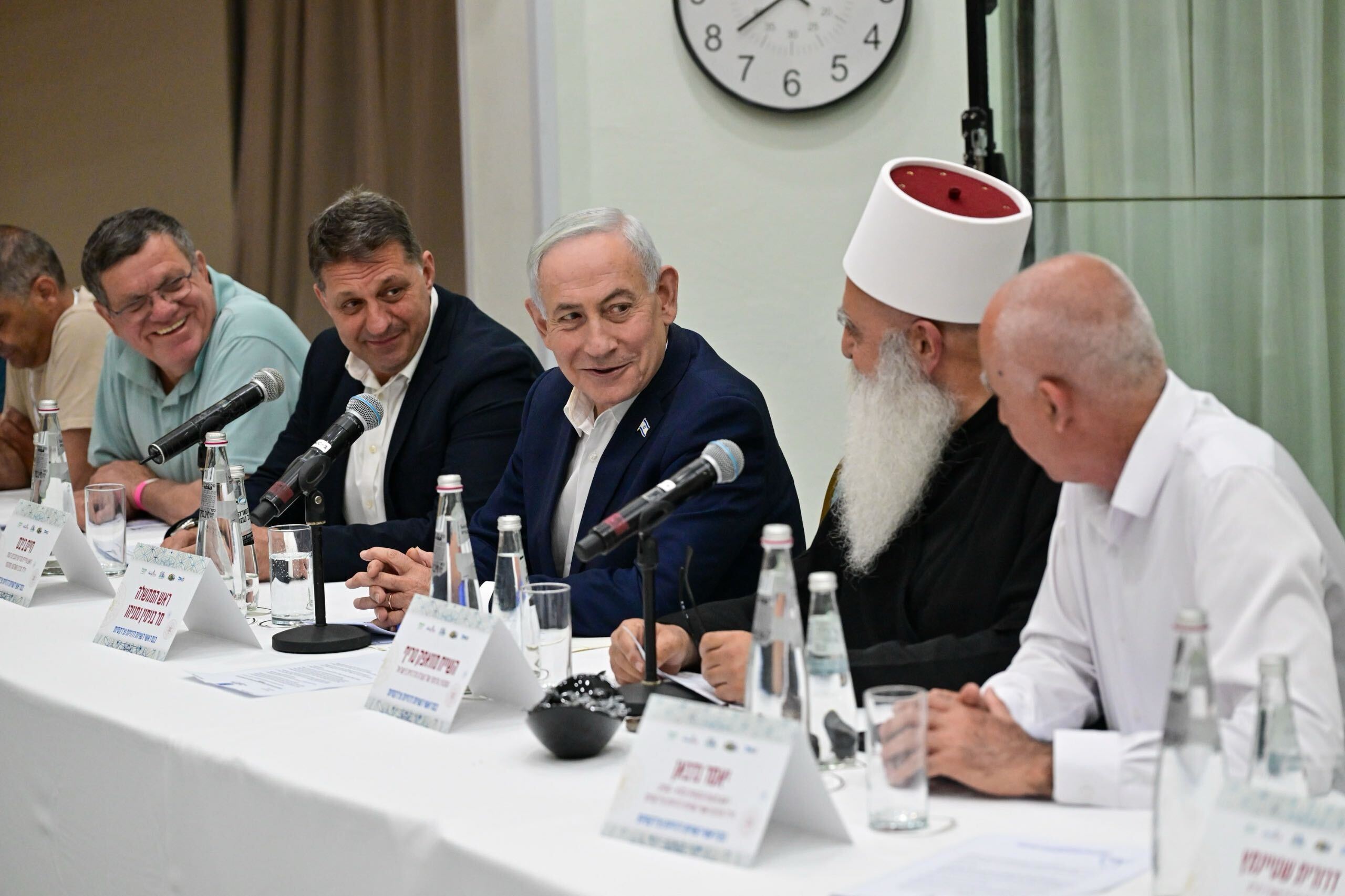
Prime Minister Benjamin Netanyahu attends a conference of Druze and Circassian council heads at the Dead Sea, on May 10, 2026. (Kobi Gideon/ GPO)
Israel is fully committed to defending the Druze in Syria, Prime Minister Benjamin Netanyahu tells Druze and Circassian council heads at a conference on the shore of the Dead Sea.
“I want to tell you what the most important mission is, to protect life,” he says. “I am committed to this, and by the way, I am also speaking with [US] President Donald Trump about it. I am committed to bringing all the strength and all the power of Israel to this sacred mission, because you bring strength and power to our alliance.”
“I want you to know that I do this for one simple reason — because we are brothers,” he continues, adding that “the Druze and the Circassians are [our] brothers — brothers do not abandon one another.”
He leaves the gathering early, according to Hebrew media reports, telling the attendees that he has to return to Jerusalem for a phone call with Trump.
Iran’s response to US proposal said to demand control over Hormuz, removal of oil sanctions
Iran’s response to the US proposal for ending the war includes a demand for the Islamic Republic to maintain control over the Strait of Hormuz, the Hezbollah-affiliated Al Mayadeen news outlet reports, citing sources familiar with the matter.
The Iranian response also stipulates that the US must lift all oil-related sanctions and release any frozen Iranian funds, the outlet reports.
Sources tell the Arabic outlet that, for the time being, negotiations will continue to take place only as written communiques transmitted via Iranian mediators.
Source claims Netanyahu knew about secret meeting between confidant Bardugo and Herzog
Prime Minister Benjamin Netanyahu was aware of the secret meeting between his confidant, journalist Jacob Bardugo, and President Isaac Herzog in late March to discuss the premier’s request for a pardon, a source close to Bardugo tells Channel 12.
The nighttime meeting at an apartment in Shoham, which was not revealed to the public, took place shortly before Herzog urged dialogue between the sides on a plea bargain. It also came about after bitter criticism of Herzog by Bardugo on the pro-Netanyahu Channel 14 for not pardoning the prime minister, who has refused to admit wrongdoing despite High Court precedent indicating he must do so for a pardon.
During the meeting, Bardugo reportedly called Herzog a “coward” for not pardoning the premier, while the president complained that he was facing criticism from both sides of the political spectrum over the matter.
Speaking with Channel 14, Bardugo says he told Herzog that he was “speaking on my own behalf” and accuses the president of leaking the content of the meeting.
In a statement to Channel 12, the President’s Office says that “no one from the president’s entourage leaked details from the meeting” and argues that the quotes published were either “clearly incorrect or have been distorted in a biased manner.”
“The purpose of the leak is to sabotage the president’s efforts to bring the parties in Netanyahu’s cases to talks. The purpose of the meeting was only an attempt to lower the flames and the toxic discourse during a sensitive and tense period,” the statement continues, adding that Herzog “meets regularly with many elements from all corners of the public and the media, and there is nothing unusual in the meeting itself.”
“At no point was the president or anyone on his behalf told that Mr. Bardugo was acting on behalf of the prime minister or conveying messages on his behalf.”
Signaling dissatisfaction with Iran’s response to deal, Trump warns Tehran ‘will laugh no longer’ at US
Hours after Iran said it responded through Pakistani mediators to the latest US proposals to reach a ceasefire and nuclear deal, US President Donald Trump accuses Tehran of “playing games” in negotiations with the US for decades, warning it “will be laughing no longer.”
U.S. President Donald Trump:
"Iran has been playing games with the United States, and the rest of the World, for 47 years (DELAY, DELAY, DELAY!), and then finally hit “pay dirt” when Barack Hussein Obama became President. He was not only good to them, he was great, actually… pic.twitter.com/oIUCFgZYLf
— Open Source Intel (@Osint613) May 10, 2026
“Iran has been playing games with the United States, and the rest of the World, for 47 years,” writes Trump, before criticizing the Iran policies of former US presidents Barack Obama and Joe Biden.
“They will be laughing no longer!” Trump adds, signaling dissatisfaction with Tehran’s response in the talks, which have been unfruitful for weeks.
The US has not officially acknowledged Tehran’s response to its proposal.
‘A passionate advocate for the Jewish people’: ADL mourns its longtime director Abe Foxman
Anti-Defamation League director Jonathan Greenblatt mourns the death of his predecessor, Abraham Foxman, whom he recalls as an “iconic Jewish leader” who was “relentlessly dedicated to his pursuit of a world without hate.”
“America and the Jewish people have lost a moral voice, a passionate advocate for the Jewish people and the State of Israel, and a remarkable leader,” Greenblatt says in a statement published by the organization.
He credits Foxman with transforming the ADL during his long career, “while confronting antisemitism and hate (from both left and right), opposing the global rise in antisemitism, holding world leaders accountable and working to ensure that Israel was Jewish, secure, and democratic.”
“Abe’s voice was heard – and listened to – by popes, presidents, and prime ministers, a voice he used wherever Jews were at risk,” Greenblatt adds. “Abe Foxman spoke on the global stage with moral authority and clarity and was relentlessly dedicated to his pursuit of a world without hate.”
ADL board chair Nicole Munchnik credits Foxman with helping to “build the modern liberal era of America.”
“He was recognized across the globe as a great leader and passionate advocate for tolerance, a voice of the generation rebuilding in the shadow of the Shoah, and longtime adviser to American presidents and world leaders,” she says. “To those of us who knew him, Abe was a warm friend, adviser, spirited antagonist, and hugger – all over lunch.”
IDF says Hamas Nukhba operatives killed in Gaza airstrike
The IDF says it killed terror operatives from Hamas’s elite Nukhba forces in the Gaza Strip earlier today.
According to the IDF, the operatives were identified by troops in the field, who alerted the Israeli Air Force to their presence.
It says the Air Force then “struck and eliminated” the terrorists “in order to remove the threat.”
In a separate incident overnight, the military says troops identified two operatives “carrying out suspicious activity on the ground in the area of the Yellow Line.”
The operatives “approached the troops, posing an imminent threat,” the IDF says, adding that they too were targeted in an Air Force strike.
“IDF troops under the Southern Command remain deployed in accordance with the ceasefire agreement and will continue to operate to remove any immediate threat,” the statement adds.
Two officers interrogated on suspicion of assaulting Arab public prosecutor
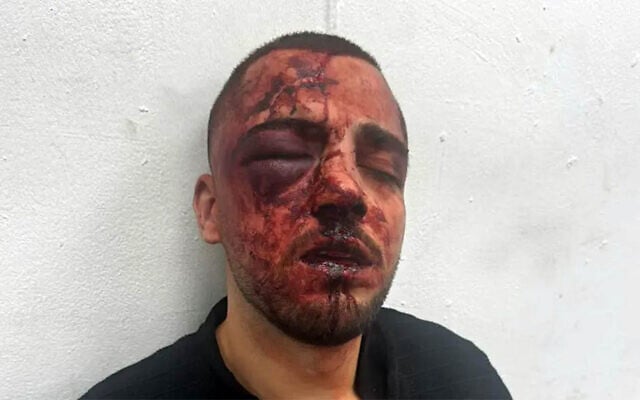
Salah Khalil Faisal Na'ameh, an Arab Israeli prosecutor in the Southern District Attorney's Office, is seen after he was attacked by police officers during arrest in Beersheba on May 1, 2026. (Used in accordance with Clause 27a of the Copyright Law)
Two additional police officers have been interrogated on suspicion of involvement in the beating of a Beersheba prosecutor and his two relatives last week, the Department of Internal Police Investigations announces.
The two officers questioned today are suspected of assault and causing serious bodily harm.
The lawyer, Salah Khalil Faisal Na’ameh, who works for the Southern District Attorney’s Office, suffered a broken nose, injuries to one of his eyes and both kidneys in the alleged beating, in which police had been responding to a noise complaint from the home.
Police accused Na’ameh and his two relatives, who both work in medicine, of assaulting officers who arrived at the apartment, but he and his coworkers rejected the police’s version of events.
Both officers have been barred from setting foot in police facilities for five days and from contacting others involved in the case.
The ongoing probe is being conducted by the Department of Internal Police Investigations, a State Attorney’s Office agency that probes police on criminal suspicions.
Herzog: Abe Foxman was ‘legendary leader’ of Jewish people, champion of justice
President Isaac Herzog calls former Anti-Defamation League director Abraham Foxman, who passed away earlier today, “a legendary leader of the Jewish people, a champion of justice and equality, and a longtime, dear friend of mine.”
“Coming into a world at war, the Holocaust shaped Abe’s character and defined his mission: combating antisemitism and hypocrisy, calling out racism and bias, speaking up for the Jewish people and the Jewish democratic Israel,” Herzog eulogizes. “His story, of rising from the ashes, is our story, the story of our people.”
Foxman, says Herzog, was “a passionate Zionist, a humanist, and an outspoken, wise friend. The affection and the respect we had for one another enabled us to openly discuss every challenge and every obstacle. I am so grateful for the profound conversations we shared over the years, and for the brave leadership he exemplified.”
”I will miss Abe’s counsel and voice, and I know that his legacy and his message will live on.”
‘A modern Eichmann trial’: Lawmakers, justice minister tout imminent passage of bill to try Oct. 7 perpetrators
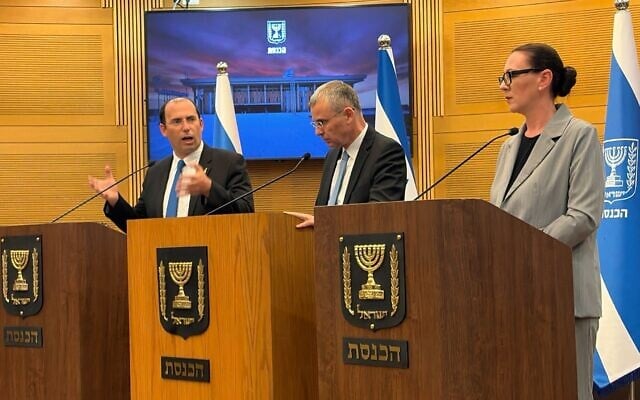
L-R: Knesset Constitution, Law and Justice Committee chairman Simcha Rothman, Justice Minister Yariv Levin and Yisrael Beytenu MK Yulia Malinovsky in the Knesset, May 10, 2026. (Sam Sokol/Times of Israel)
Justice Minister Yariv Levin, Knesset Constitution Law and Justice Committee chairman Simcha Rothman, and Yisrael Beytenu MK Yulia Malinovsky hold a joint press conference in the Knesset to celebrate the imminent passage of a bipartisan bill establishing a special military tribunal for trying Palestinian terrorists accused of committing atrocities during the October 7, 2023, invasion.
Addressing reporters, Levin asserts that the legislation, which is due to go through the final two readings needed for it to pass into law tomorrow evening, “ensures not only that justice is served, but also that the historical record of the horrific massacre — of the victims, the hostages, and those responsible — will endure for generations.”
“Together, we have succeeded in forging a very broad consensus in the Knesset, crossing coalition and opposition lines, so that this historic legal proceeding will take place on an agreed-upon basis and earn the trust of the entire nation,” he says.
Answering a reporter’s question, Levin argues that the bill will “ensure proceedings meet all standards so they gain international recognition and trust, especially in the United States,” while also making sure that trials are “managed efficiently so they finish within reasonable timeframes, despite being a massive event involving hundreds of defendants.”
Security forces captured approximately 300 of the invaders inside Israel following the attacks, and have held them in various detention centers since, with Israeli law enforcement and prosecutorial agencies deliberating over the last two and a half years on how best to put them on trial.
Under the legislation, the tribunal will be able to charge the assailants with all relevant crimes, including genocide under the terms of Israel’s 1950 Law for the Prevention of Genocide, harming Israeli sovereignty, causing war, assisting an enemy during a time of war, and terror charges under Israel’s 2016 law for combating terrorism.
Those convicted of genocide charges would be liable for the death penalty.
Citing the biblical verse “I will pursue my enemies and destroy them, and I will not return until they are consumed,” Rothman describes the bill as “a clear message to Israel’s enemies.”
Malinovsky, in turn, asserts that the tribunals enabled by the legislation will constitute a “modern Eichmann trial,” referring to the trial of notorious Nazi Adolf Eichmann in 1961, adding that “this law enjoys the broadest consensus seen here in years.”
Asked why the bill is necessary given that the coalition recently passed a death penalty for terrorists law, Malinovsky replies that “from the start, it was clear that the October 7 event is a separate case.” She adds that, because laws cannot be applied retroactively, her legislation had been, of necessity, based “on legislation and offenses that already existed in the statute book on October 7.”
Jeremy Sharon contributed to this report.
Former ADL director Abe Foxman dies at 86
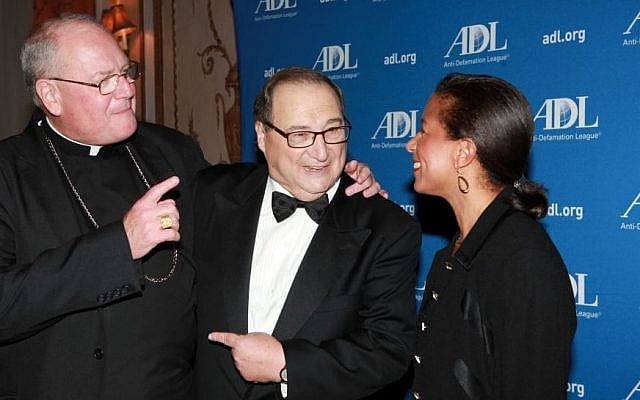
Abe Foxman, center, speaks with Cardinal Timothy Dolan and Susan Rice, the US national security adviser, at an event in New York honoring the outgoing national director of the Anti-Defamation League, June 17, 2015. (JTA/ David Karp)
The former national director of the Anti-Defamation League, Abraham (Abe) Foxman, has died at the age of 86.
Foxman, a lawyer and activist, served as the national director of the ADL between 1987 and 2015, and remained the national director emeritus until his passing.
Born on May 1, 1940, in what is now Belarus, Foxman spent the first years of his life in the care of his Polish Catholic nanny, having been entrusted to her by his parents in a bid to keep him safe during the Holocaust.
He was reunited with his parents in 1944, and the family immigrated to the US in 1950.

After receiving his law degree from the New York University School of Law, Foxman climbed the ranks of the ADL, eventually being appointed director of the anti-hate organization in 1987.
He stepped down from the post in 2015, and was succeeded by Jonathan Greenblatt.
From 2016 until 2021, Foxman served as the vice chair of the board of trustees at New York’s Museum of Jewish Heritage.
He will be buried at 10 a.m. EST on Tuesday (5 p.m. Israel time), and the funeral will be live-streamed.
Israel’s Noam Bettan walks the turquoise carpet at Eurovision opening ceremony

Israeli singer Noam Bettan, representing Israel with the song 'Michelle,' poses for photographers on the turquoise carpet for the opening ceremony of the Eurovision Song Contest 2026 at the City Hall Square in Vienna, Austria, on May 10, 2026. (Tobias SCHWARZ / AFP)
Israel’s Noam Bettan walks the “turquoise carpet” at the opening ceremony of the 2026 Eurovision Song Contest in Vienna, Austria.
“I’m so honored to be here and thank you so much for the opportunity,” the singer tells interviewers at the event, after walking down with Israel’s delegation and a number of security guards, to the tune of “Hava Nagila” played by the live band.
“I’m having the most fun time I’ve had in my life. This experience is incredible. The stage is huge. I’m with an amazing crew of amazing dancers,” Bettan adds. “Thank you all for the support and the love.”
Unlike last year’s “turquoise carpet” opening ceremony in Basel, Switzerland, no Palestinian flags can be seen in the gathered crowd, although some unclear chanting could be heard on the livestream. One attendee could be seen waving a sign that said “Zero points for antisemitism.”
Bettan will perform “Michelle” on Tuesday evening in the Eurovision’s first semifinal, aiming to qualify for a spot in Saturday’s grand final.
Netanyahu: War with Iran not over, enriched uranium must be ‘taken out’
Prime Minister Benjamin Netanyahu says that the war with Iran is not over as there remains enriched uranium in Iran’s possession that “has to be taken out” of the country, and broader “work to be done” against its military capabilities.
“I think [the war] accomplished a great deal, but it’s not over because there’s still nuclear material, enriched uranium that has to be taken out of Iran,” Netanyahu tells the CBS newsmagazine program “60 Minutes.”
“There are still enrichment sites that have to be dismantled. There are still proxies that Iran supports. There are ballistic missiles that they still want to produce. Now, we’ve degraded a lot of it, but all that is still there, and there’s work to be done,” Netanyahu says in a clip previewed from the interview, which will air in full later tonight.
Netanyahu does not initially specify whether he refers only to Iran’s stockpile of highly enriched near-weapons-grade uranium — believed to be buried underground in Isfahan — or its full supply of enriched uranium. But when asked how the highly enriched material should be removed, he responds, “You go in, and you take it out.”
“I think it accomplished a great deal, but it’s not over,” Israeli Prime Minister Benjamin Netanyahu tells 60 Minutes about the war in Iran. Netanyahu says highly enriched uranium must be removed from Iran and believes “it can be done physically.” pic.twitter.com/N5XbvzpYa0
— 60 Minutes (@60Minutes) May 10, 2026
Netanyahu suggests the uranium can be physically removed with or without an agreement with Tehran, and that the US is on board with either option, though he declines to discuss any military plans or timeline for such an operation.
“What [US] President [Donald] Trump has said to me: ‘I wanna go in there.’ And I think it can be done physically. That’s not the problem. If you have an agreement and you go in and you take it out, why not? That’s the best way,” he says.
Asked if it can be taken out by force if no agreement is reached, Netanyahu replies, “Well, you’re gonna ask me these questions, I’m gonna dodge them, because I’m not gonna talk about our military possibilities… I’m not gonna give a timetable to it, but I’m gonna say that’s a terrifically important mission.”
IDF: Sirens near Lebanon border were caused by interceptor missiles targeting threat over troops in Lebanon
The sirens that sounded in Lebanon border communities a short while ago were set off by interceptor missiles launched at an apparent Hezbollah aerial threat over an area of southern Lebanon where troops are deployed, the military says.
It says the sirens were activated in Israel as a precaution due to concern about shrapnel from the interceptors.
Iranian media claims two Mossad-linked cells ‘dismantled’ by security forces
Iran’s intelligence ministry claims to have “dismantled” two Mossad-linked cells operating inside Iran, the semi-official Mehr news agency reports.
Citing the Iranian intelligence ministry, the outlet says one alleged Mossad operative was killed in a clash with security forces, and the other members of the cell were arrested. It says one member of the cell was arrested at a border in northern Iran while trying to smuggle military intelligence.
According to the outlet, a number of weapons and drones were confiscated during the raid on the cell, as were Starlink internet devices.
It claims that the group was “planning terrorist operations against sensitive centers” and an assassination plot in Tehran.
It claims that a second Mossad-affiliated cell was busted and its members arrested in a simultaneous operation elsewhere in the country.
Iranian state media proposes charging international companies a fee to use fiber optic cables in the Strait of Hormuz
Iran’s semi-official Tasnim news agency proposes that the Islamic Republic could start charging international companies a fee to use undersea fiber-optic cables laid in the Strait of Hormuz, the English-language Iran International reports.
Tasnim, which has ties to the Islamic Revolutionary Guard Corps, posits in an article that the underwater internet cables could become a major revenue source for Iran at a time when the heavily sanctioned country is searching for new streams of income and increased control over the Strait of Hormuz.
The outlet suggests that the Islamic Republic could begin charging foreign companies annual licensing fees to use the communication routes that link the Persian Gulf to the rest of the world. It says that additional income could be generated by giving Iranian companies exclusive control over cable repair and maintenance.
But the news agency says the benefits could be more than just economic, Iran International reports, as Iran could require tech giants, including Amazon and Meta, to operate in accordance with Iranian law if they want access.
Making a similar proposition, the semi-official Fars news agency claims that Iran has the right to exercise its sovereignty over the Strait of Hormuz, including over the fiber optic cables laid in it, and that the right of transit does not change that.
The suggestions published by the Iranian media outlets appear to be the latest attempt by the Islamic Republic to make money from the Strait of Hormuz, a key shipping route through which around 20% of all oil and natural gas is transported.
Iran has imposed a near-total closure over the strait since the outbreak of war with the US and Israel on February 28, and has proposed requiring transiting vessels to pay a fee if they wish to pass through the waterway.
Rocket, drone infiltration sirens sound in communities on the Lebanon border
Sirens warning of rockets and a suspected drone infiltration sound in communities close to the Lebanon border.
The IDF says it is investigating the cause.
Dean Livne to serve as acting head of Central Elections Committee until after this year’s vote
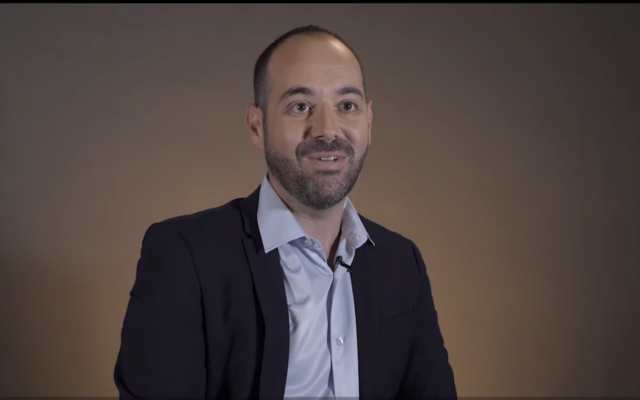
Dean Livne, tapped on May 10, 2026, as the Central Elections Committee acting director-general. (Screenshot/Globes)
Central Elections Committee chairman Deputy Supreme Court President Noam Sohlberg announces that the committee’s recently retired legal adviser, Dean Livne, will serve as acting directorgeneral following the resignation of veteran election czar Orly Adas, who will leave the role in July after 15 years on the job.
Sohlberg says he selected Livne to temporarily fill the post because Adas’s announcement earlier this month that she will resign months before the elections meant he was required to “ensure that an experienced person, possessing the knowledge and familiarity required to perform the task, serves in the position immediately” in order to ensure “functional continuity.”
The conservative justice explains that there was no time to organize a search committee, and his first choice from within the Central Elections Committee staff declined to take on the job, so he turned to Livne, who served as the committee’s legal adviser for over a decade until his resignation only three months ago.
Sohlberg cites Livne’s “extensive experience, familiarity with election laws” and other qualifications, adding that a search committee for a full-time replacement would be convened after the election.
The committee is an independent state body responsible for managing parliamentary elections and protecting their integrity. It is chaired by a Supreme Court justice, currently Sohlberg, and comprises representatives of the various factions in the Knesset. It is responsible for tallying votes and has the power to disqualify parties ahead of elections.
Senior Israeli, US figures unveil plan for new bilateral relationship based on technology partnership, not aid

Giant screens installed along a highway display the national flags of US and Israel, in Tel Aviv on March 4, 2026. (Jack GUEZ / AFP)
Amid cratering support for Israel in the United States, a former senior US official and a former senior Israeli official are offering a new vision for the bilateral relationship.
“We need to establish the relationship anew,” former IDF Military Intelligence chief Amos Yadlin tells The Times of Israel.
“The model in which Israel is assisted by the United States and receives aid has a very low chance of continuing under any future administration,” he says, “and perhaps even under the Trump administration, so we need to find a new basis for the relationship that is a transition from aid to partnership.”
Six in 10 Americans say they have a very or somewhat unfavorable view of Israel, up 20 percentage points since 2022, according to a new Pew Research Center survey released last month.
“We have work to do,” emphasizes former US ambassador to Israel Tom Nides in a Zoom conversation with The Times of Israel. “We have to tell the story of Israel. We have to tell the story about the innovation. We got to tell the story about Israel being a melting pot. Israel is a country of seven-plus million Jews and two million Arabs. We got to talk about what’s been great about the State of Israel and what they have done.”
In order to recast ties in a way that is more relevant for emerging technologies and geopolitical realities, while addressing some of the political concerns about the relationship, Yadlin and Nides are advancing the US-Israel Technology Alliance — Strategic Technology Compact.
The initiative, rolled out at the AI+ Expo over the weekend in Washington, DC, looks to build “the Special Relationship 2.0” by combining American capital, industrial might, and world-class laboratories with Israel’s speed, experience, and engineering ingenuity, according to the organizers.
“The United States has lots of technology,” said Nides. “We’re leading in technology and AI and innovation. It’s not lost on anyone that Israel is the startup nation. These two countries have been working together to create technology innovations and breakthroughs.”
“These two nations working collectively together is both good for Americans, the average American, and good for the average Israeli,” he continued. “And quite frankly, it’s good for the region and for the world as a whole.”
According to a draft proposal of the initiative — created by the US think tank Special Competitive Studies Project and the Israeli consultancy MIND Israel — the US-Israel relationship has rested on defense cooperation, security assistance, shared geopolitical interests, and cooperation between businesses.
“That foundation remains essential,” write the organizers. “But it is no longer sufficient for a century that will be defined by leadership in artificial intelligence, semiconductors, advanced energy, cyber, quantum, bioconvergence, and strategic manufacturing: both military and civilian.”
The US-Israel Tech Alliance looks to move beyond the security foundation for the relationship by creating “a more modern, more reciprocal, and more productive basis for long-term strategic partnership.”
The organizers call for both governments to sign a memorandum of understanding that would see Jerusalem and Washington commit to at least $1 billion per year of public funding of joint projects.
“The United States gains a trusted, battle-tested technology ally that strengthens American leadership in AI, cyber, energy, quantum, and industrial resilience,” according to the draft proposal. “Israel gains durable access to the world’s most important technology ecosystem – including federal programs, laboratories, capital pathways, procurement channels, and scale-up opportunities.”
Ministerial panel backs bills intended to give government ‘sole discretion’ over senior appointments
The Ministerial Committee for Legislation votes to back a pair of bills giving government ministers “sole discretion” over the selection of candidates for senior appointments, including the attorney general and heads of the Shin Bet and Mossad security agencies.
“The Government holds full and exclusive authority to appoint or refrain from appointing a person to a senior position in the civil service,” one of the two bills states, adding that the terms of such officials “shall terminate within one hundred days” of the formation of a new government unless extended — and that the government would have the power to remove senior officials “at any time at its sole discretion.”
Among the positions affected by the bills are the IDF chief of staff, the police inspector general, Shin Bet and Mossad chiefs, Prison Service head, civil service commissioner, and the attorney general, as well as director generals of government ministries and other senior officials.
The approval of the bills comes despite strong opposition from the office of the attorney general, which has stated that they would unacceptably politicize government.
“The time has come for an elected government to be able to work with public officials who are committed to its policy” and this legislation is an “important step” on the way to “restoring governance,” says Justice Minister Yariv Levin.
Should the bills pass into law, a government-appointed eligibility committee will be responsible for vetting nominees for senior appointments. The appointments would then be approved by a Knesset panel made up of two coalition and two opposition lawmakers, and a chairman selected by the entire parliament, effectively giving the governing coalition total control of the process.
The new procedures would also replace the current system for choosing the attorney general and civil service commissioner, making it easier to hire and fire them.
The sponsor of the bills, Likud MK Shalom Danino, says in a joint statement with Levin that the intent “is to establish an orderly process for appointing senior officials” and that, as members of the executive branch, “the power of dismissal is an inherent part of the government’s constitutional authority to manage the executive branch and the government apparatus.”
“The public responsibility imposed on the government requires that it be allowed effective control over the executive echelon — otherwise the connection between responsibility and authority will be broken,” he says.
UK faces ‘epidemic of anti-Jewish hate,’ United Synagogue president says at rally

People attend a rally organized by the Campaign Against Antisemitism, opposite Downing Street in central London on May 10, 2026. (Photo by JUstin Tallis/AFP)
Great Britain faces an “epidemic of anti-Jewish hate,” with arson attacks, stabbings and open intimidation of Jews on British streets, United Synagogue president Saul Taylor tells a London rally against antisemitism.
Some 20,000 people attended the rally, including many non-Jews, organizers say.
In a strongly worded speech, Taylor criticizes the broader anti-racism movement for failing to stand up for Jews.
“If this were any other community, this would be a national outrage,” he says. “Where are the Jewish Lives Matter marches? Where is the so-called anti-racist movement? As we know only too well, Jews don’t seem to count.”
British Jews have been rooted in the country for 370 years, and “are not going anywhere,” Taylor says.
“We are, and we always have been, proud British Jews, and we do not want to leave,” Taylor says. “We will not be beaten.”
Jews should not have to live under constant security, Taylor says, citing security measures that cost the United Synagogue about £1 million a year. Calling it a “tax on being Jewish in Britain,” he notes that one synagogue alone spends £20,000 a month on security.
Following the recent stabbing of two Jews in the heavily Jewish neighborhood of Golders Green, the government has moved more to fight antisemitism in the past week than it has in a long time, Taylor says. “But there is much more that needs to be done,” he adds.
Taylor praises organizations such as Community Security Trust, Shomrim and Hatzola for their role in community protection. He urges the government to ban extremist groups and “hate marches” — referring to the pro-Palestinian and anti-Israel marches that have frequently been accused of engaging in antisemitism.
He calls on Prime Minister Keir Starmer to ensure that offenders feel “the full force of the law.”
Iran’s response to US proposal focuses on ‘ending the war and maritime security,’ state media says
Iran’s response to the latest US peace proposal focuses on “ending the war and maritime security,” local media reports, shortly after Tehran said it had delivered its answer to Pakistani mediators.
“It should be noted that the main focus of Iran’s response to the US proposal is on ‘ending the war and maritime security’ in the Persian Gulf and the Strait of Hormuz,” the ISNA news agency says, without offering further details.
The US proposal, if Iran agrees to it, will formally end the war and reopen the Strait of Hormuz before beginning talks on more contentious issues, including the Iranian nuclear program.
WATCH: IDF drone targets suspected bomb-planter in southern Gaza
The IDF publishes footage of a drone strike in southern Gaza targeting a terror operative suspected of planting an explosive device near troops operating in the area.
According to the military, the strike was conducted in coordination between the Israeli Air Force and the Kfir Brigade operating on the ground in the Gaza Strip.
צפו בתיעוד: שיתוף הפעולה בין מפעיל כלי טיס מאויש מרחוק לקצין בחטיבת כפיר ברצועת עזה
בסגירת מעגל מהירה, כלי טיס מאוייש מרחוק של חיל האוויר, תקף בסיוע לחטיבת כפיר מחבל החשוד בהנחת מטען בדרום רצועת עזה.
חיל האוויר ממשיך לסייע לכוחות הלוחמים בגזרות השונות בהתקפה ובהגנה כל העת pic.twitter.com/UGhx7srrMw
— צבא ההגנה לישראל (@idfonline) May 10, 2026
Iranian spokesman warns of ‘decisive’ military response to any US naval attacks
Any attacks against Iranian ships in the Gulf will be met with a “heavy and decisive” response against US ships and bases in the region, says the spokesman for Iran’s parliamentary National Security and Foreign Policy Commission.
“As of today, our restraint is over,” writes Ebrahim Rezaei in a Persian-language post on X. “Any aggression against our vessels will be met with a heavy and decisive Iranian response against American vessels and bases.”
“The clock is ticking against the Americans’ interests; it is to their benefit not to act foolishly and sink themselves deeper into the quagmire they have fallen into,” he continues. “The best course is to surrender and concede concessions. You must get used to the new regional order.”
Meanwhile, Qatari Prime Minister Mohammed bin Abdulrahman Al Thani tells Iran’s Foreign Minister Abbas Araghchi in a phone call that “freedom of navigation is a well-established principle that must not be compromised,” and that closing the Strait of Hormuz only puts the region in danger and makes the current crisis worse, according to the Qatari readout.
Coalition accuses attorney general of corruption, endangering security over opposition to incoming Mossad chief
Coalition ministers accuse Attorney General Gali Baharav-Miara of corruption and endangering state security after she endorsed petitions today seeking to overturn the appointment of Prime Minister Benjamin Netanyahu’s military secretary, Maj. Gen. Roman Gofman as the next director of the Mossad intelligence agency.
Finance Minister Bezalel Smotrich says Baharav-Miara is part of “a corrupt system that has hijacked the State of Israel,” and accuses her and the High Court of being “two corrupt bodies violently imposing their position on the elected government.”
Claiming the attorney general “repeatedly acts to thwart” government policy, Smotrich again calls for her resignation and vows to advance legislation splitting the role of the attorney general into separate positions, which would effectively deprive the position of all authority and independence.
National Security Minister Itamar Ben Gvir accuses Baharav-Miara of “fighting the State of Israel and endangering its security,” telling her: “In Tehran, they are applauding you. They could not dream of a better ally than you.”
Communications Minister Shlomo Karhi again calls on the government to defy any High Court ruling overturning Gofman’s appointment as well as both previous and future rulings blocking the attorney general’s dismissal.
“The last month alone is more than enough to justify a new government decision: canceling the High Court order, reaffirming the immediate dismissal of the ousted attorney general, and appointing an acting attorney general without delay,” says Karhi in a post on X.
The High Court in December struck down the government’s decision to fire Baharav-Miara, ruling it had failed to provide legal justification for changing the dismissal process for an attorney general. Critics have argued that Baharav-Miara was fired simply for repeatedly pointing out that the government was acting in violation of the law, and that the government had designed a political process to facilitate her dismissal on political, not professional, grounds.
Left on the sidelines, Eisenkot says Bennett-Lapid merger ‘not how you build partnerships’
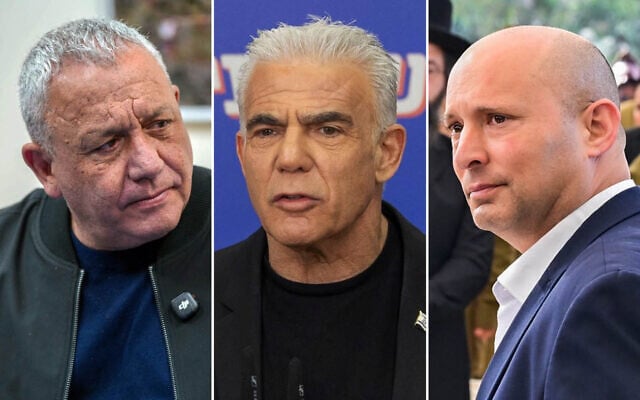
L-R: Former IDF chief of staff Gadi Eisenkot seen during a visit to Kibbutz Yiftah near the Israeli border with Lebanon, March 9, 2026. (Ayal Margolin/Flash90); opposition leader and head of the Yesh Atid party MK Yair Lapid in the Knesset, March 30, 2026. (Oren Ben Hakoon/Flash90); former prime minister Naftali Bennett attends a funeral at the Military Cemetery in Beit She'an on April 9, 2026. (Michael Giladi/Flash90)
Yashar chairman Gadi Eisenkot criticizes the union of former prime minister Naftali Bennett and Opposition Leader Yair Lapid, telling party activists in a recording from a conference on Thursday that he had long pushed to create a large centrist party to challenge Prime Minister Benjamin Netanyahu, and that his opposition colleagues’ decision to go ahead and merge without him was “not how you build partnerships.”
“The main alternative I tried to promote about six months ago was organizing the camp that the media calls ‘center left,’ and which I call the ‘statesmanlike camp’ that would go with the liberal right. My thought was to reach an optimization of a structure that would bring the maximum number of votes and lead to victory. Certainly not to repeat what happened in the last elections,” Eisenkot says in a recording published by the Ynet news site.
Such a party would have included Eisenkot, Bennett, and Lapid but not Yair Golan’s The Democrats or Avigdor Liberman’s Yisrael Beytenu, in order to give voters three alternatives: a “super-party” in the center alongside left and right-wing alternatives.
However, he did not succeed and ultimately received a phone call informing him of Bennett and Lapid’s union only minutes before it was publicly announced — after which the two announced that they had “opened the door for me and were even saving the second and third spots for me,” Eisenkot continues.
“That’s not how you build partnerships. Now, I’m not insulted. I immediately picked up the phone and said let’s meet and continue to cooperate. What guides me is how we defeat this bad government and build an alternative.”
“There is no anger in me, nothing at all, and I am not taking any merger off the table. What matters is how to win,” Eisenkot adds.
Following reports that Eisenkot and Liberman were in talks on a potential merger, the two politicians announced last Thursday that they are working to expand cooperation ahead of the upcoming election, but did not confirm any plans to run on a unified slate.
Iran has sent response to US proposal on ending war, state media reports
Iran has submitted its response to the latest US proposals to permanently end the war and begin peace talks via Pakistani mediators, Iranian state media reports.
The US proposal would formally end the war and reopen the Strait of Hormuz before beginning talks on more contentious issues, including the Iranian nuclear program.
UK Conservative Party leader: Britain ‘must always be a sanctuary for Jewish people’

UK Conservative Party leader Kemi Badenoch speaks to a rally in London against antisemitism on May 10, 2026. (Screenshot)
Speaking at a London rally against antisemitism, UK Conservative Party leader Kemi Badenoch vows to confront rising antisemitism in Britain, saying the country “must always be a sanctuary for Jewish people.”
Speaking to a crowd of thousands attending the event near the residence of Prime Minister Keir Starmer, Badenoch says she was not there to “do politics” but to honor a promise to stand with British Jews amid growing fears regarding extremism and hate. She condemns “the hatred of Jews” and criticizes those who, she said, were afraid to name or challenge it.
Badenoch links antisemitism in Britain to a broader surge in global extremism, recalling Islamist attacks and the Hamas-led October 7, 2023, atrocities in Israel.
“The people who want us to be afraid must never be allowed to win,” she says. She pledges to fight for “a Britain where Jews can go to school and worship freely.”
Zamir tells Knesset committee that IDF urgently needs more soldiers – report
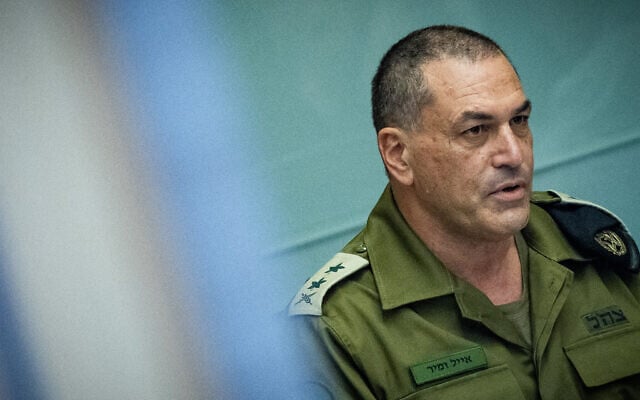
IDF Chief of Staff Eyal Zamir attends a Foreign Affairs and Defense Committee meeting at the Knesset in Jerusalem, May 10, 2026. (Yonatan Sindel/Flash90)
IDF Chief of Staff Lt. Gen. Eyal Zamir reiterates to the Knesset Foreign Affairs and Defense Committee in a closed-door session that the military urgently needs more soldiers amid ongoing fighting on multiple fronts, according to Hebrew media reports.
“I am not dealing with political or legislative processes – I am dealing with multi-front warfare and defeating the enemy,” Zamir reportedly tells lawmakers after appearing before the committee following pressure from chairman Boaz Bismuth. “In order to continue doing that, the IDF urgently needs more soldiers.”
According to the reports, Zamir urges lawmakers to advance legislation enabling the enlistment of military-age ultra-Orthodox men, extend mandatory service from 30 to 36 months and increase the defense budget. A contentious bill sponsored by Bismuth would enshrine blanket exemptions for yeshiva students.
Hezbollah rockets targeting troops in south Lebanon intercepted, IDF says
Hezbollah fired several more rockets at Israeli troops stationed in southern Lebanon a short while ago.
The military says the projectiles were intercepted. There are no reports of injuries.
Separately, the military says that an airstrike yesterday killed a Hezbollah operative who approached troops in southern Lebanon.
British chief rabbi at rally: UK’s ‘poisonous antisemitism has become normalized’
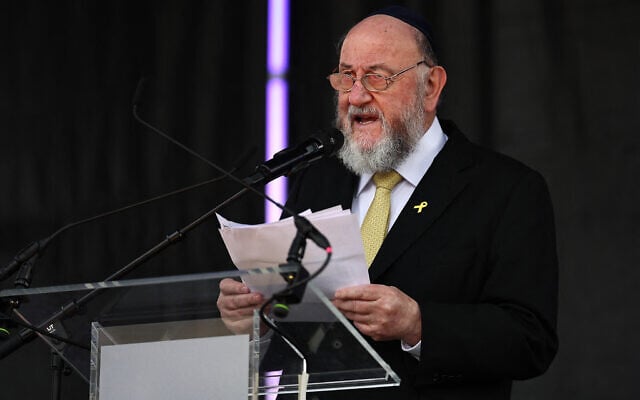
Illustration: UK Chief Rabbi Ephraim Mirvis speaks to people gathering for a commemorative event organized by the Jewish community to honor the lives lost in the Hamas massacre in southern Israel on October 7, 2023, in Trafalgar Square, London on October 5, 2025. (Photo by HENRY NICHOLLS / AFP)
Speaking at a rally against antisemitism in London, UK Chief Rabbi Ephraim Mirvis warns that antisemitism has become “normalized” across British society and urges the country to confront the rising tide of hatred.
Citing the Book of Psalms, Mirvis tells the rally that citizens must “turn away from that which is unacceptable and always to what is right,” arguing that it is now easy to see what is unacceptable. He mentions recent antisemitic incidents including an arson attack on a synagogue and the targeting of Jews in violent attacks, and makes note of security fences around Jewish institutions.
“It is unacceptable that poisonous antisemitism has become normalized in the UK,” he says, noting its presence in politics, the media, universities, schools, the arts, the National Health Service and on the streets.
Mirvis condemns social media platforms for allowing “Jew hatred” to spread and criticizes Iran for allegedly fomenting violence against British citizens.
“Why has the Iranian ambassador not been expelled?” he asks. A group that is reportedly linked to Iran has claimed responsibility for some of the attacks.
Mirvis praises the “silent majority” of non-Jewish Britons who have begun speaking out, saying their support shows that attacks on Jews are attacks on all of society.
“This moment should be seen as a potential turning point in history,” he says. “This is an opportunity for British society from now onwards to confront antisemitism at long last, and to deal with it effectively.”
Far-right provocateur hurls homophobic abuse at gay secularist activist in Tel Aviv
Naor Narkis, who has gained notoriety for his anti-religious advocacy in ultra-Orthodox communities, was targeted by homophobic abuse in Tel Aviv last night by a group of right-wing activists including Mordechai David, a prominent far-right activist aligned with senior members of Prime Minister Benjamin Netanyahu’s Likud Party who regularly harasses critics of the government.
Footage shows David and his companions shouting “f*ggot” and “tranny” at Narkis, filming him and trying to block him, as the secularist activist and his male partner enter the Tel Aviv Cinematheque holding hands.
מרדכי דוד חוסם את נאור נרקיס בדרכו לסינמטק.
מרדכי דוד ופעילי ימין נוספים ובהם ויקטור שריקי ואלירן סימנטוב, עוקבים אחרי נאור נרקיס אל תוך בניין הסינימטק ונכנסים לאולם הקולנוע ללא כרטיסים תוך שהם מתעלמים מהעובדת שנמצאת במקום.תל אביב 09/05/2026 🎥עופרי איתן pic.twitter.com/W7j64UNscN
— אלימות ישראל (@Alimut_Israel) May 9, 2026
David’s group can be seen following Narkis and his partner into a movie theater at the Cinematheque, even as staff say the right-wing activists cannot enter without tickets. The activists linger in the theater complex, with some of them taking seats, until security escorts them out.
Narkis and his partner say the right-wing group also made crude references to the couple’s sex life and yelled that the two men were “sick with AIDS.”
“Police who were on the scene did nothing,” Narkis writes on Facebook, calling on openly gay Knesset Speaker Amir Ohana, a member of Likud, to condemn the incident.
The Israel Police does not immediately respond to a request for comment on Narkis’s accusation.
The Aguda LGBTQ umbrella group says in a statement that “to stop a person who is walking with his partner, threatening him, blocking his path and hurling anti-LGBTQ abuse at him… is a moral low point.”
The homophobic attack was “especially concerning given Mordechai David has long enjoyed the public embrace of lawmakers and ministers from the coalition, and has even been personally invited to events alongside senior law enforcement officials,” the Aguda says, adding that it has asked police chief Daniel Levy to probe the incident.
Major rally against antisemitism kicks off in London

Attendees at a rally against antisemitism in London, May 10, 2026. (Screenshot/YouTube)
A London rally against antisemitism (watch here) led by dozens of Jewish organizations has begun at Downing Street, the location of Prime Minister Keir Starmer’s official residence, following a surge of attacks on Jewish targets in the country.
Thousands of people are expected to attend the event, which started at 1 p.m. local time (3 p.m. Israel time). It is being held in response to a series of recent attacks, including the stabbing of two Jews in the heavily Jewish neighborhood of Golders Green, the torching of four Hatzolah ambulances, arson attacks on synagogues, and a deadly shooting on Yom Kippur at Heaton Park Synagogue in Manchester in October.
Attendees wave British, Irish and Israeli flags, and hold signs calling on the UK to stand against antisemitism. Organizers hope a large crowd will join what Jewish Chronicle columnist Stephen Pollard called a “million mensch march.”
There is a heavy security presence, and bags will not be admitted into the protest area, organizers say.
Jewish community and political leaders, including Conservative Party leader Kemi Badenoch, are set to speak at the event, put on in cooperation between dozens of Jewish organizations. Starmer has been invited and is considering attending, according to local media.
The rally follows local elections last week that saw significant victories for the far-right Reform UK Party as well as the far-left, anti-Israel Greens, leading to mounting calls for Starmer to resign.
Lebanon says two Hezbollah-linked paramedics killed by Israeli strikes in south
Lebanon’s Health Ministry says two paramedics from the Hezbollah-affiliated Islamic Health Committee were killed and five others wounded today in Israeli strikes on the country’s south.
A ministry statement says Israel “directly targeted, with two strikes, two Health Committee sites,” killing one paramedic and wounding three others in Qalaway, and killing another paramedic and wounding two others in Tibnin. The statement decries Israel’s continued “violation of international laws.”
There was no immediate comment from the IDF on the strike, though the military has repeatedly warned in recent weeks that Hezbollah, the Iran-backed terror group, is using ambulances and medical facilities in Lebanon for military purposes.
IDF says it intercepted Hezbollah rockets, drones in south Lebanon; no injuries
The Israel Defense Forces says it intercepted several rockets and apparent drones launched by Hezbollah at troops stationed in southern Lebanon today.
No injuries were caused in the incidents.
Woman arrested after allegedly shouting ‘F*ck the Jews’ at kids’ sports game in Sydney
After allegedly shouting antisemitic remarks at a children’s netball game in Sydney, a woman has been charged for using offensive language in or near a public place or school, New South Wales Police say.
According to reports, the 42-year-old woman shouted antisemitic remarks like “F**k the Jews” and “They should have all been eradicated” at a Saturday morning under-12 match between the Jewish-affiliated Maccabi Netball NSW club and Saints Netball Club.
Police were called to the match and removed the woman after parents complained.
Sideline outrage in Sydney's east: a junior netball match has led to criminal charges after alleged antisemitic remarks from the sidelines. Police, clubs investigating as community reels – zero tolerance for hate in youth sport. No place. #Antisemitism #Sydney pic.twitter.com/PhKlQyz7NF
— AussiEx.au (@aussiExau) May 10, 2026
The Saints club later condemned the alleged remarks and apologized to the Jewish community, saying antisemitism “does not reflect the values” of the organization. The Randwick Netball Association also condemned the remarks.
“Netball is a place where everyone is welcome and we will not tolerate antisemitic or discriminatory behaviour in our community in any way,” the association’s president said in a statement. “Right now our priority is care for the Maccabi Netball Club and all of its members. My message to you is that you are welcome, you belong, and you are valued.״
The incident comes in the wake of years of rising antisemitism in Australia since the Hamas-led October 7, 2023, invasion and massacre in Israel. In December, 15 Jews were killed in a terror attack at a Hanukkah celebration on Sydney’s Bondi Beach.
“Decent Australians have put up with too much for too long,” says Executive Council of Australian Jewry co-CEO Alex Ryvchin. “The families who stood up yesterday should be commended and they have every right to attend weekend sports with pride and pleasure, not concerned as to what might happen next.”
Comptroller tells heated hearing his Oct. 7 probe essential as bereaved parents yell at justices
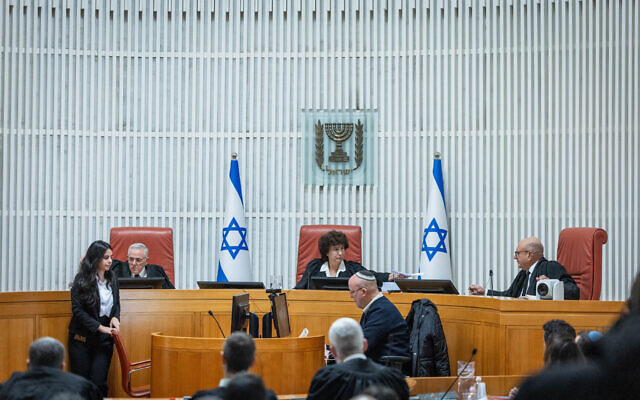
Supreme Court justice Daphne Barak-Erez presides over a hearing on petitions calling to halt or limit State Comptroller Matanyahu Englman’s investigations into the failures surrounding the Hamas-led October 7 attack, December 29, 2025. Chaim Goldberg/Flash90)
State Comptroller Matanyahu Englman insists that his office is empowered to review the failings behind the catastrophic Hamas-led October 7, 2023, invasion and that its ability to do so is critical for preserving the comptroller’s independence with the framework of Israel’s democracy.
Englman makes his comments during a High Court hearing over petitions asserting that the State Comptroller’s office does not have the authority or competence to probe government policy, security strategy, and apparent intelligence failures relating to the October 7 attack.
“What has guided me during the entire review of the war is the Israeli citizen. Fixing the problems, with the institution of the comptroller preserving its independence and not being dependent on any official or the establishment of another [investigative] mechanism, which we see as very important but which we do not think contravenes in any way a state comptroller review,” says Englman in an impassioned address to the court.
During the hearing, two bereaved parents begin shouting at the judges, accusing them of responsibility for the October 7 disaster.
One of the parents screams “They murdered our children because of you,” while another shouts “You forbade soldiers from firing on those who broke through the fence… October 7 is on your hands.”
Their comments reflect a campaign within the right-wing media and political landscape to attribute blame to the High Court for the October 7 invasion. The court in 2018 explicitly rejected petitions against the IDF’s open-fire regulations, and upheld the military’s policy of shooting those who approached the Gaza border security barrier.
In his own remarks, Englman argues that his probe does not come at the expense of a state commission of inquiry but would rather complement it, should the government establish such an investigation. The government has refused to set up a state commission of inquiry, Israel’s highest investigative authority, arguing that it would be biased, despite polls showing most Israeli want one.
He says that his office has focused on details relating to key issues that have arisen from his investigation and that are included in four draft documents that have yet to be published. He listed the interface between intelligence agencies and public diplomacy failures as two examples.
“We very much request that the state comptroller be able to fulfill his role in Israel’s democracy, in accordance with the limits of his authority,” concludes Englman.
But several of the five presiding justices during the hearing appeared skeptical of claims by the state comptroller’s legal representative that the quasi-constitutional Basic Law: The State Comptroller empowers the office to review government policy and security strategy.
They also called into question some of the methods used by the state comptroller in compiling his reports, including claims that some senior security officials have not been granted the right to submit their version of events.
UAE says it intercepted 2 Iranian drones
Iran fires two drones at the United Arab Emirates, the Emirati Defense Ministry says.
Both were “successfully engaged,” according to the UAE.
Iran has fired 2,265 drones, 551 ballistic missiles, and 29 cruise missiles at the UAE since the start of the US-Israeli campaign against Iran on February 28.
Netanyahu to discuss Iran, Trump in ’60 Minutes’ interview on CBS tonight
An interview with Prime Minister Benjamin Netanyahu will air on the CBS newsmagazine program “60 Minutes” this evening in the US.
According to promotional material, Netanyahu speaks with reporter Major Garrett about “the ongoing conflicts in the Middle East, prospects for a peace deal, and what he told President Trump in the White House Situation Room prior to the president’s decision to strike Iran.”
Sunday on 60 Minutes: Israeli Prime Minister Benjamin Netanyahu speaks with CBS News' Major Garrett about the ongoing conflicts in the Middle East, prospects for a peace deal, and what he told President Trump in the Situation Room prior to the president’s decision to strike Iran. pic.twitter.com/MzZ0QWcJf3
— 60 Minutes (@60Minutes) May 10, 2026
Netanyahu has given periodic interviews to international media since the October 7, 2023, Hamas-led attack, while largely restricting his interviews with Israeli outlets to those that are considered openly supportive of him.
Khamenei briefs army chief on ‘guiding measures to pursue military operations’ — Iranian media
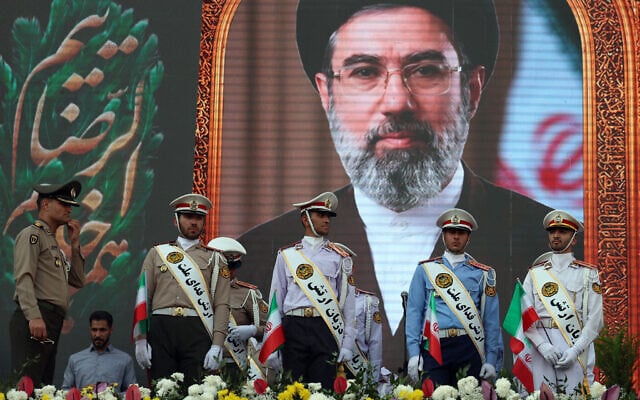
Iranian army soldiers stand in front of a picture of Iran's Supreme Leader Ayatollah Mojtaba Khamenei during a pro-regime rally in Tehran, Iran, on April 29, 2026. (AFP)
The head of Iran’s armed forces unified command met Supreme Leader Mojtaba Khamenei and received from him “new guiding measures to pursue military operations and firmly confront adversaries,” the semi-official Fars news reports.
The Fars report says that Ali Abdollahi, who commands the Khatam al-Anbiya Central Headquarters, had briefed Khamenei on the readiness of the country’s armed forces. It does not say when their meeting took place.
“The armed forces are ready to confront any action by the American-Zionist [Israeli] enemies. In case of any error by the enemy, Iran’s response will be swift, severe, and decisive,” Abdollahi is reported as saying.
Khamenei, who was appointed to replace his father as supreme leader in March, has not been seen or heard publicly, and uncertainty has swirled around his condition.
Times of Israel staff contributed to this report.
Iraqi ministers said set to be questioned after report that Israel built base in desert
The Qatari newspaper Al-Araby Al-Jadeed reports, citing an Iraqi source, that the Iraqi parliament will summon the country’s defense and interior ministers for questioning over a report in The Wall Street Journal claiming that Israel built a military base near the Saudi-Iraqi border in the Najaf desert to support operations during the war against Iran.
A source in the Iraqi parliament tells the newspaper that the ministers will be summoned along with commanders from Iraq’s security establishment.
A security source also told the newspaper that the area mentioned in the report, where the base was allegedly located, is currently “clear” and no military force remains there.
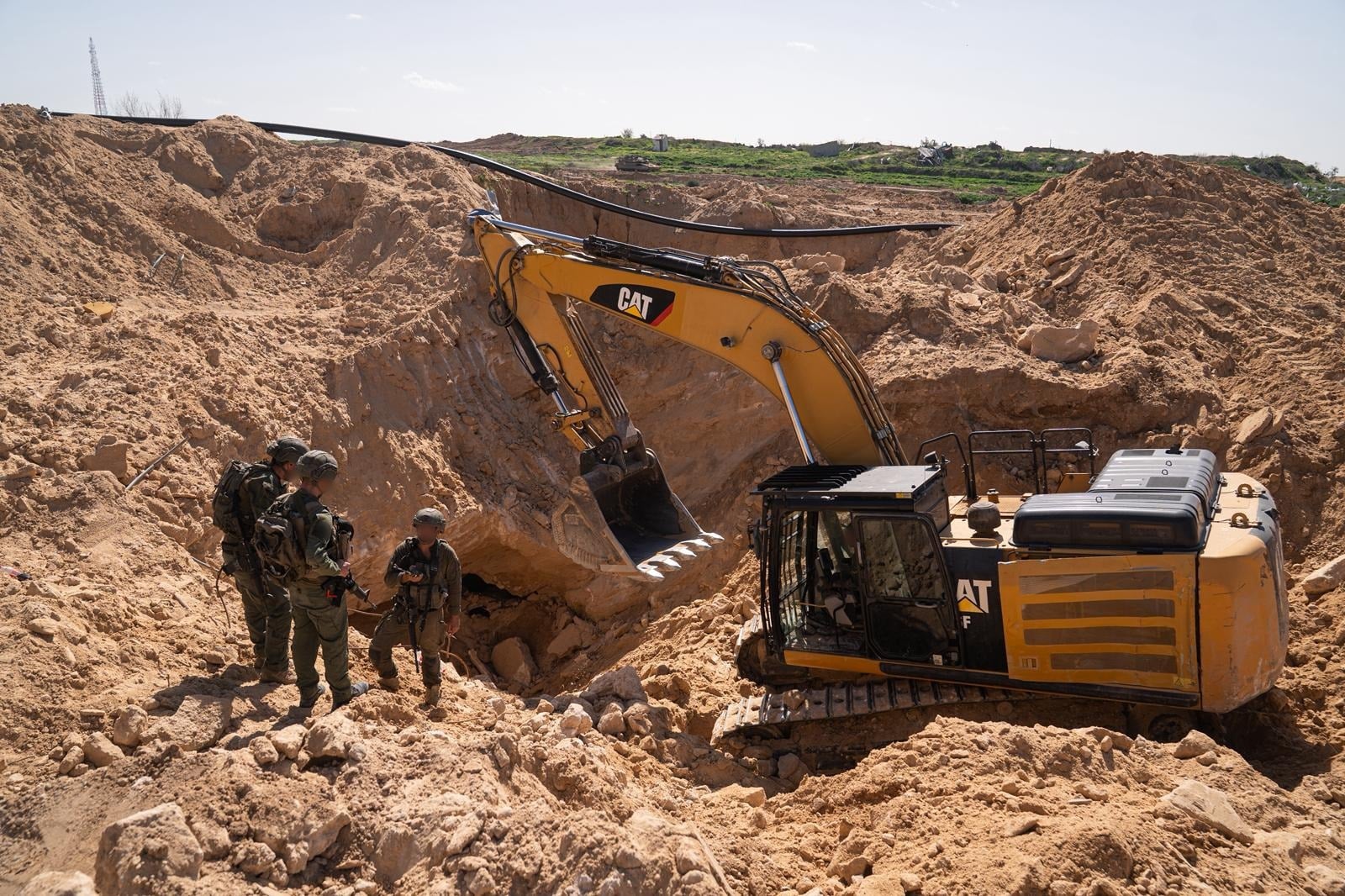
IDF destroys 2 tunnels in central Gaza on Israeli-controlled side of ceasefire line

Israeli troops work to destroy a terror tunnel discovered in central Gaza, in a photo cleared for publication on May 10, 2026. (Israel Defense Forces)
Troops from the Kfir Brigade destroyed two tunnels used by terror operatives in central Gaza, the IDF says, as the military continues efforts to clear terror infrastructure in the Israeli-controlled section of the Strip.
The tunnels had a combined length of approximately two kilometers (1.25 niles), the army says.
According to the IDF, the tunnels contained several living quarters as well as weapons, while troops also located dozens of rockets and explosive devices during searches in the area.
The military publishes photos of troops sealing the tunnels with cement.
Qatar says cargo ship in its territorial waters was targeted by drone
Qatar’s Ministry of Defense says a commercial cargo vessel in the country’s territorial waters, northeast of its Mesaieed Port and coming from Abu Dhabi, was targeted by a drone earlier today.
The attack resulted in a limited fire onboard the vessel, with no reported injuries, the ministry says, adding that the vessel continued its journey toward Mesaieed Port after the fire was brought under control.
The incident comes amid continuing tensions over Iran’s blockade of the Strat of Hormuz in the Gulf amid the US-Israeli war with Iran, which has been observing a truce for more than a month.
Kuwait’s military says hostile drones detected in airspace
Kuwait’s armed forces detected several hostile drones in Kuwaiti airspace earlier today and responded according to established procedures, Defense Ministry spokesperson Colonel Saud Abdulaziz Al-Atwan says.
Palestinian doctors in West Bank launch partial strike over delayed salary payments

Illustrative: In this file photo taken on January 27, 2021, Palestinian doctors and technicians work at the IVF laboratory at the Razan Center fertility clinic in Nablus, in the West Bank. (Jaafar Ashtiyeh/AFP)
The Palestinian Doctors Association announces a partial strike beginning today in government hospitals and public medical institutions across areas governed by the West Bank-based Palestinian Authority, amid an ongoing crisis over salary payments to public sector employees, including doctors.
The crisis stems from the fact that, for the past year, Israel has not transferred Palestinian tax revenues to the PA, which it agreed to do under the 1990s Oslo Accords. The sums amount to hundreds of millions of shekels per month and constitute around 60% of the Palestinian Authority’s revenues.
Last month, the Palestinian Finance Ministry announced that it would pay all public employees, including senior officials, a monthly salary of NIS 2,000.
In a statement, the doctors’ group said the strike includes “the closure of health centers and clinics, emergency-only operations at government hospitals — with the exception of treatment for kidney patients, blood diseases, and maternity cases — as well as a strike at Health Ministry buildings in Ramallah and Nablus.”
The doctors also wrote in their statement that they “hold the government fully responsible for the dangerous deterioration threatening patients and medical services.”
AG asks High Court to strike down Roman Gofman’s appointment as Mossad director
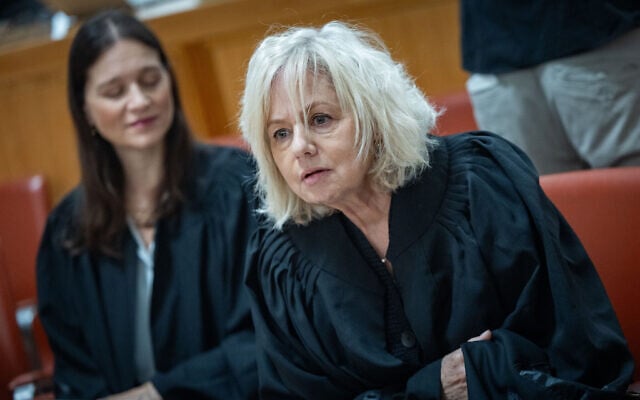
Attorney General Gali Baharav-Miara attends a ceremony for outgoing Supreme Court Justice Yosef Elron at the Supreme Court in Jerusalem, September 18, 2025. (Yonatan Sindel/Flash90)
Attorney General Gali Baharav-Miara endorses petitions against the appointment of Maj. Gen. Roman Gofman as the next director of the Mossad intelligence agency, telling the High Court that the appointment “suffers from extreme and glaring unreasonableness.”
The appointment of Gofman, who has been serving as Prime Minister Benjamin Netanyahu’s military secretary, was greenlit last month by the Senior Appointments Advisory Committee.
In a lengthy filing, Baharav-Miara points to three flaws in the committee’s ruling. She says the three committee members who supported Gofman’s appointment did so before reviewing the dissenting opinion of committee head Asher Grunis, and that two members were kept from seeing classified documents.
She adds that Ori Elmakayes, who, as a teenager, was allegedly used by Gofman for an “influence campaign,” was not allowed to appear in front of the committee.
Elmakayes and Telem–the Movement for Integrity in Government, filed the petitions against Gofman, which focused on his choice to use Elmakayes, then 17, in an Arabic-language influence campaign.
As a result of Gofman’s actions, Elmakayes was detained and interrogated by the Shin Bet domestic security agency, held in isolation for two months, charged with espionage offenses, and detained for 18 months before the charges were dropped.
“The committee did not conduct a sufficient or exhaustive factual inquiry,” writes Baharav-Miara, “and its decision appears to be deficient in a manner that undermines the integrity-related aspects of the matter, including the prime minister’s ability to rely upon it in deciding to appoint Gofman as head of the Mossad.”
This alone, she says, “is enough to justify canceling the prime minister’s decision.”
The case’s “integrity defects,” she adds, “go to the root of the appointment to the position of head of the Mossad.”
The Elmakayes affair, she writes “casts a heavy shadow over Gofman’s integrity and, by extension, over his appointment to the position of head of the Mossad.”
The appointment, therefore, “suffers from extreme and glaring unreasonableness, cannot stand legally, and must be annulled,” she writes.
She adds that current Mossad chief David Barnea sent a confidential letter to be forwarded to the court related to the petitions.
Thousands expected today at ‘million mensch’ London rally against rising antisemitism

Protesters gather near Downing Street during a “national emergency” rally organized by the Campaign Against Antisemitism following a knife attack in Golders Green, in London, April 30, 2026. (AP Photo/Alberto Pezzali)
Thousands of people are expected to attend a Jewish communal rally against antisemitism in London today following a surge of attacks on Jewish targets in the country.
Dozens of Jewish organizations have joined together to protest outside Downing Street, the location of Prime Minister Keir Starmer’s residence, at 1 p.m. local time (3 p.m. Israel time). Starmer has been invited and is considering attending, according to local media, while Conservative Party leader Kemi Badenoch is expected to speak along with Chief Rabbi Ephraim Mirvis, who is Orthodox, and senior progressive rabbis.
Other senior politicians have been invited, including Ed Davey, the leader of the Liberal Democrats, and Nigel Farage, who heads the far-right Reform UK. A petition protesting the invitation to Farage has garnered 2,000 signatures.
Zack Polanski, the Jewish, anti-Israel leader of Britain’s far-left Green Party, has not been invited. Polanski has made anti-Israel, pro-Palestinian issues a centerpiece of his party’s platform, and he recently criticized police officers who arrested the suspect in a stabbing attack targeting Jews — for which he apologized.
The rally follows a series of recent attacks including the stabbing of two Jews in the heavily Jewish neighborhood of Golders Green, the torching of four Hatzolah ambulances, arson attacks on synagogues, and a deadly shooting on Yom Kippur at Heaton Park Synagogue in Manchester in October.
Organizers hope a “silent majority” will join what Jewish Chronicle columnist Stephen Pollard called a “million mensch march.”
Stand with British Jews today at 1PM outside Downing Street.
Entrance only via Trafalgar Square end of Whitehall of Whitehall Place. No bags permitted. Searches in place. pic.twitter.com/nbvqekaB1Q
— Board of Deputies of British Jews (@BoardofDeputies) May 10, 2026
Security will be heavy, and bags will not be admitted into the protest area, organizers say.
The rally follows local elections last week that saw significant victories for Reform UK as well as the Greens, leading to mounting calls for Starmer to resign.
“For two and a half years we have warned about the staggering rise in antisemitism in this country,” says Keith Black, Chair of the Jewish Leadership Council. “Yet, antisemitism in Britain is not just rising, it is escalating into deadly acts of violence and terror.”
Qatari PM discussed Iran ceasefire efforts with Rubio, Witkoff in Miami, Doha says
Qatari Prime Minister and Foreign Minister Mohammed bin Abdulrahman Al-Thani discussed mediation efforts to reach a US-Iranian agreement in a meeting with US Secretary of State Marco Rubio and special envoy Steve Witkoff in Miami yesterday, the Qatari Foreign Ministry says in a statement.
Prime Minister and Minister of Foreign Affairs @MBA_AlThani_ Meets US Secretary of State, US President's Special Envoy to the Middle East
Miami | May 10, 2026
HE Prime Minister and Minister of Foreign Affairs Sheikh Mohammed bin Abdulrahman bin Jassim Al-Thani met Sunday with… pic.twitter.com/QxICsWSGcw
— Ministry of Foreign Affairs – Qatar (@MofaQatar_EN) May 10, 2026
The three “discussed the latest developments in the region, as well as the Pakistani mediation aimed at reducing escalation that contributes to enhancing security and stability in the region,” the statement reads.
It said the Qatari leader “expressed the need for all parties to respond to the ongoing mediation efforts, which would open the way for addressing the root causes of the crisis through peaceful means and dialogue, and lead to reaching a comprehensive agreement that achieves sustainable peace in the region.”
Qatar has been quietly operating as a go-between in efforts to reach a permanent ceasefire with Tehran, while allowing Pakistan to play the main mediating role, a source confirmed to The Times of Israel yesterday.
Culture Minister Zohar claims Hamas ‘concocted’ October 7 attack during Bennett-Lapid government
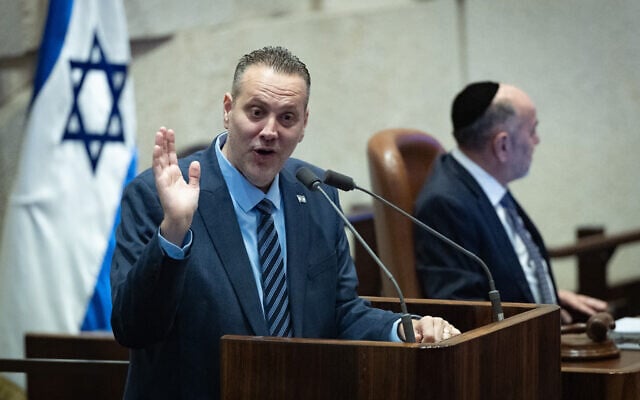
Culture Minister Miki Zohar speaks at the Knesset in Jerusalem on November 26, 2025. (Yonatan Sindel/Flash90)
Culture and Sports Minister Miki Zohar says the Hamas-led October 7, 2023, attack was “concocted” during the term of the short-lived government led by former prime ministers Naftali Bennett and Yair Lapid, which left office in late 2022.
Prime Minister Benjamin Netanyahu was in power in the months before the invasion and massacre, as well as when it occurred, and has led Israel nearly uninterrupted since 2009. Zohar, a member of Netanyahu’s Likud Party, acknowledged in a radio interview that the attack “happened on our watch.”
“But it was concocted during the previous watch of Bennett and Lapid as prime ministers,” he adds. He claims that Hamas leader Yahya Sinwar planned the attack under the previous government “the moment he saw [their] weakness.”
In response to Zohar’s comments, Lapid says in a post on X: “Miki, you were a minister in the government on October 7, Netanyahu was prime minister on October 7, and Likud, [Finance Minister Bezalel] Smotrich and [far-right coalition party] Otzma Yehudit held all the security portfolios on October 7.”
He adds, “1,200 people were murdered on your watch. Hundreds were abducted on your watch… You ignored all our warnings and alerts, strengthened Hamas as a matter of policy, and brought upon us the greatest disaster to befall the Jewish people since the Holocaust.”
Lapid and Bennett recently formed a joint party called Together that aims to unseat the government in elections set to take place in late October.
On X, Bennett writes, “The outgoing government has begun another campaign to evade responsibility for the blood of those murdered on October 7.”
A Hamas memo from 2022, during the 18 months when the Bennett-Lapid government was in power, reportedly detailed plans for the massacre. But as early as 2018, Netanyahu was reportedly warned several times about Hamas’s plans to invade Israel. He has never acknowledged direct responsibility for the failures surrounding October 7 and has instead attempted to place the blame on others, including the security establishment.
Hamas says 2 policemen killed in IDF strike on vehicle in Gaza’s Khan Younis
Hamas’s Interior Ministry in Gaza says that the head of the investigations department of the Khan Younis police, Faez Abd al-Hadi — an officer holding a rank equivalent to lieutenant colonel — and another policeman with the rank of sergeant were killed in an IDF strike on a vehicle in Khan Younis in the southern Gaza Strip.
Earlier, media outlets in Gaza reported that two people were killed and several others wounded in the strike, which took place in the al-Amal neighborhood of Khan Younis.
There is no immediate comment from the IDF.
World deprived of 1 billion barrels of oil over past 2 months, Saudi Aramco CEO says
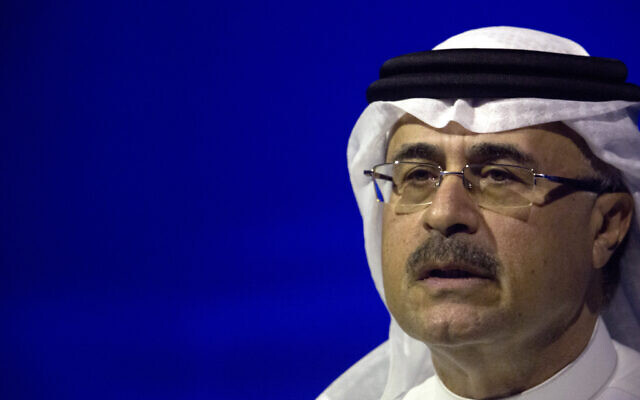
Amin Nasser, the chairman and CEO of the state-run oil giant Saudi Aramco, speaks at the World Energy Congress in Abu Dhabi, United Arab Emirates, September 10, 2019. (Jon Gambrell/AP)
The world has been deprived of about 1 billion barrels of oil over the past two months as Iran has blocked the Strait of Hormuz amid its war with the US and Israel, and even if energy flows resume it will take time for the system to return to normal, the chief executive of Saudi oil giant Aramco says.
“Our objective is simple: keep energy flowing, even when the system is under strain,” Amin Nasser tells Reuters in a statement.
The strait is a key pathway for the global oil supply.
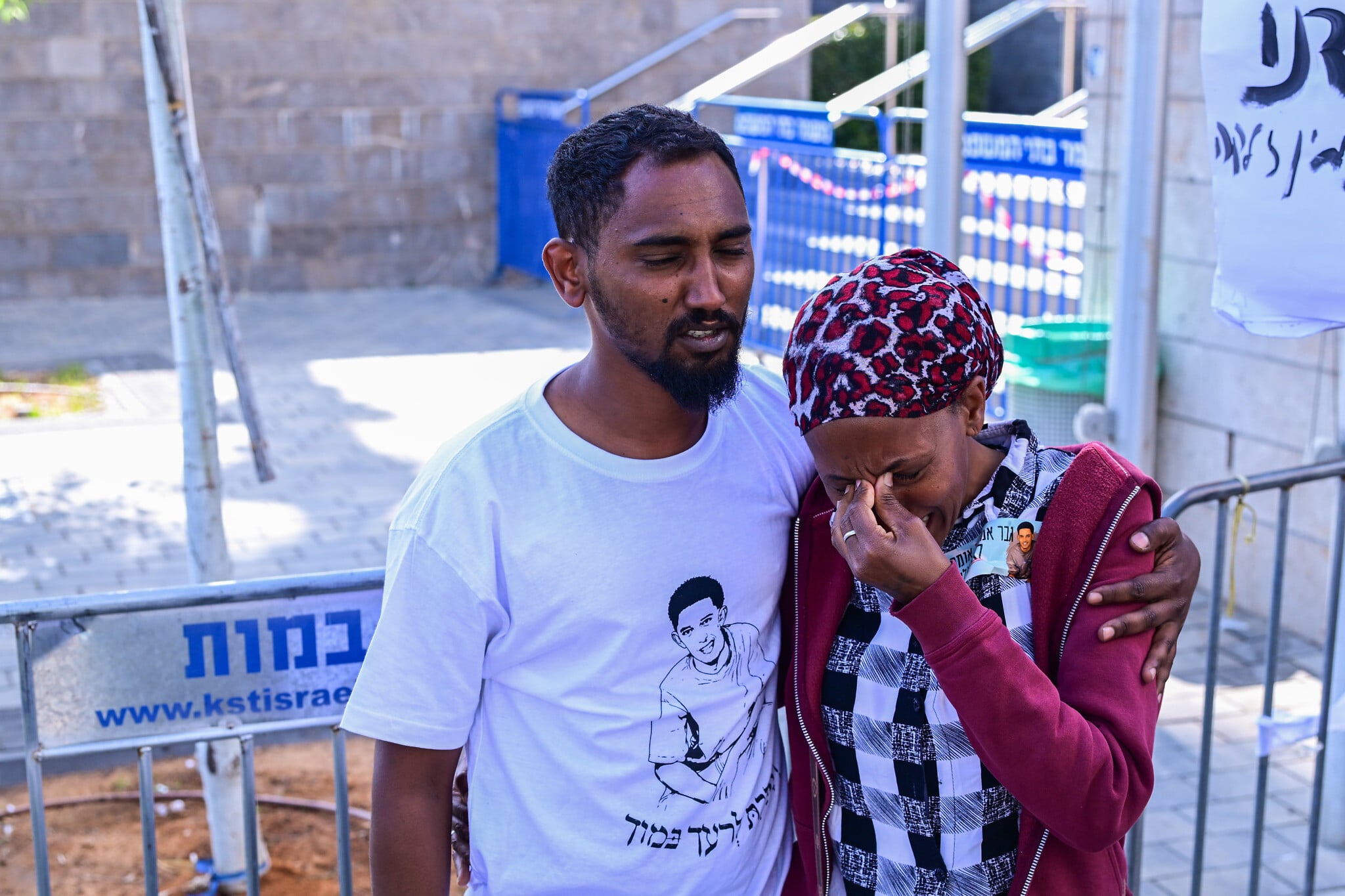
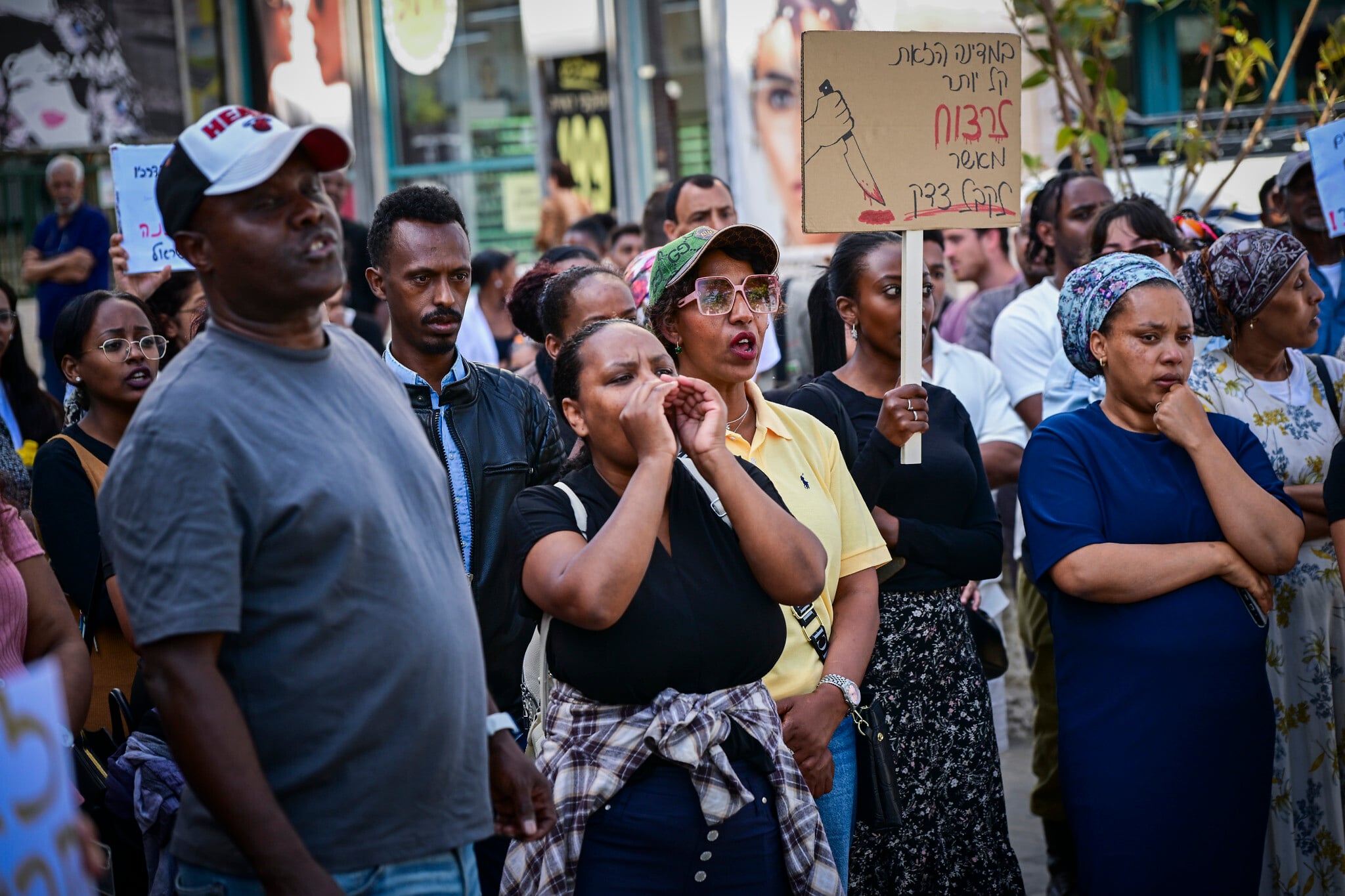
Protesters decry ‘lack of punishment’ in charges against Yemanu Zelka murder suspects
Protesters outside the Lod District Court are demonstrating against the indictments filed against 16 minors suspected of involvement in Yemanu Zelka’s killing on Independence Day, insisting the charges have been watered down.
“A life sentence is what all of these criminals deserve,” one protest organizer says, before leading the crowd in a chant: “Justice for Yemanu!”
A protester holds a sign that reads: “Lack of punishment will cost in the blood of our children.”
Zelka, a 21-year-old Pizza Hut employee, was ambushed and stabbed on the holiday outside his workplace in Petah Tikva by a group of teenage boys, then left to bleed out on the ground. He died of his wounds in the hospital a day later.
The 15-year-old suspected of carrying out the stabbing was charged with negligent murder, while the other fifteen defendants were charged with causing serious bodily harm with intent. Police had sought the harsher charge of aggravated murder.
Protesters outside courthouse in Lod demand murder charges for all those involved in the killing of Yemanu Zelka, after indictments filed against sixteen suspects pic.twitter.com/2Yo6EVBXhm
— charlie summers (@cbsu03) May 10, 2026
Analysts appear to locate Israel’s secret military base in Iraqi desert
Open-source intelligence (OSINT) analysts appear to have found the secret military base set up by Israel in the Iraqi desert to support its campaign against Iran.
Last night, The Wall Street Journal reported that Israel built the base shortly before the US-Israeli war with Iran started on February 28, in order to serve as a hub for logistics in support of the Israeli Air Force.
The site located by OSINT analysts appears to be a makeshift airstrip in a dry lakebed, some 180 kilometers (112 miles) southwest of the city of Karbala. It is seen in satellite imagery taken just days before the war began.
a temporary ~1.6km airstrip was set up in a dry lake bed about 180km southwest of Najaf/Karbala https://t.co/GNp0stDYkP it probably became unusable by mid-March due to rain in the area https://t.co/fn48V5wLVd https://t.co/tcTM8E9BgR pic.twitter.com/IJq6I7xj3S
— Samir (@obretix) May 9, 2026
IDF says it killed over 10 Hezbollah operatives, struck some 40 sites in Lebanon over weekend
Over 10 Hezbollah operatives were killed and some 40 sites used by the terror group were targeted in strikes in southern Lebanon over the weekend, the IDF says.
The military says the targets included buildings used by Hezbollah, weapons depots, a rocket launcher, and other infrastructure.
The operatives were struck after being identified near Israeli troops, the IDF adds.
במהלך סוף השבוע: כוחות אוגדה 91 תקפו יותר מ-40 תשתיות וחיסלו יותר מ-10 מחבלים מארגון הטרור חיזבאללה
במהלך סוף השבוע, חטיבת האש של אוגדה 91 תקפה יותר מ-40 תשתיות טרור וחיסלה יותר מ-10 מחבלים מארגון הטרור חיזבאללה שפעלו בסמוך לכוחות צה"ל בדרום לבנון. בין התשתיות שהותקפו: מבנים… pic.twitter.com/ZDfx34RkgT
— צבא ההגנה לישראל (@idfonline) May 10, 2026
Minor indicted for negligent murder of Yemanu Zelka on Independence Day; 15 other teens charged

Yemanu Binyamin Zelka, who was stabbed and killed at his Pizza Hut job in the early hours of Independence Day. (Social media, undated; used in accordance with Clause 27a of the Copyright Law)
The central suspect in the fatal stabbing of 21-year-old Yemanu Zelka on Independence Day is charged in Lod District Court, alongside 15 other minors suspected of involvement in the murder.
The 15-year-old suspected of stabbing Zelka outside the Pizza Hut where he worked in Petah Tikva is charged with negligent murder. The 15 other defendants are charged with causing serious bodily harm with intent. Zelka was stabbed to death after he had asked the teens not to use party spray in the restaurant.
According to the indictment, the central suspect hit a critical vein when stabbing the young man, causing significant blood loss that led him to die from his wounds a day later.
Ahead of the indictment, police had recommended the harsher charge of aggravated murder, which would carry a life sentence. The indictment likewise does not meet family’s insistence that murder charges be leveled against every suspect involved.
Earlier today, Geteso, the older brother of the deceased, said that “everyone who took part in his ambush is a murderer.”
Police arrested a total of 19 people in connection with Zelka’s killing. Three were not indicted.
IDF says it intercepted two apparent Hezbollah drones in south Lebanon
Two apparent Hezbollah drones spotted over areas of southern Lebanon where troops are deployed were intercepted this morning, the military says.
No injuries were caused in the incidents.
States complying with US sanctions will face hardship in Strait of Hormuz, Iranian army says
Vessels from countries that comply with US sanctions against Iran will, starting now, face difficulties crossing the Strait of Hormuz, Iranian Army Spokesperson Mohammad Akraminia says, according to the semi-official Tasnim news agency.
Iranian lawmakers have said they are drafting a bill to formalize Iran’s management of the Strait of Hormuz, with clauses including forbidding passage to vessels of “hostile states.”
High Court begins weighing petitions to halt state comptroller’s probe of October 7
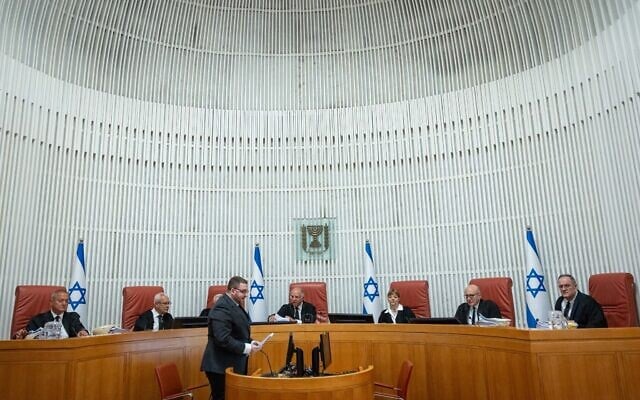
Justices hear petitions demanding the formation of a state commission of inquiry into security failures surrounding the Hamas-led onslaught of October 7, 2023, at the High Court in Jerusalem on April 23, 2026. (Yonatan Sindel/ Flash90)
The High Court of Justice begins a hearing on petitions to halt the State Comptroller’s investigation surrounding the Hamas-led attack on October 7, 2023.
There have been several previous challenges to State Comptroller Matanyahu Englman’s probe of the Octboer 7 invasion and massacre. Today’s hearing is based on petitions from the Military Advocate General’s Corps’ Military Defense unit and Movement for Quality Government, filed in September, which ask the court to order Englman not to investigate issues at the heart of military and intelligence failings which led to the attack.
The petitions allege that Englman’s information-gathering processes suffered from “substantive flaws” which have prejudiced the rights of some subjects of his probe. They argue more broadly that the ombudsman has no remit to conduct an inquiry into the October 7 attack, since the role of the office is to examine the operations of government agencies, but not to examine policy and strategy.
Englman insists that the quasi-constitutional Basic Law: State Comptroller authorizes him to examine the functioning of all state institutions. He says that due to the ongoing refusal of the government to establish a state commission of inquiry into the attack, his probe is the only state-backed examination of the October 7 invasion.
The hearing comes after the High Court decided at the end of April to give the government another two months to decide how to investigate the October 7 catastrophe, in light of petitions asking that the court order the government to establish a state commission of inquiry into the attack.
Bulk carrier hit by unknown projectile near Qatar, UK maritime organization says
A bulk carrier reported being struck by an unknown projectile while sailing 23 nautical miles northeast of Doha, Qatar, the UK Maritime Trade Operations organization says.
The incident sparked a small fire that was extinguished, with the vessel’s master reporting no casualties or environmental impact, UKMTO says.
Authorities are investigating the source of the projectile. Vessels in the area have been advised to transit with caution.
The incident comes as tensions remain high in the Gulf between the US and Iran amid a ceasefire in the US-Israeli war against the Islamic Republic.
Suspects in Yemanu Zelka killing set to be indicted today for negligent murder — reports
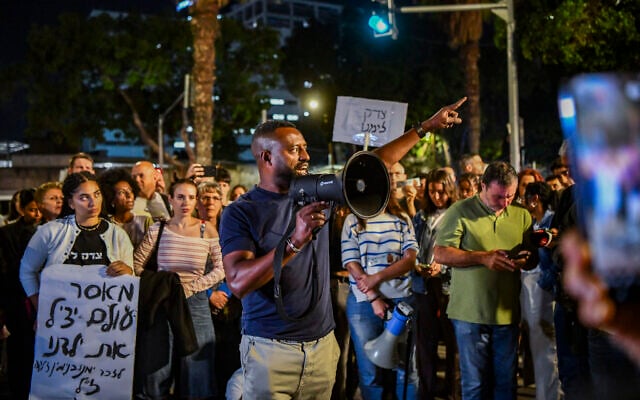
Protesters gather on May 9, 2026, outside the State Attorney's Office in Tel Aviv, holding signs and calling for justice following the killing of Yemanu Binyamin Zelka, a Pizza Hut employee who was stabbed and later died of his wounds on Independence Day (Avshalom Sassoni/Flash90)
The suspects in the killing of Yemanu Zelka on Independence Day are expected to be indicted today, with the main suspect expected to face a charge of negligent murder, Hebrew media outlets report.
Police recommended last week that the main suspect, age 15, face a charge of aggravated murder, but the lesser charge of negligent murder is reportedly expected because the murder weapon has not been found.
Last night, dozens of people, including Zelka’s family members, protested outside the State Attorney’s Office in Tel Aviv against the anticipated filing.
A total of 16 suspects will be charged today in connection with their involvement in the murder, according to Channel 12.
Zelka, a 21-year-old Pizza Hut employee in Petah Tikva, was stabbed to death on the night of the holiday in an attack by a group of adolescents after he told them not to spray party foam in the restaurant.
After waiting outside for Zelka to finish his late-night shift, the youths ambushed and beat him, with one assailant taking out a knife and stabbing him. He died of his wounds a day later.
Car bomb attack on checkpoint said to kill at least 12 police in northwest Pakistan
Militants detonated a car bomb at a checkpoint in northwestern Pakistan and opened fire on police, killing at least 12 and wounding five, officials say.
“Last night in the Fateh Khel area of Bannu, a suicide bomber rammed an explosives-laden vehicle into a police checkpoint, after which multiple militants entered the post,” Bannu police official Muhammad Sajjad Khan tells AFP, adding 12 officers are confirmed dead with one more missing.
Foreign Ministry says two Gaza flotilla activists have been deported after week-long detention
The Foreign Ministry says that the two foreign activists who were taken off a Gaza-bound flotilla on May 1 have been deported from Israel.
Saif Abu Keshek, a Spanish national of Palestinian origin, and Brazilian Thiago Avila were brought to Israel for questioning last week after their flotilla was intercepted by the Israeli Navy in international waters off Greece.
Israel has accused both individuals of being affiliated with the Popular Conference for Palestinians Abroad (PCPA), a group Washington has said is “clandestinely controlled by Hamas,” referring to the Palestinian terror group. The PCPA is sanctioned by Israel and the US.
Despite this, no charges were filed against the men.
“After their investigation was completed, the two professional provocateurs, Saif Abu Keshek and Thiago Ávila, from the provocation flotilla, were deported today from Israel,” the Foreign Ministry writes on X.
“Israel will not allow any breach of the lawful naval blockade on Gaza.”
IRGC navy threatens to hit US targets in the region if oil tankers come under fire
Iran’s Islamic Revolutionary Guard Corps threatens to target US sites in the Middle East and “enemy ships” if its tankers come under fire, Iranian media reports.
“Any attack on Iranian tankers and commercial vessels will result in a heavy attack on one of the American centers in the region and enemy ships,” it says, a day after US attacks against two Iranian tankers in the Gulf of Oman.
Man arrested for allegedly hurling antisemitic abuse at Jewish passengers on London bus
A man has been arrested on suspicion of hurling antisemitic abuse at Jewish children on a bus in London and claiming to have a knife on his person, the UK’s Jewish Chronicle newspaper reports.
According to the report, the incident occurred on Thursday on a bus that travels through Stamford Hill, a neighborhood of London that is home to more than 15,000 ultra-Orthodox Jews.
Witnesses cited by the Jewish Chronicle recount that the suspect told Jewish passengers aboard the bus, including children, that it was a “shame Hitler didn’t kill you,” and that they should have been sent to the gas chambers.
Shomrim, a Jewish security organization in London, says in a statement that as the incident unfolded, “the bus driver stopped the bus and activated the emergency alarm” while members of the public stepped in to assist the Jewish passengers.
The organization says it arrived on the scene and “swiftly detained the suspect” until the police arrived, at which point they were handed over and arrested.
In a statement carried by the Jewish Chronicle, the Metropolitan Police confirm that a 50-year-old man was arrested “on suspicion of making threats to kill.”
Although the man claimed that he was carrying a knife with him during the incident, the police say he was searched and was not found to be carrying any weapon.
AJC condemns antisemitic AI image depicting Israeli reporter as puppet master
The American Jewish Committee condemns an artificial intelligence image depicting Israeli reporter Barak Ravid as a puppet master, as the Axios and Channel 12 journalist’s reporting on the Iran war has come under antisemitic attack.
Accusing the well-sourced Ravid of trying to manipulate markets with his coverage, one X user posted an AI image portraying Ravid as a puppet master — an age-old antisemitic trope.
“The sheer volume of antisemitic lies packed into this one AI-generated fake TIME cover is astonishing. A Jewish journalist as puppet master. Controlling markets. Manipulating governments. In it for the money. A secret Mossad agent pulling strings from the shadows,” AJC says in a statement.
“These are centuries-old antisemitic smears. They didn’t disappear. They just got an AI upgrade,” it continues. “This is bigotry, and it has a target: Barak Ravid a Jewish journalist doing his job.”
It was just a matter of time until the Antisemites come out of their filthy holes and join the campaign of lies against me. The classic tropes: Mossad, controlling the world, trying to make money. Decent people here should come out publicly against this kind of hate pic.twitter.com/etVo8aNvEI
— Barak Ravid (@BarakRavid) May 8, 2026


read more: